
Sterile Seed Starting Mix: Do You Need to Sterilize It?
Learn how sterile, pasteurized, fresh and soilless seed-starting mixes differ—and when heat treatment is worth considering.
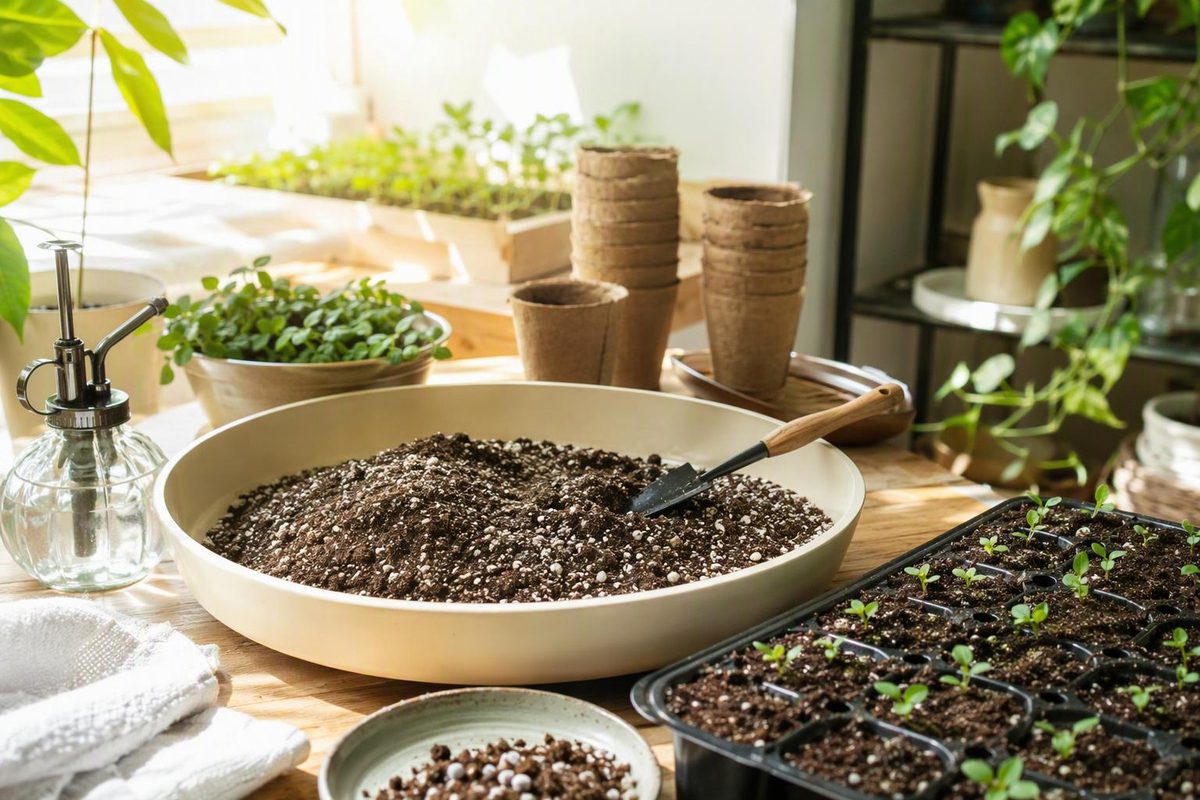
For ordinary indoor seed starting, use a new, clean commercial seed-starting mix; you generally do not need to sterilize it yourself. Utah State University Extension recommends new, clean growing media and says bagged soilless mixes are usually suitable. The goal is to reduce disease risk around vulnerable seedlings—not to maintain a microbe-free tray throughout their growth. Source: Utah State University Extension
“Sterile” is not the same as fresh or soilless
These words describe different things:
| Term | What it tells you |
|---|---|
| Sterile | Strictly, no living microorganisms remain after treatment, including beneficial ones. |
| Pasteurized | Treated to eliminate targeted disease organisms while leaving some other organisms alive. |
| Fresh or new | Not previously used to grow plants. This is useful for avoiding carryover from an earlier crop, but is not proof of sterility. |
| Soilless | Made without mineral garden soil. This describes the ingredients, not whether the finished mix was heat-treated. |
Washington State University’s soil-treatment bulletin distinguishes complete sterilization from selective pasteurization. Penn State Extension likewise explains that pasteurization can kill pathogens and weed seeds without killing all the beneficial organisms. Minnesota Extension describes commercial seed-starting mixes as usually containing peat and vermiculite without true soil.
“Disease-free” is a different claim again: absence of disease organisms does not require absence of all microbial life. And a mix without visible mold is not necessarily free of pathogens; damping-off organisms can survive in soil and plant debris. Source: University of Minnesota Extension
Does every commercial seed-starting mix arrive sterile?
Do not assume so. Some products deliberately include microorganisms. For example, Espoma lists added mycorrhizal fungi as active ingredients in its Organic Seed Starter. That is incompatible with the strict meaning of sterile, but it does not by itself make the mix unsuitable for sowing. This is an ingredient example, not a product recommendation. Source: Espoma’s product information
Read the actual ingredients and directions rather than treating “seed starting,” “organic” or “soilless” as interchangeable with “sterilized.” For texture, ingredients and buy-or-make choices, see our separate guide to mix for seed starting.
When is heat treatment worth considering?
Not as a routine extra step for a new bagged mix. The more relevant question arises when making a mix with garden soil or untreated compost. For the simplest low-risk indoor approach, Minnesota Extension recommends new potting mix and advises against garden soil, reused mix and compost in seedling trays. Source: University of Minnesota Extension
If you choose a compost-based homemade mix, Penn State recommends asking whether the compost has been pasteurized and warns of higher damping-off risk without that treatment. Heating is not a cure for every ingredient problem: the same guidance notes that compost-based mixes can also have excessive salts or inadequate nutrients. Source: Penn State Extension
If you decide to heat-treat a homemade medium, use a published pasteurization procedure with a thermometer—not an improvised attempt to make the mix “extra sterile.” Treatment depends on the temperature reached inside the medium and the time held there. Overheating can create compounds toxic to plants. Source: Washington State University
Keep clean mix clean
Even treated medium can be contaminated afterward. Used trays, dirty tools, hands and splashing water can introduce damping-off pathogens. Clean and disinfect reused containers, keep planting tools clean, and do not add old potting mix to a fresh batch. Keep the medium moist rather than soggy and provide drainage; a “sterile” label cannot compensate for persistently wet conditions. Source: University of Minnesota Extension