
Seeds for Trees: How to Choose, Treat, and Sow Them
Choose tree seed by species and origin, apply the right dormancy treatment, and sow it with practical moisture, light, and protection checks.
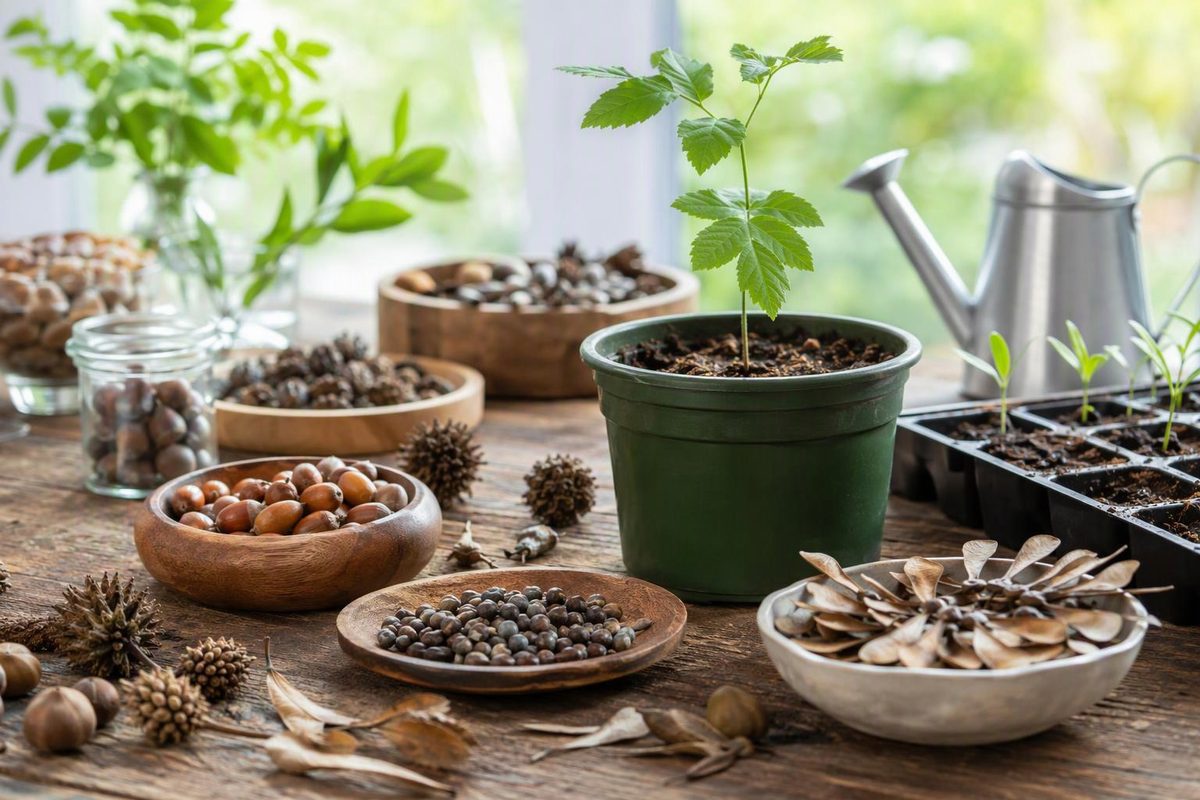
Tree seeds are not interchangeable. Red maple seed can be sown as soon as it ripens, while eastern redbud seed needs both a breached seed coat and several weeks of moist chilling. Start with the exact species, then follow its dormancy cycle rather than applying one treatment to every packet.
First decide whether seed is the right starting material
Growing from seed makes sense when you want several inexpensive seedlings, enjoy observing the full life cycle, or can accept variation among the resulting trees. It is less suitable when you need a named cultivar, particular fruit quality, predictable mature shape, or known size.
Most apples and crabapples do not reproduce true from seed. The same applies to most cultivated cherries, peaches, and plums; nurseries preserve selected varieties by grafting or budding. Their seeds may germinate, but the seedlings will not be genetic copies of the parent, according to Iowa State University Extension’s tree-seed guide.
Before ordering or collecting seed, check:
- Botanical name: “Maple seed” is not specific enough. Red maple (Acer rubrum) and sugar maple (Acer saccharum) require different handling.
- Origin or provenance: This matters especially for restoration and long-lived forest plantings. Climate at the seed source can affect later growth and survival. As of September 2026, the public Climate-Adapted Seed Tool serves five western states and has species-specific models for only some trees, so use local forestry guidance outside its scope.
- Collection year and storage: Ask when the seed was gathered and how it was stored. Elm, silver maple, cottonwood, and willow seeds ripen in spring and may retain the ability to grow for only three to four weeks, so Iowa State advises prompt sowing.
- Mature fit: Confirm eventual height and spread, soil and moisture needs, cold tolerance, and local invasive status before raising a tree you may keep for decades.
Prefer a seller that identifies the species, collection year or test date, seed quantity, origin, and treatment protocol. A common name plus a generic direction such as “soak overnight” is not enough to plan reliable treatment.
Match the treatment to the species
Many viable tree seeds are dormant. Cold-moist stratification holds seed under cool, damp conditions for a defined period, mimicking part of winter. Scarification scratches, files, or otherwise opens a hard seed coat so water can enter. Some species require both.
These temperate-tree examples show why the botanical name matters:
| Tree seed | Treatment before spring sowing | Useful checkpoint |
|---|---|---|
| Red or silver maple | None; sow promptly after late-spring or early-summer ripening | Mature samaras change from green toward yellow or brown |
| Sugar maple | 40–90 moist-cold days at 33–41°F | Keep the medium damp, not waterlogged |
| Black walnut | 90–120 moist-cold days at 34–41°F, or sow in fall | After husking, filled nuts generally sink in water |
| White or swamp white oak | Sow in fall | Collect sound acorns promptly after they drop |
| Bur oak | 30–60 moist-cold days at 32–41°F if spring-sown; fall sowing is another option | Most damaged or unfilled acorns float |
| Red or pin oak | 30–45 moist-cold days at 32–41°F if spring-sown; fall sowing is another option | Collect ripe acorns as soon as they fall |
| Eastern redbud | Scarify first, then chill 5–8 weeks at 35–41°F | Plant promptly, about ¼ inch deep, after treatment |
These figures come from Iowa State’s species-by-species germination directions. They are examples for the named species, not a universal tree-seed calendar. The USDA Forest Service’s 2008 Woody Plant Seed Manual provides handling information for 236 woody-plant genera when a packet lacks adequate directions.
Conifers also differ by species. Plant the seed extracted from a mature cone—not the cone itself—and find a protocol for that pine, fir, spruce, or other conifer. Iowa State’s tree-seedling guide explains how mature conifer seed is collected from cones.
For black walnut specifically, fall sowing and refrigerator stratification involve different tradeoffs in winter conditions and animal pressure; see the black walnut seed guide.
Choose fall sowing or refrigerator stratification
Fall sowing is often the simpler route for a locally hardy species whose seeds naturally overwinter. Sow into a labeled outdoor nursery bed or a deep, draining container. Weather supplies the moist chill, but the seed remains exposed to rodents, digging, washout, and irregular moisture. Iowa State recommends anchored hardware cloth over a seedbed where rodents are a problem, removing it as germination begins.
Refrigerator stratification gives you more control. Mix the seed with a moist, airy medium in a container with some ventilation, label the species and start date, and hold it at the temperature and for the duration specified for that species. Inspect it periodically. The medium should remain damp without standing water. Sow promptly if a root begins to emerge.
Do not substitute dry refrigeration for cold-moist stratification unless the species protocol permits it. Iowa State’s method uses moist sand and peat moss because both cool temperature and moisture are part of the treatment.
Sow for moisture, air, and protection
Use a draining seed-starting medium in containers or a prepared, well-drained nursery bed. Follow the species-specific depth rather than one “twice the seed width” rule. Iowa State, for example, specifies about ¼ inch for redbud, ¼–1 inch for maple samaras, and 1–2 inches for black walnuts.
After sowing:
- Keep the seed zone evenly moist, not saturated. Germinating seed needs water and oxygen. Compacted or waterlogged medium restricts gas exchange, as Penn State Extension explains.
- Label every pot or row. Include the species, seed source, sowing date, and treatment dates.
- Exclude seed predators. Secure mesh over outdoor pots or beds without blocking drainage; remove or raise it before shoots become trapped.
- Allow for uneven emergence. Dormancy can stagger germination. Do not empty a pot merely because the first seedlings have appeared and others have not.
- Provide light as soon as shoots emerge. Germination and seedling conditions differ: some seeds germinate under cover, but emerged seedlings need adequate light. For indoor seedlings, use the lighting and airflow checkpoints in the indoor seed-starting guide.
Thin crowded seedlings before their roots become entangled. If using pots, choose containers deep enough for the species and transplant before roots circle densely around the wall. Keep roots moist and shaded during planting, and protect young trees from mowers, rodents, and browsing animals.
Useful checkpoints are visible: the stratification medium remains damp without becoming saturated; a root tip emerges before or with the shoot; and the first true leaves develop without stretching, yellowing, or collapsing. Compare those observations with the protocol for your species rather than expecting every tree seed to emerge on the same date.