
Double Hollyhock Seeds: How to Choose and Sow
Learn which double hollyhock seed details matter, when to sow for first- or second-year flowers, and how to limit rust in tall garden plants.
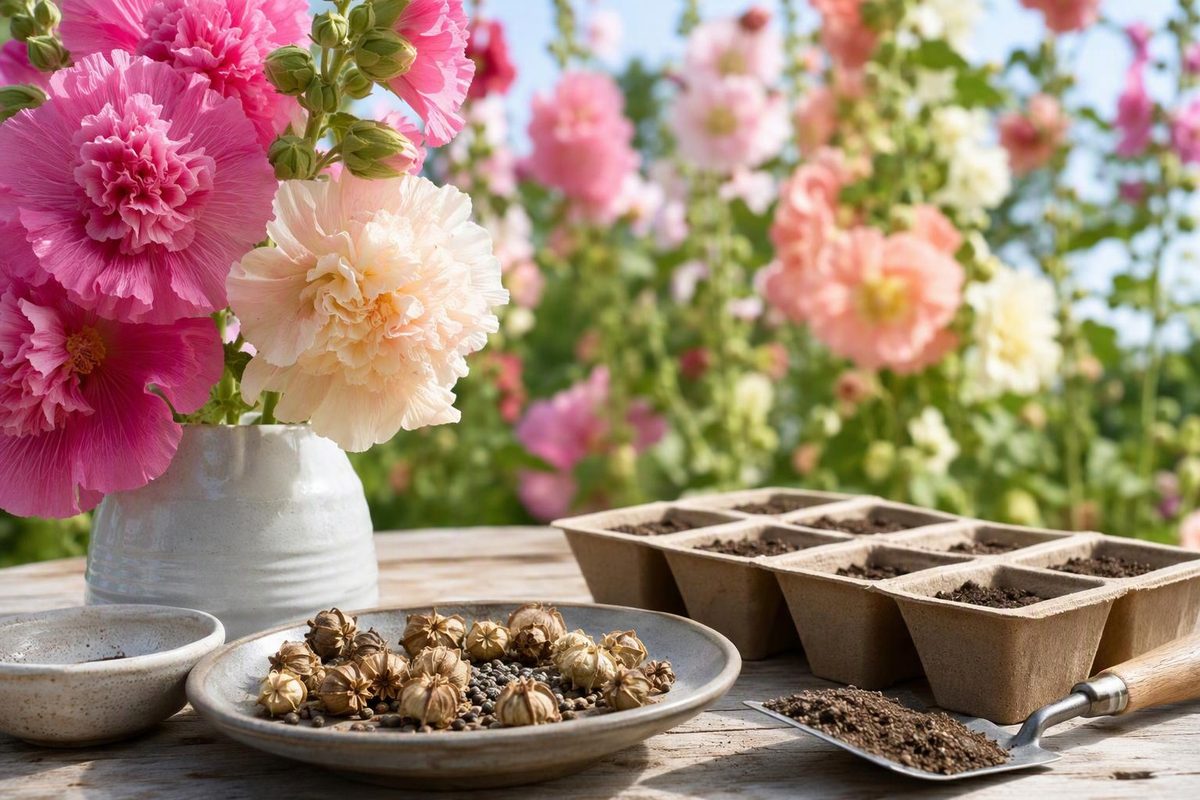
Double hollyhock seeds produce Alcea rosea plants with densely layered flowers; “double” describes the flower form, not the number of seeds, plants, or blooms in a packet. Buy a named double-flowered strain, sow it shallowly, and expect a standard tall hollyhock to form leaves in its first season and flower in its second.
Some strains may bloom in their first year when started early, but that trait should be stated on the packet. The Royal Horticultural Society’s growing guide gives second-year flowering as the normal schedule.
Choose the packet type, winter pattern, and starting method; the planner shows the realistic sowing and bloom schedule.
Your Sowing Plan
Spring Indoor Start, Second-Season Flowers
Bloom expectation: Plan for flowers in the second growing season.
When to sow: Sow indoors in spring and transplant after hardening off.
Main caveat: An indoor start does not turn a standard biennial into a first-year bloomer.
Sources: RHS growing guidance and the supplier protocol for ‘Chater’s Double Mix’, as summarized in the article. Packet directions take priority for a named strain.
Choose a Named Double-Flowered Strain
A useful packet identifies the plant and strain clearly enough that you can distinguish a genuine double hollyhock from an unverified marketplace listing. Look for:
- Botanical name: Alcea rosea
- Strain or series: not merely “rare double hollyhock”
- Flower form: double or fully double
- Color: one color or a mixture
- Mature height: needed for placement and support
- Life cycle: biennial, short-lived perennial, or specifically bred for first-year bloom
- Seed quantity: a count or weight
‘Chater’s Double Mix’ is an established example. Applewood Seed identifies it as a biennial Alcea rosea strain with fully double flowers in pink, red, white, and yellow shades, reaching 60–90 inches (Applewood Seed Company). Swallowtail Garden Seeds lists the same named mix at 5–7 feet with 4–6-inch flowers (Swallowtail Garden Seeds). Treat those dimensions as expected ranges rather than guarantees.
A mixed packet does not promise equal numbers of every pictured color. If one exact color is essential, choose a named single-color strain or buy a plant while it is in bloom.
Be cautious when a listing omits the botanical name, strain, seed quantity, or realistic growing information. Implausible flower colors are another warning sign. Apply the same checks covered in our guide to screening suspicious flower-seed listings.
Sow the Seeds Shallowly in Moist Mix
Follow the packet when its directions differ. For a typical double A. rosea strain:
- Fill cells or small pots with damp seed-starting mix. The mix should feel evenly moist rather than saturated.
- Place one or two seeds in each cell. Press them against the surface and cover them lightly instead of burying them deeply.
- Keep the seed zone warm, not hot. RHS reports germination at 61–70°F (16–21°C). Swallowtail specifies 70–75°F and 14–28 days for ‘Chater’s Double Mix’, so allow several weeks before treating the sowing as a failure (RHS; Swallowtail Garden Seeds).
- Maintain moisture without waterlogging the mix. Check it with a fingertip rather than misting on a fixed schedule.
- Provide strong light after emergence. Remove any humidity cover, move the seedlings under a grow light or into a very bright position, and thin each cell to one plant.
Cold stratification is not a universal requirement for commercial A. rosea seed. RHS describes warm spring germination without chilling, as does the supplier protocol for ‘Chater’s Double Mix’. Fall sowing can work, but it is a seasonal option rather than a treatment every packet needs.
Match the Sowing Season to the Expected Bloom Year
Standard Strains Normally Flower in Their Second Season
For dependable second-year flowers, sow outdoors in late spring or early summer after severe frost has passed. Keep the seedlings watered while they establish. They should form leafy rosettes, overwinter, and produce flower spikes in the next growing season.
An indoor start gives closer control of moisture and protects small seedlings from slugs. Sow in spring, provide strong light after germination, and transplant after hardening off. Starting indoors does not automatically turn a standard biennial strain into a first-year bloomer.
First-Year Bloom Requires the Right Strain and an Early Start
If first-year flowers are the priority, buy seed specifically described as bred for first-year bloom and follow that packet’s timing. A generic “double hollyhock” label does not establish that trait, and early indoor sowing cannot guarantee it in a standard strain.
The draft sources do not provide one universal starting date for all first-year strains. Timing varies by strain and local conditions, so the packet must supply that missing detail.
Mild and Cold Winters Call for Different Outdoor Timing
In mild-winter climates, late-summer or early-fall sowing may allow plants to establish in cool weather. Avoid transplanting small seedlings during extreme summer heat.
In very cold regions, spring or early-summer sowing gives the plants more establishment time before winter. Severe frost should be past before young plants go into an exposed bed.
Give Tall Plants Sun, Drainage, and Room
Set young plants about 24 inches apart in fertile, well-drained soil. Choose full sun and shelter from strong wind; those are the spacing and site recommendations in the RHS guide.
North Carolina Extension describes A. rosea as approximately 5–8 feet tall and 1–2 feet wide, with full sun—defined there as at least six hours of direct light—and moist, well-drained soil (NC State Extension).
A suitable planting position has six or more hours of direct sun in most climates, soil that drains after rain, and enough space between plants for air movement. In a windy garden, place the plants near a fence, wall, or stake that can support the tall flower spikes. Keep them where they will not shade shorter plants.
Move seedlings while they are still small. Once planted, keep the root zone moist during establishment without leaving the soil saturated.
Inspect Lower Leaves for Hollyhock Rust
Hollyhock rust commonly begins with yellow or orange spots on the upper surfaces of lower leaves and reddish-orange to brown pustules beneath them. The fungal disease spreads by airborne spores and is worse in wet or humid conditions (RHS rust guidance).
Inspect the undersides of lower leaves regularly. Remove and discard affected leaves, clear dead foliage at the end of the season, and avoid dense planting. Direct irrigation toward the soil instead of routinely wetting the foliage.
Heavily affected plants may still flower. Replacing old plants every few years and removing diseased debris can help limit carryover in the bed.
Saved Seed May Lose the Parent’s Color or Form
After flowering, cut down the stalks or leave selected pods in place until they turn brown. Seed collected from a cultivar may produce plants unlike the parent, especially when other hollyhocks flower nearby. RHS notes that seedlings from cultivars and hybrids may not be identical to their parents.
Saved seed is suitable when variation is welcome. Buy another packet of the named strain when preserving the double form or a particular color matters more than seeing what the next generation produces.