
Black Walnut Tree Seeds: Fall Sow or Cold-Stratify?
Choose by winter cold and predator exposure, with a practical 90–120-day chill target plus screening, planting depth and rodent protection.
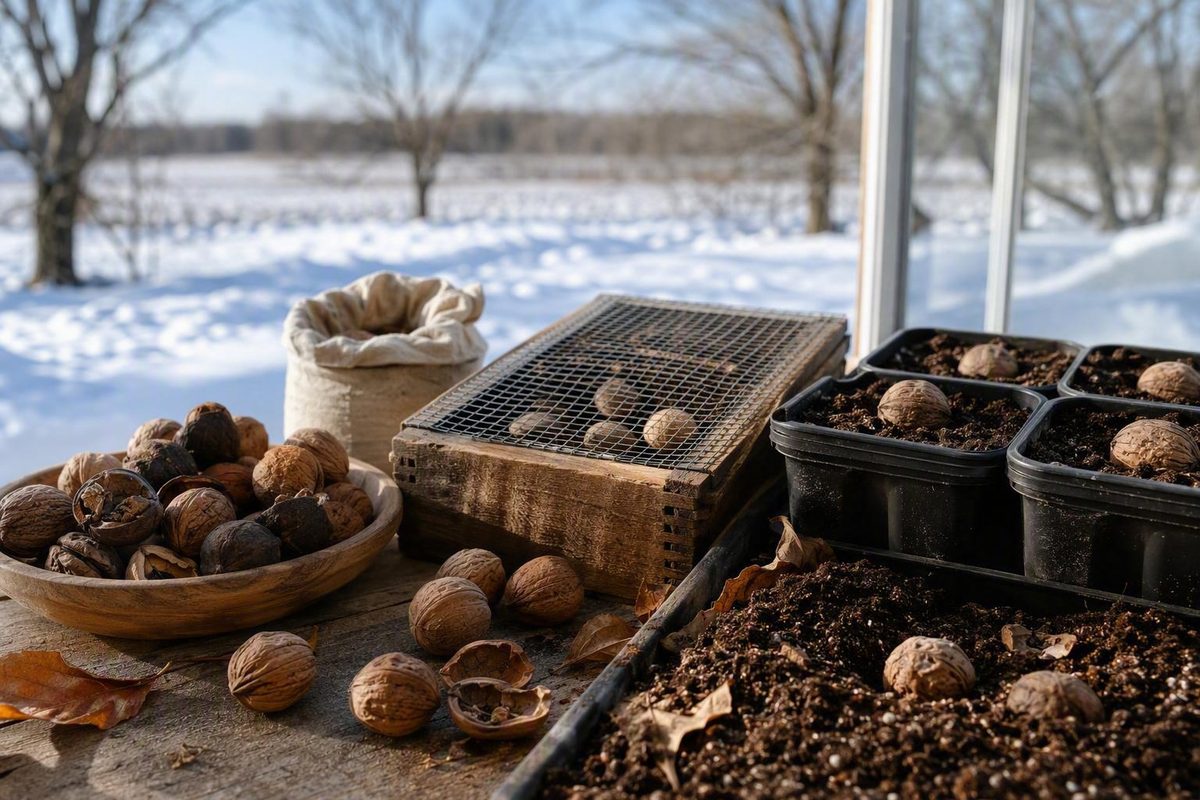
Eastern black walnut (Juglans nigra) can be started by sowing mature nuts outdoors in fall or by giving them a controlled cold, moist treatment before spring planting. Whichever route you choose, plant several nuts, protect them from rodents, mark the location, and be prepared to wait until the second spring for a seedling to emerge.
Quick answer: choose fall sowing or refrigerated stratification
This guide covers eastern black walnut, Juglans nigra. Remove the fleshy outer husk for screening and refrigerator stratification, but do not remove the kernel or crack the shell. For fall sowing, leaving the husk intact is a documented option.
| Fall-sow outdoors | Refrigerate, then sow in spring |
|---|---|
| Let winter provide the cold-moist treatment. | Chill dehusked nuts in a moist, aerated medium. |
| Use where winter provides sustained cold and soil moisture. | Use where winter chilling is unreliable or spring planting is preferred. |
| Requires less indoor handling. | Shortens the nuts’ exposure to outdoor predators. |
| Demands secure rodent protection. | Provides more control over moisture, temperature, and timing. |
For controlled chilling, a practical target is approximately 90–120 days. Requirements vary by seed source, so this is a working range rather than a guarantee of germination, according to the USDA Forest Service species account.
Forestry guidance commonly places that treatment near 34–41°F (1–5°C). Oklahoma State University gives a broader approximate treatment of three months at 33–50°F, reinforcing that there is no single exact setting for every batch of black walnut tree seeds (Oklahoma State University Extension).
Choose fall sowing only if the nuts can remain moist, receive enough winter cold, and stay protected from squirrels and other rodents. Choose refrigerator stratification when you want greater control or less outdoor exposure before spring planting.
Collect, dehusk, and screen the nuts
Collect mature, freshly fallen nuts in autumn. Ripening time varies by location and season, so use natural drop and mature fruit rather than adopting a calendar from another region.
For controlled stratification, remove the outer husk without cutting or cracking the shell. Wear gloves and old clothing because black walnut husks can leave persistent brown stains (Ask Extension).
Husk removal also makes inspection and flotation screening easier. For natural fall sowing, however, University of Minnesota Extension says the husks do not have to be removed.
Use this preliminary float screen:
- Remove the husks.
- Place the shell-enclosed nuts in water.
- Retain the nuts that sink.
- Set aside the floaters under these propagation protocols.
- Plant or stratify more nuts than the number of trees you want.
A sinking nut is more likely to be filled, but flotation does not prove that its embryo is alive or that it will germinate. Shell damage, storage conditions, moisture, dormancy, and planting conditions can all affect the result.
If you have enough nuts to sacrifice a sample, forestry guidance suggests opening 10–20 nuts and examining the kernels. Sound kernels should be white and firm rather than shriveled, discolored, watery, or rancid-smelling. The same guidance adjusts planting numbers according to estimated sound seed:
- 80–100% sound: two nuts per spot
- 60–80% sound: three nuts per spot
- 40–60% sound: four nuts per spot
- Below 40% sound: five or more per spot
These are forestry direct-seeding recommendations, not a mandatory home-garden formula (USDA Forest Service direct-seeding review). For one landscape tree, the practical lesson is to sow several promising nuts and later retain the best suitably placed seedling.
Method 1: sow black walnut nuts outdoors in fall
Choose the intended permanent site before sowing. Black walnut develops a strong taproot early, and direct sowing avoids disturbing it during transplanting.
Published planting depths vary by system. A USDA NRCS nursery protocol covers nuts with 1–2 inches of soil, then adds clean straw to reduce winter heaving and screens to prevent rodent loss (USDA NRCS propagation protocol). Home-garden and forestry guidance commonly recommends 2–3 inches. Together, those directions support a contextual range of about 1–3 inches, not one universally correct depth.
To fall-sow:
- Place the nut within the documented depth range.
- Cover it and firm the soil gently.
- Mark the exact position with a durable label or stake.
- Where winter heaving is a concern, apply a light layer of clean mulch.
- Install a securely anchored rodent barrier.
Hardware cloth or similar screening can admit water and air while preventing animals from lifting or digging out the nut.
Rodent exclusion is part of the planting method, not optional aftercare. If an unprotected nut disappears, the empty planting spot can easily be mistaken for a germination failure.
Fall sowing requires less handling and lets winter provide natural stratification. Its tradeoff is prolonged exposure to predators. It is suitable only where the nut will remain moist and experience enough cold to complete after-ripening.
Method 2: cold-stratify the nuts in a refrigerator
For a small batch, use this controlled procedure:
- Dehusk and screen the nuts. Remove the fleshy husks without damaging the shells, then retain the sinking nuts from the float test.
- Prepare a moist, aerated medium. Suitable materials include vermiculite, sand, sawdust, or peat moss. Oklahoma State favors vermiculite because it holds moisture, is sterile, and remains aerated when moist rather than wet.
- Mix the nuts and medium loosely. The medium should be evenly moist but not saturated. Do not compress it tightly enough to restrict oxygen.
- Label the container. Record the species, seed source, collection or purchase details, treatment start date, and anticipated sowing window.
- Refrigerate for approximately 90–120 days near 34–41°F (1–5°C). This is a practical forestry range rather than a promise that every seed source will respond identically (USDA Forest Service direct-seeding review).
- Check periodically. Look for drying, excess water, or visible mold. Restore moisture if the medium is beginning to dry, but do not leave the nuts waterlogged.
- Sow after chilling. Plant within the documented depth range, firm the soil, label the position, and install animal protection.
Keep a simple record:
| Record | What to note |
|---|---|
| Seed source | Parent-tree location or vendor lot |
| Stratification start | Date placed in refrigeration |
| Target window | Planned range of sowing dates |
| Checks | Date, moisture condition, visible mold |
| Sowing | Date, location, depth, protection |
Do not crack, file, or sand the shell to help the embryo. Eastern black walnut kernels can absorb water through the shell, which can split naturally along its edges as after-ripening finishes.
Protect the planting and wait through the right window
The first stage of germination occurs out of sight. The radicle, or young root, develops before the shoot emerges above the soil.
The Forest Service gives April or May as a general emergence period following stratification, but that is not a deadline for every climate, seed source, or planting date. Its species account also notes that some viable nuts may not emerge until the second spring (USDA Forest Service).
Predation can overwhelm an otherwise sound method. In one Ontario woodland-opening experiment summarized in the Forest Service’s direct-seeding review, squirrels consumed 78–86% of planted nuts. Protected seed stocked 80% of planting spots, compared with 16% for unprotected seed. Those figures describe one forestry field setting, not expected home-garden germination rates, but they demonstrate why a physical barrier matters.
If no shoot appears during the first spring, do not immediately dig up the planting. Keep it labeled and protected, verify that the soil has not been disturbed, and maintain appropriate moisture while allowing for delayed emergence.
Troubleshoot black walnut seeds that do not emerge
| Possible cause | What to check | Bounded next step |
|---|---|---|
| Inadequate chilling | Actual treatment duration and temperature | Give the next batch a complete cold-moist treatment, allowing for seed-source variation |
| Medium dried out | Notes and condition of the medium | Maintain even moisture and inspect more regularly |
| Waterlogging or low oxygen | Saturated medium or tightly packed containers | Use moist—not wet—medium and pack it loosely |
| Poor seed quality | Shell damage, flotation result, and storage history | Start with fresh nuts and sow several |
| Animal loss | Damaged mesh, digging, or a displaced marker | Reinforce and anchor the barrier |
| Excessive depth | Actual depth compared with the supported range | Avoid deep burial when replanting |
| Delayed dormancy release | Whether the site remains marked and protected | Allow through the second spring |
| Unsuitable site | Shade, drainage, compaction, and weeds | Improve the site or choose a better-drained, sunnier location |
Drying can interrupt moist after-ripening, while saturation and compaction can restrict oxygen. Flotation improves the odds of selecting filled nuts but cannot establish embryo viability.
Depth matters as well. A planting-depth study summarized in the Forest Service direct-seeding review found that 3-inch sowing produced more seedlings after one growing season than 5- or 7-inch sowing, while deeper planting delayed or reduced germination. That result does not make three inches a universal rule; it is a reason to avoid burying nuts deeply.
Check the site before committing to a tree
Before planting, confirm that the location provides:
- Full sun: Black walnut is intolerant of dense shade.
- Deep soil: Shallow bedrock and severe compaction restrict root development.
- Fertility: Growth is strongest on productive soil.
- Reliable moisture: Young trees need moisture without prolonged saturation.
- Good drainage: Persistently wet, poorly drained ground is unsuitable.
- Permanent placement: Early site selection reduces the need to move a taprooted seedling.
- Long-term space: Consider the future canopy, roots, overhead lines, structures, and garden beds.
Black walnut is not a compact ornamental. Trees on good sites may reach 100–120 feet, according to the USDA Forest Service species account. No universal building setback is established by the available guidance, so evaluate the mature-tree space at the specific site rather than relying on a small size shown in a sales listing.
Control competing weeds during the seedling’s first two or three years, as recommended in Forest Service establishment guidance.
Decide what you want from the mature tree as well. A seed-grown black walnut is genetically variable and will not reliably reproduce the nut characteristics of its parent or a named cultivar. Orchard guidance uses seedlings as rootstocks and grafts selected cultivars when predictable kernel quality, shell traits, and nut production are the goal.
Plan surrounding beds without reducing every problem to juglone. Laboratory-applied juglone can injure germinating seeds and seedlings, but field evidence has not conclusively separated chemical effects from shade, drought, nutrient competition, and competing roots. Washington State University’s review of black walnut allelopathy also questions the evidence behind familiar lists of “sensitive” and “tolerant” plants. Manage light, water, soil, and root competition before diagnosing juglone injury by appearance alone.
Decode seed-vendor germination and quality claims
Seed listings may place several percentages together even though they measure different things:
| Term | What it tells you |
|---|---|
| Lot purity | How much of the lot is the named seed rather than other material |
| Full-seed or cut test | How many sampled units appear filled when opened |
| Estimated viability | An estimate of how many embryos may be alive |
| Observed germination | How many seeds germinated under stated test conditions |
These figures are not interchangeable. For example, the cited commercial listing for a 2025 crop-year lot displayed 98% beside the test description “Cut (Full Seed).” That is an apparently filled-seed result, not evidence of 98% observed germination. The seller’s 120-day stratification and 1–2-inch sowing instructions apply to that listing and broadly overlap with Extension and USDA guidance, but they do not replace source-aware recommendations. Check the live commercial listing because lot details can change.
Before buying black walnut tree seeds, look for:
- The scientific name Juglans nigra
- Geographic seed origin or provenance
- Crop or collection year
- Storage history
- Test type and test date
- Whether a percentage means purity, fullness, viability, or observed germination
- Lot-specific stratification and sowing directions
Packet quantity, price, crop year, provenance, and availability are changeable details. Confirm them on the current listing rather than relying on an older product summary or search result.
Do black walnut shells need to be cracked or scarified before planting?
No. Do not routinely crack, file, or sand eastern black walnut shells. Oklahoma State Extension explains that the kernel can absorb water through the hard shell and that the shell splits naturally along its edges as after-ripening is completed. For this species, follow the documented cold-moist treatment rather than adding an unsupported mechanical scarification step.
Can black walnut seeds be started in pots?
The available species-specific guidance favors sowing in the intended permanent location because black walnut develops a long taproot early and can be difficult to lift or transplant without root damage.
The evidence reviewed here does not establish a minimum container depth or a validated home-garden container protocol. If permanent-site sowing is possible, it is the better-supported approach.
Choose a permanent sunny site with deep, well-drained soil; screen several mature nuts; fall-sow them or provide approximately 90–120 days of cold-moist treatment; use the documented planting-depth range; install rodent protection; and keep the location labeled through a possible second spring. Growing Juglans nigra from seed can produce a valuable landscape tree, but it will not predictably duplicate a selected nut cultivar.