
Rudbeckia ‘American Gold Rush’: Buy the Plant, Not Seeds
How to buy, plant and care for ‘American Gold Rush’ rudbeckia—and why a seed packet cannot promise the named cultivar.
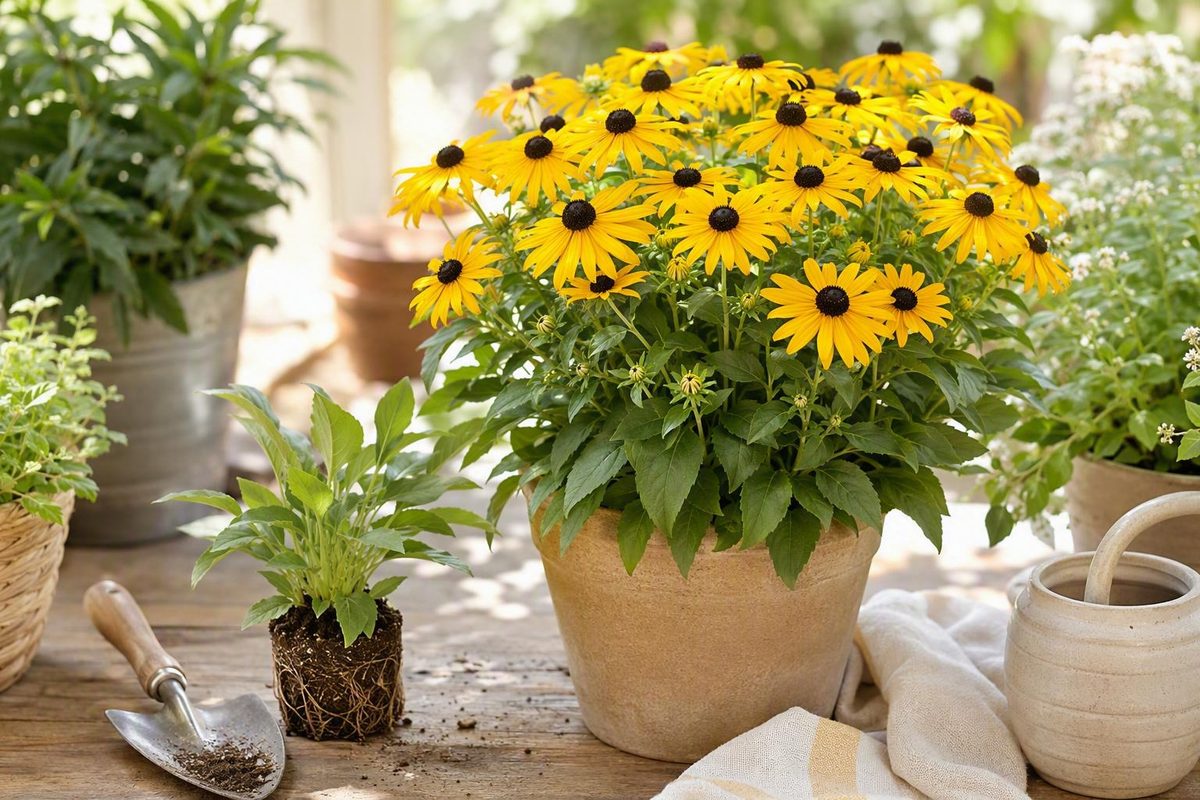
If you want the named cultivar Rudbeckia ‘American Gold Rush’, buy a labeled live plant or plug rather than a packet of seed. This black-eyed Susan is a clonally maintained hybrid: its patent record says the original selection was reproduced by division and stem cuttings, with the resulting plants remaining identical to the parent (Google Patents). A seedling may still be an interesting rudbeckia, but sexually produced seed cannot promise a genetic copy of ‘American Gold Rush’.
That distinction matters when a marketplace listing puts the cultivar name on a seed packet. Look for a live-plant format and the patent number PP28,498 on the listing or tag. If the seller promises true ‘American Gold Rush’ plants from seed, apply the same checks used to screen questionable flower-seed listings.
What you are buying
‘American Gold Rush’ is a compact, mounding perennial with golden-yellow flowers and dark centers. The Perennial Plant Association gives a mature size of 22–27 inches tall and as much as 40 inches wide, with bloom extending toward fall; it named the cultivar its 2023 Perennial Plant of the Year (Perennial Plant Association). Its narrower, hairy foliage was selected for improved resistance to Septoria leaf spot, a common cause of dark spotting and early decline in black-eyed Susans.
Improved resistance does not mean immunity to every problem. Missouri Botanical Garden still advises watching for aphids, powdery mildew, downy mildew, Septoria leaf spot and aster yellows (Missouri Botanical Garden). Buy a plant with evenly colored foliage, sturdy stems and no spreading black spots, distorted growth or visible insect colonies.
For a conservative climate screen, use USDA zones 4–9, the range listed by both the breeder and the Perennial Plant Association (Intrinsic Perennial Gardens). A warm wall cannot reliably compensate for a garden colder than the stated range.
Where and how to plant it
Choose full sun for the densest flowering, although partial shade is acceptable. Use average, well-drained soil rather than a heavily amended bed: overly rich soil can encourage the stems to flop (Perennial Plant Association).
Allow roughly 30–40 inches from the center of one plant to the next if you want mature clumps to meet without immediate crowding. The plant may arrive much narrower; judge spacing by its documented mature spread, not the pot diameter.
- Water the pot before planting if the root ball is dry.
- Dig a hole no deeper than the root ball and loosen a wider area around it.
- Set the crown at about soil level. Commercial production guidance places the crown just below the soil surface and plugs level with the surface (Walters Gardens). Do not bury the leafy crown several inches deep.
- Backfill, firm gently and water until the entire root zone is moist.
- Add mulch around—not over—the crown. All-America Selections likewise advises keeping mulch off the crown and foliage (All-America Selections).
During establishment, check moisture in the root ball itself; surrounding soil can look damp while a peat-heavy nursery root ball remains dry. Water when it begins to dry, but do not keep the crown in persistently soggy soil. New upright growth and leaves that remain firm through the day are better establishment signs than a fixed watering interval.
Care after establishment
Established plants tolerate some drought, but flowering and leaf condition are easier to maintain in soil that drains well and does not stay bone-dry for long periods. Deadhead faded flowers if you want to encourage additional bloom. Alternatively, leave the final seedheads standing for winter structure and birds, then cut the old stems back in late winter or early spring.
Do not respond to crowding by automatically dividing this cultivar. As of September 21, 2026, ‘American Gold Rush’ is identified as patent-protected, and the U.S. Patent and Trademark Office says a plant patent lets its owner exclude others from asexual reproduction; the USPTO specifically includes division among asexual methods (USPTO). Gardeners in the United States should leave propagation by division or cuttings to licensed growers while protection remains in force. You may still plant, move, prune and care for the original plant you purchased.
The practical result is simple: purchase one healthy, correctly labeled plant, give its mature mound enough room, and evaluate success by clean new foliage, a crown that stays firm rather than waterlogged, and expanding growth during the first season—not by whether saved seed reproduces the cultivar.