
When to Plant Poppy Seeds: Spring or Fall?
Choose a poppy seed sowing window by climate and species, then use shallow planting, steady moisture and seedling checks to get them established.
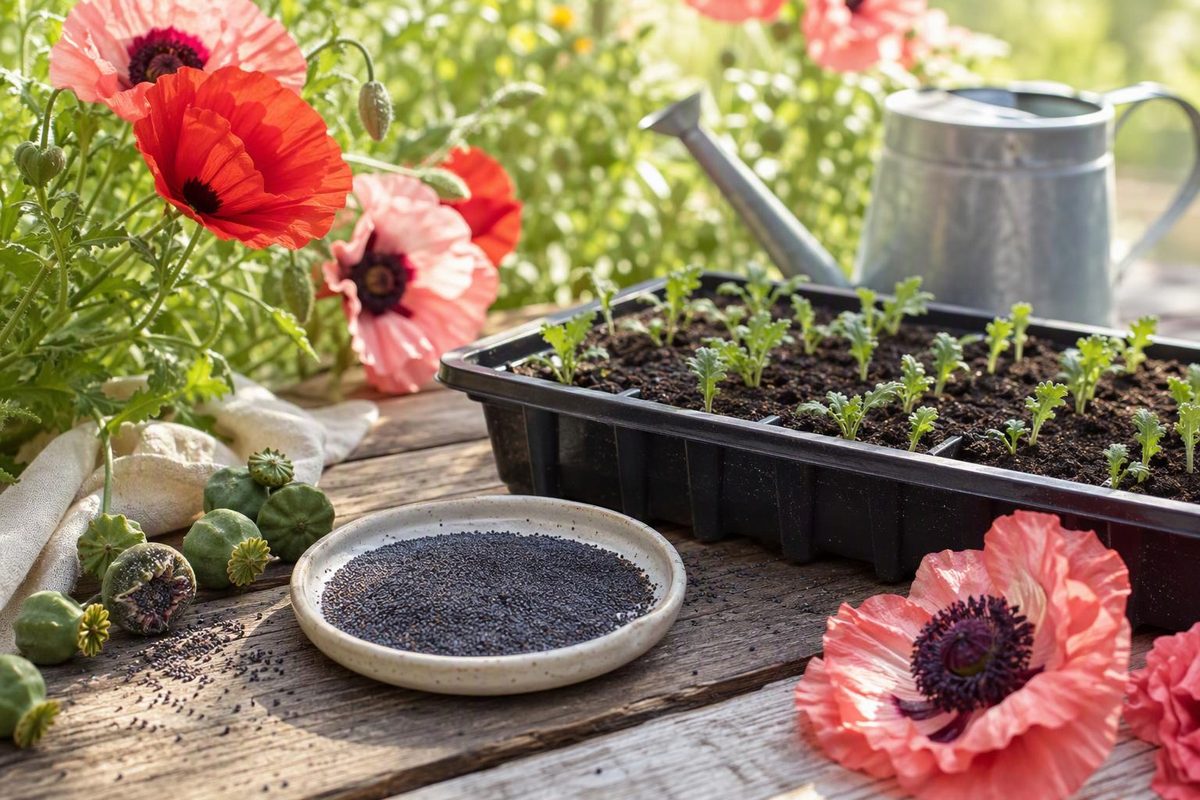
For many garden poppies, sow seeds directly outdoors 4–6 weeks before your average last spring frost, or in fall for flowers the following spring. In mild-winter climates, fall is usually the better window. You do not need to wait for frost-free weather as you would with tender summer flowers. These are the general sowing windows in Botanical Interests’ poppy growing guide; check the species on your packet before choosing one.
Choose your window by weather, not a fixed month
- Cold winters, workable soil in early spring: Count back 4–6 weeks from your average last frost. If the bed is still frozen then, use the guide’s alternative: sow as soon as the soil can be worked. Do not force cultivation of a frozen or saturated bed.
- Cold winters, a bed you can prepare in fall: Fall sowing is another option. For breadseed poppy specifically, Utah State University Extension’s Utah-focused guidance recommends late fall or very early spring and reports better germination after exposure to freezing and thawing.
- Mild winters: Plan around the cool season rather than waiting for spring warmth. Botanical Interests recommends late-summer to early-fall sowing generally, and fall-only sowing for its Shirley corn poppies in mild climates. (General timing, Utah seed-poppy guidance, Shirley packet directions)
For example, with an average last frost of April 15, the 4–6-week spring window is approximately March 4–18. That is a planning window, not an instruction to sow into unworkable ground.
Read the poppy name on the packet
“Poppy” covers several different plants. These distinctions help resolve timing and sowing questions:
| Poppy type | Useful packet-to-plot guidance |
|---|---|
| Corn, Shirley or Flanders poppy (Papaver rhoeas) | Annual. Botanical Interests’ Shirley Single Blend calls for early-spring or fall direct sowing; press seeds into the surface. Its listed emergence window is 10–15 days. Packet directions |
| California poppy (Eschscholzia californica) | A different genus. The Orange California packet recommends spring sowing at a soil temperature of 50–60°F, or fall sowing; scatter and rake in lightly. Listed emergence is 7–14 days. Packet directions |
| Iceland poppy (Papaver nudicaule) | A short-lived perennial often grown as an annual. Nudicaule Blend calls for early-spring or fall sowing, with an optimal soil temperature of 50–60°F. Press seeds into the surface; listed emergence is 10–15 days. Packet directions |
| Breadseed poppy (Papaver somniferum) | Hardy annual. Utah State’s guidance favors late fall or very early spring, with no more than 1/8 inch of soil cover. Emergence takes 7–28 days, depending on soil temperature. Extension guidance |
Oriental poppies (Papaver orientale) are perennials, so do not treat them as simply another annual flower packet. Botanical Interests includes them in its spring/fall sowing guide but notes that they prefer average-to-rich, well-drained soil. Follow your variety’s directions rather than assuming its flowering schedule matches Shirley or California poppies. Poppy groups and growing conditions
Sow shallowly and keep the surface moist
Direct sowing is the simplest default because poppy roots are sensitive to disturbance. Prepare a weed-free, well-drained bed, then scatter seed sparingly or sow small groups at the packet’s spacing. Press or lightly rake as directed—do not bury surface-sown seed under a thick layer of soil or mulch. Light aids germination for many poppies. Sowing guidance
Water gently enough that the tiny seeds stay in place. Keep the seed zone moist, not waterlogged, through emergence and early establishment. An established poppy’s drought tolerance does not mean its newly sown seed can dry out. Once seedlings are established, watering can taper according to species and weather. Watering guidance
Thin crowded seedlings while they are small. For Shirley Single Blend, the producer specifies thinning at 1–2 inches tall to one plant every 6–8 inches; other packets may call for different spacing. Shirley thinning directions
If nothing comes up
Use the emergence figures above as checkpoints, not deadlines for seed sitting outdoors through winter. Utah State reports that seed poppy can take about four weeks in cool weather, versus two in warmer conditions. Before resowing, check whether the surface dried out, seeds washed away, or soil covered them too deeply. If seedlings appeared and then vanished, inspect for slugs and snails, which can attack young poppies. Extension germination and pest guidance
For a broader check before replacing the seed, see how long seeds take to germinate and what to inspect.