
How to Grow Zinnia From Seed
Grow zinnias from seed indoors or outdoors with practical sowing depth, soil-temperature targets, germination checks and seedling-care steps.
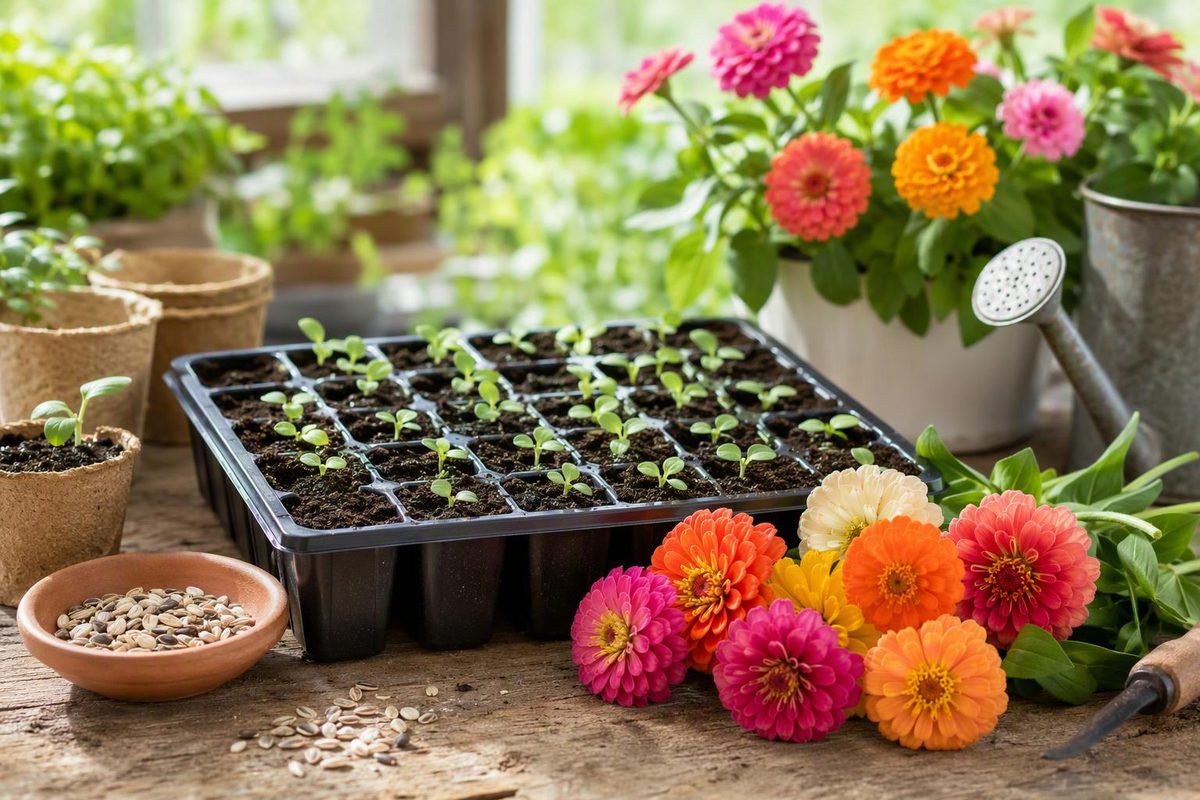
Sow zinnia seeds about ¼ inch deep, keep the seed zone evenly moist, and provide warmth. Direct sowing works well once the garden soil is warm; an indoor start gives you seedlings ready to plant when conditions improve. These directions cover annual garden zinnias (Zinnia spp.); use your packet for variety-specific spacing and sowing instructions.
Choose your sowing date by conditions
For direct sowing, wait until frost danger has passed and the soil at sowing depth reaches at least 70°F (21°C). University of Minnesota Extension uses that soil-temperature threshold for zinnias. Choose full sun and well-drained soil, not a bed that remains waterlogged after rain. UMN Extension’s zinnia guide recommends eight or more hours of sun.
For indoor starting, count back about four weeks from your intended outdoor planting date, following Johnny’s Selected Seeds’ growing instructions. That date should be after frost danger has passed, not automatically your average last-frost date. UMN recommends soil warmed to at least 60°F (16°C) for transplants.
In a cool spring, delay planting rather than crowding oversized seedlings into a cold bed. Zinnias are very frost-sensitive, and Johnny’s warns against letting starts become root-bound.
Sow directly in the garden
- Prepare the surface. Remove weeds and break up large clods so the seeds can be covered evenly.
- Sow ¼ inch deep. Cover lightly with soil, then water gently without washing the seeds out.
- Keep the seed zone moist. Check daily during dry or windy weather. A damp surface immediately after watering does not mean the soil will stay moist until the next day.
- Thin to the packet’s final spacing. Keep healthy seedlings rather than leaving every sprout crowded together.
The depth is supported by both Johnny’s and UMN Extension. UMN gives a broad 8–24-inch spacing range, depending on plant habit; a compact border variety and a bushy garden zinnia need different amounts of room.
Start indoors without tangling the roots
Use clean individual cells or small pots with drainage holes and fresh seed-starting mix. Moisten the mix before filling and sowing. Plant one seed per cell, about ¼ inch deep, and cover it. If you sow two as insurance, wait until true leaves develop, then snip the weaker seedling at soil level rather than pulling apart their roots. UMN’s indoor seed-starting guide explains this thinning method.
Keep the mix moist but not saturated, and give seedlings light promptly once they emerge.
At 70–75°F (21–24°C), UMN reports germination in 4–8 days. These are germination conditions, not a promise that every seed will emerge on schedule. Measure the mix temperature if the tray sits on a chilly shelf. UMN’s propagation guidance gives post-sprouting temperatures of 70–75°F by day and 65–70°F at night.
After sprouting:
- Provide strong light. UMN recommends 12–16 hours daily under fluorescent or LED lights; adjust placement to the fixture’s output. Long, thin stems are a warning that light is inadequate.
- Let the mix dry slightly between waterings, but do not let seedlings wilt. Drain any water left in the tray.
- Keep one plant per cell and avoid disturbing the root ball.
For help setting up trays, lighting and watering, see our indoor seed-starting guide.
Harden off, then plant
Over about two weeks, begin with a few sheltered outdoor hours in shade, then gradually increase sun exposure and time outside. Bring plants indoors when temperatures drop. This gradual adjustment reduces sun and wind injury, as described in UMN’s hardening-off instructions.
Once conditions are suitable, transplant with the root ball intact and water it in gently.
If seeds or seedlings stall
- No sprouts after the expected window: check the temperature at seed depth and whether the mix dried out or stayed soggy before resowing. The 4–8-day estimate assumes warm germination conditions; Johnny’s notes that lower temperatures slow germination.
- Stretched seedlings: improve lighting rather than adding fertilizer.
- Seedlings collapsing with soft, narrowed stems: damping-off may be involved. Affected seedlings rarely recover. Avoid saturated mix, and use cleaned, disinfected containers and fresh mix for replacement starts.
Once garden plants are established, switch from keeping the shallow seed zone moist to watering when the top 1–2 inches of soil are dry. Water at the base and preserve airflow between plants. Remove spent flowers to encourage more blooms. These are UMN’s established-plant care recommendations—not the watering rule for newly sown seeds.