
How to Grow a Sunflower Plant From Seed
Learn when to sow sunflower seeds, how deep to plant them, and how to thin and care for seedlings, with guidance for pots, indoor starts and tall varieties.
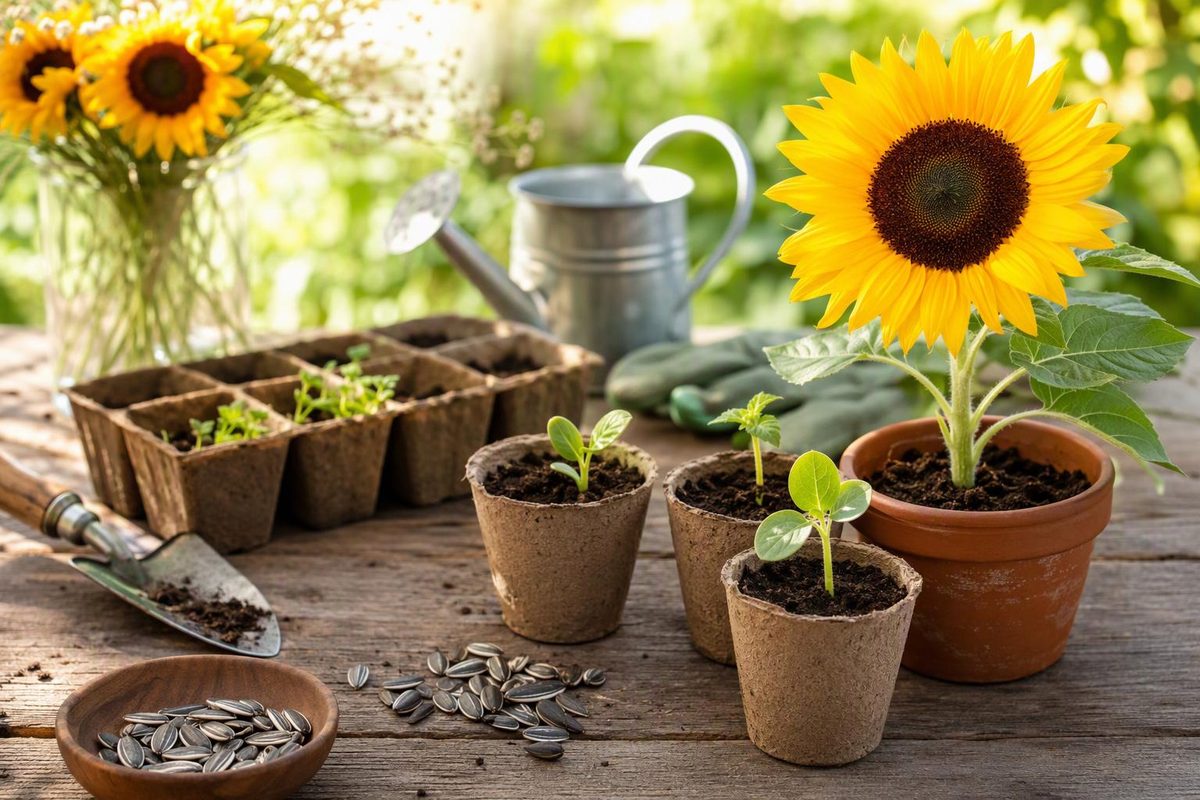
The simplest way to grow a sunflower plant from seed is to sow directly where it will grow, after frost risk has passed and the soil has warmed. Plant at the depth on the packet, gently water the seed zone, keep it moist until shoots emerge, and thin seedlings to the variety’s recommended spacing.
Choose your frost and soil conditions to check whether to sow outdoors now.
Outdoor Sowing Check
Check Conditions Before Sowing
Confirm that local frost risk has passed and measure the soil at sowing depth. Without those checks, this tool cannot recommend sowing now.
| When Ready | What to Use |
|---|---|
| Planting depth | Your seed packet’s depth |
| Seed-zone moisture | Moist, not saturated |
| Final spacing | Your variety’s packet instructions |
Source: UGA home-garden guidance. The 60°F (16°C) target is an ideal planting target, not a minimum germination temperature.
These instructions cover common annual sunflowers, Helianthus annuus, not perennial sunflower species. Choose a packet by mature height and purpose: a dwarf for a container, a branching type for several flowers, or a giant for a tall plant with a large head. Those differences belong to the variety; extra feeding will not turn a dwarf into a giant. The RHS sunflower guide covers variety selection and ongoing care.
Sow After Frost in Warm, Well-Drained Soil
Choose a spot with at least six hours of direct sunlight daily and soil that drains rather than remaining waterlogged. Tall varieties need shelter from strong winds and room for support. NC State Extension gives these site requirements for annual sunflowers.
Time sowing by local spring conditions, not a universal calendar month. For a straightforward home-garden approach, wait until frost risk has passed and soil at sowing depth reaches at least 60°F (16°C). University of Georgia Extension uses this as its ideal planting target—not the lowest temperature at which sunflower seed can germinate.
Check with a soil thermometer rather than judging by a warm afternoon. Remove weeds and rake the surface into a crumbly seedbed. If fertility is uncertain, use a soil test rather than automatically adding a large dose of fertilizer.
Use the Packet’s Depth, Then Keep the Seed Zone Moist
Follow the planting depth on your seed packet. About ½ inch (12 mm) is supported by both RHS garden sowing instructions and Johnny’s tall single-stem sunflower guidance. Recommendations differ: UGA advises 1–2 inches for its garden-row method, with deeper planting in sandier soil. One depth is not universal.
- Place seeds at the packet’s sowing spacing, cover with soil, and label the row or planting spots.
- Water gently so the soil settles without washing seeds out.
- Check moisture daily while waiting for emergence. Water when the soil around the seeds begins drying; keep that layer moist, not saturated.
Expect emergence in roughly 7–14 days under warm conditions. Johnny’s gives that range at 70–75°F (21–24°C) for tall single-stem sunflowers. Cooler outdoor soil can make the wait longer. That germination range is not a requirement to keep mature plants at the same temperature.
Thin to the Spacing for Your Sunflower Type
Once seedlings are established, keep the strongest plants and remove extras to reach the packet’s final spacing. Snipping unwanted seedlings at soil level avoids pulling on neighboring roots.
Spacing depends on the variety and your goal. Utah State Extension’s cut-flower production guidance distinguishes close-spaced single-stem crops from branching plants; RHS gives a general garden spacing.
| Planting Purpose | Final Spacing | Scope |
|---|---|---|
| Single-stem cut flowers | 4–6 inches | USU production guidance |
| Branching sunflowers | 18–24 inches | USU production guidance |
| General garden planting | About 18 inches (45 cm) | RHS garden instructions |
The close cut-flower spacing is not a default for giant garden sunflowers. Use the variety’s packet instructions when deciding how much room to leave.
For a pot, choose a dwarf variety, use a container with drainage holes, and follow its container-spacing instructions. There is no single pot size or spacing supplied here that fits every dwarf cultivar.
Start Indoors Only for a Short Head Start
Indoor sowing can protect seeds and young shoots from wildlife and give you a short head start. USU recommends starting 2–3 weeks before your intended transplant date, using individual cells or pots of seed-starting mix.
Provide strong light as soon as shoots emerge. Our indoor seed-starting guide covers lighting and hardening off.
Gradually acclimatize seedlings to outdoor conditions, then transplant after freezing weather has passed. Keep the root ball intact: sunflowers are sensitive to root disturbance. Avoid separating tangled seedlings or letting plants become root-bound.
Water Established Plants and Support Tall Stems
After establishment, water thoroughly during dry spells rather than repeatedly wetting only the surface. For giant sunflowers, keep the soil consistently moist rather than letting it dry out between waterings. Containers dry faster than garden soil, so check them more often.
Following RHS ongoing-care guidance, install sturdy support for tall garden varieties at planting time and loosely tie the stem as it grows. Leave a gap around stems if you mulch.
Check the Seed Zone if Shoots Do Not Appear
If there are no shoots after two warm weeks, gently uncover one sowing spot. Check whether the seed is still present, whether the seed zone is dry, and whether the seed looks firm or decayed before resowing. Allow more time in cooler soil rather than treating the warm-condition germination range as a deadline.
Inspect Missing Seedlings for Feeding Damage
If shoots appear and then disappear, inspect for feeding damage. Slugs and snails eat young sunflowers; indoor starts can reduce that early exposure, as described in the RHS guide.
Leave Single-Stem Sunflowers Unpinched
If a single-stem plant is growing well, leave its growing tip intact. Johnny’s warns that pinching these sunflowers can cause poor blooms or no bloom at all. Do not apply advice for branching flowers to a single-stem variety.
Use the Variety’s Flowering Estimate and Watch Seed Maturity
Use the packet’s flowering estimate to plan your season rather than expecting every sunflower to bloom on the same date. No universal sowing-to-flowering figure is supplied here.
If you leave a head for seeds, UGA describes observable signs that maturity is approaching: the back of the head turns from green to yellow-brown, and the tiny flower remnants covering the seeds dry and fall away.