
Kamani Tree: Identification, Seed Germination, and Site Fit
Identify true kamani, prepare its hard-shelled seed, and decide whether this salt-tolerant tropical tree has enough warmth and space for your site.
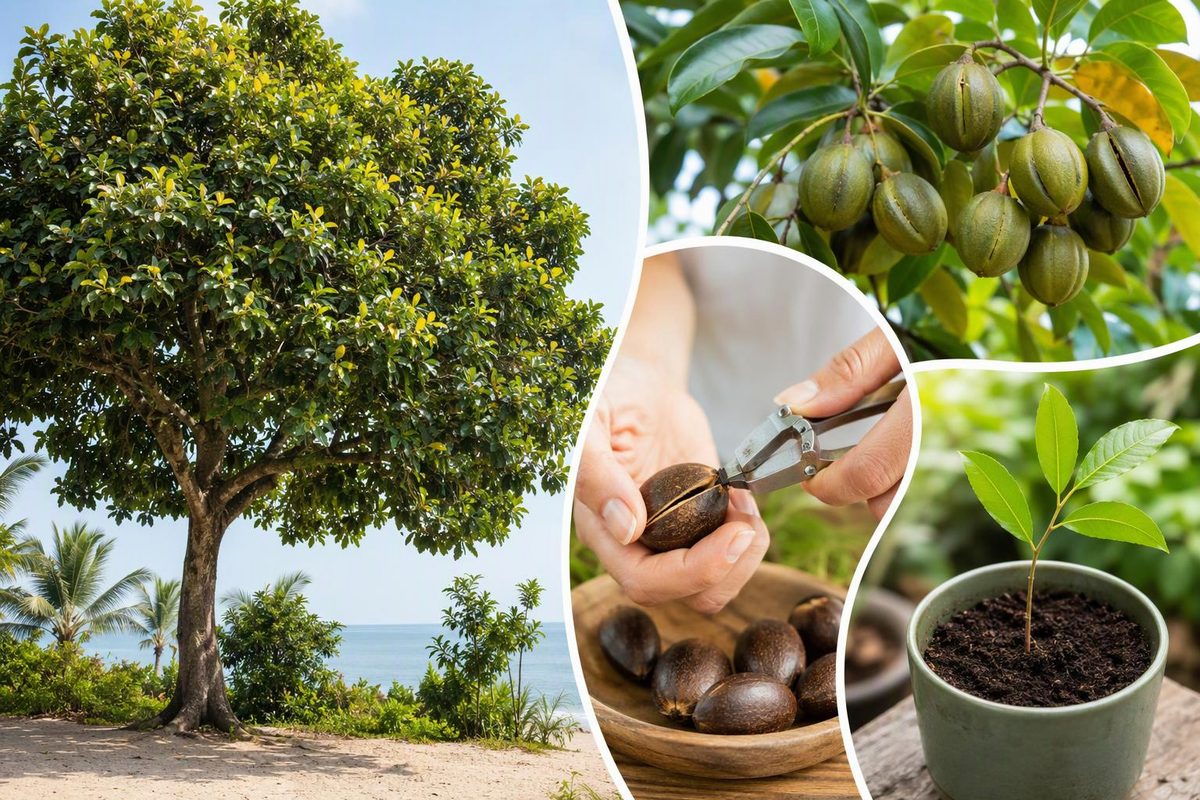
True kamani is Calophyllum inophyllum, also called tamanu, beauty leaf or Alexandrian laurel. It is a broad-crowned tropical evergreen suited to reliably frost-free sites, not an ordinary temperate garden. Confirm the botanical name before collecting or buying seed: “false kamani,” or tropical almond, is a different species, Terminalia catappa.
Choose your winter conditions, available space and seed treatment to see the site verdict and likely germination window.
Kamani Site and Seed-Treatment Check
Site fit: Suitable on these two checks
Cracked shell: 38-day trial average; nursery window 6–10 weeks.
Cracking speeds emergence compared with an intact shell while retaining more protection than complete removal.
| Shell | Trial Average | Nursery Window |
|---|---|---|
| Intact | 57 days | 2+ months |
| Cracked | 38 days | 6–10 weeks |
| Removed | 22 days | 3–6 weeks |
This site check covers winter cold and crown space only. Soil must drain freely, and local planting or invasive-species guidance still applies.
Sources: Florida Extension profile and USDA Forest Service nursery protocol. Germination figures are trial averages and protocol windows, not deadlines.
Identify True Kamani by Its Leaves, Flowers and Fruit
Look for several features together:
- Thick, glossy, dark-green leaves arranged in opposite pairs
- Numerous fine, nearly parallel veins running from the midrib toward the leaf edge
- Fragrant white flowers with many yellow or orange stamens
- Round green fruits that become yellow or brown and wrinkled when mature
- Cream-colored resinous sap in cut twigs or bark
The Hawaiʻi Division of Forestry and Wildlife describes kamani as a low-branching evergreen, typically 25–65 feet tall, with a broad crown and clustered ball-shaped fruits. Its leaves are opposite, while tropical almond has much larger leaves clustered toward the ends of its branches. Compare the agency description with the more detailed USDA and University of Hawaiʻi identification account.
Kamani is not a small patio tree. A Florida Extension profile gives a typical landscape size of 35–50 feet tall and 30–50 feet wide. Its hard, golf-ball-sized fruit and leaf litter can be troublesome beside a walkway or play area. The profile also says the kernel may be poisonous and the tree does not tolerate freezing temperatures. See the Florida Extension profile.
Plant Kamani Only in a Frost-Free, Spacious Site
Plant kamani in the ground only where winters are reliably frost-free. The Florida profile places it in USDA zones 10B–11, but a hardiness-zone label does not guarantee protection from an unusual freeze.
A suitable site offers:
- Full sun or partial shade
- Room for a crown that may spread 30–50 feet
- Well-drained sand, loam or clay
- A location where fallen fruit can be collected
Kamani is particularly well adapted to tropical coasts. A USDA Forest Service account reports growth in soils ranging from coastal sand to clay and exposure to high winds, sea spray and brackish water tables. It has also grown inland. These tolerances do not make saturated potting mix desirable; container seedlings still need free drainage. Read the USDA species account.
Check the species’ status with a local agriculture, forestry or invasive-species authority before sowing outside its established range. Guidance is jurisdiction-specific. The Forest Service nursery protocol says kamani may be invasive in some introduced areas, while the current UF/IFAS assessment lists it as “not a problem species” in Florida; its 2025 South Florida assessment is marked incomplete. Check the UF/IFAS assessment.
Sow Fresh Kamani Seed Without Refrigerating It
Use fresh, fully mature fruit when possible. Ripe fruit is yellow to brown and wrinkled rather than smooth and green.
A storage study classified kamani seed as recalcitrant and vulnerable to chilling injury, making cold storage unsuitable. The same study retained viability for more than eight months under warmer storage conditions, while the Forest Service nursery protocol says clean, unshelled seed may keep for a few months in cool, dry conditions. For a home grower, the least complicated choice is to sow fresh seed and never refrigerate or freeze it. See the storage study.
- Soak the fruit overnight. This softens the thin outer flesh.
- Remove the flesh. The hard shell underneath encloses one large seed.
- Choose a shell treatment. Leaving the shell intact protects the seed but delays emergence. To speed germination, tap the shell lightly with a wooden mallet or crack it carefully with pliers. Complete shell removal is faster but increases the chance of damaging the seed.
- Sow one seed per container. Use a clean container more than 2⅜ inches (6 cm) across when the shell remains attached, or a smaller nursery tube for a shelled seed. Fill it with a loose, well-drained propagation mix and sow about 1 inch (2.5 cm) deep. For the wider decisions involved in raising tree seedlings, see how to choose, treat and sow tree seeds.
- Keep it warm and lightly moist. Moderate shade can help during germination in a hot, exposed location. Avoid saturated mix.
- Allow for the shell treatment. In one cited trial, intact shells averaged 57 days to germinate, cracked shells 38 days and removed shells 22 days. These are averages, not failure deadlines. A working nursery protocol gives broader windows: two months or longer intact, 6–10 weeks cracked and 3–6 weeks shelled. Read the Forest Service nursery protocol.
The useful checkpoint is emergence, not the calendar alone. Keep an intact seed under the same warm, moist—not wet—conditions beyond the average if it remains firm and shows no obvious decay.
Increase Light Gradually After Germination
In a hot lowland nursery, give a new seedling moderate shade for its first four to six weeks. Then increase the light gradually. The nursery protocol moves seedlings into full sun four to eight weeks after germination or transplanting and hardens them in full sun for at least four months before outplanting.
Keep the root ball intact when potting up. The protocol’s planting target is approximately 10 inches (25 cm) tall, with an 8 mm stem and well-formed roots. Treat those measurements as nursery benchmarks rather than guarantees: root condition matters as much as height.
Plant out at the beginning of a reliably warm, rainy period. Set the root flare at the surrounding soil level, water while the roots establish and reduce watering gradually during hardening rather than moving a constantly moist nursery plant directly into dry ground.
Do not treat kamani as a backyard nut crop. Authoritative references describe the kernel as potentially or reportedly poisonous. Keep fallen fruit away from children and pets, and use gloves if the resin irritates your skin.