
Prairifire Crabapple Tree: Size, Planting, and Care
Learn where a Prairifire crabapple fits, how to plant it at the correct depth, and what to expect from its flowers, fruit, growth, and diseases.
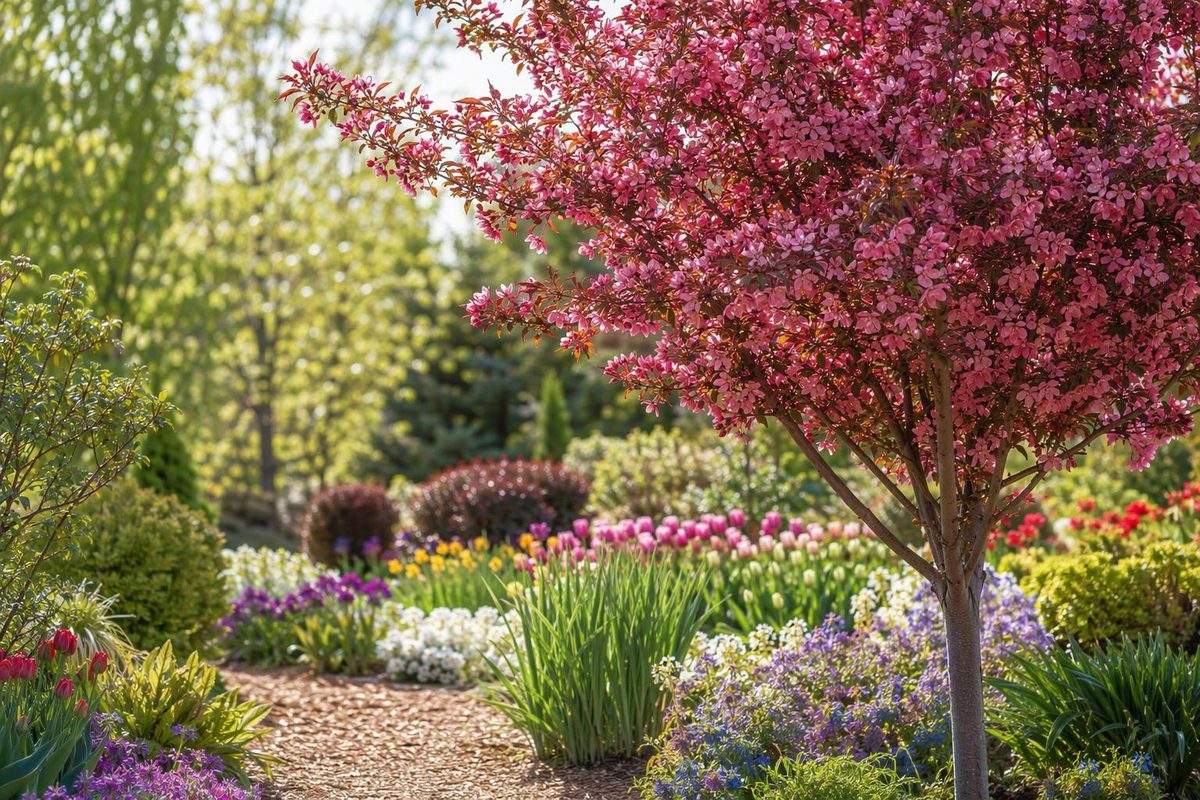
Prairifire crabapple (Malus ‘Prairifire’) is a rounded ornamental tree with deep pink-red spring flowers, purple-tinged new leaves and small red-purple fruit. Expect a mature tree about 15–20 feet tall and 15–20 feet wide—compact compared with a large shade tree, but not a dwarf.
Enter the open distance from the trunk to the nearest obstacle to check whether its mature canopy will fit.
Mature Canopy Space Check
Measure to the nearest building, pavement edge, tree or other obstacle. This checks canopy room only.
A 20-foot-wide canopy extends about 10 feet from the trunk. Add clearance where branches could interfere with roofs, vehicles or pedestrians.
Source: mature dimensions from Missouri Botanical Garden and Colorado State University Extension.
The cultivar name is spelled ‘Prairifire’, without the second “e” in prairie. That spelling appears in Oregon State University’s cultivar record, which says Dan Dayton of the University of Illinois developed the tree and introduced it in 1982. When shopping, check the botanical label rather than relying on variations in the common name.
Prairifire Reaches 15–20 Feet
| Trait | What to expect |
|---|---|
| Mature size | 15–20 feet tall and wide |
| Form | Dense, rounded to spreading-rounded |
| USDA hardiness | Zones 4–8 |
| Light | Full sun |
| Flowers | Single, deep pink-red; generally April–May, depending on climate |
| Fruit | Red-purple, about 1/2 inch; often persists into winter |
| Fall color | Orange to copper-red |
| Soil | Well-drained; adaptable, with moderate moisture |
| Disease performance | Strong resistance, but not immunity |
The size, flowers, fruit and growing conditions are documented by the Missouri Botanical Garden. Colorado State University Extension also lists a 20-by-20-foot mature size, persistent half-inch fruit and resistance to fire blight, apple scab, rust and powdery mildew in its Front Range comparison.
Allow Room for the Mature Canopy
Plan around a canopy as much as 20 feet across, not the size of the tree at purchase. Branches on an open-grown tree may eventually extend roughly 10 feet from the trunk. Allow additional clearance where low limbs could interfere with vehicles, pedestrians, roofs or other trees.
Prairifire suits a broad mulched bed or an open lawn where its crown can develop. Consider the mature canopy before planting it directly beside a patio, driveway or heavily used walk. The fruit is only about 1/2 inch across and often remains on the branches, making it less troublesome than large crabapples, but some fruit can still fall.
Choose full sun and soil that drains after rain. Excess shade reduces flowering and fruiting, produces a more open canopy and can increase powdery mildew problems. Colorado State also cautions that a hot south- or west-facing exposure can force early bloom, leaving flowers more vulnerable to a late freeze.
Buy a Labeled Tree, Not “Prairifire Seeds”
A seed collected from Prairifire will not reliably produce another Prairifire. Apples do not come true from seed, as the University of Saskatchewan explains. Buy a nursery tree labeled Malus ‘Prairifire’ if you want this cultivar’s flowers, foliage, form and disease performance.
Before buying, look for:
- a visible widening at the trunk base rather than a trunk disappearing straight into the potting mix;
- bark free of major wounds;
- no dead branch tips;
- roots that are not densely circling the container;
- a sound main framework without tightly joined competing trunks.
Crabapples are commonly grafted. Shoots from the rootstock can differ from the named cultivar, so remove suckers emerging from the base before they become woody trunks.
Keep the Trunk Flare at Soil Level
Planting too deeply can shorten a tree’s life. The trunk flare—the widening base where the first major roots emerge—should finish at soil level or slightly above it.
- Find the trunk flare. Remove excess potting mix from the top of the root ball if it has been buried.
- Dig wide, not deep. Make the hole two to three times the width of the root mass, but no deeper than the distance from the exposed flare to the bottom of the root ball.
- Correct circling roots. Loosen, straighten or prune roots wrapping around the outside of a container-grown root ball.
- Backfill with the excavated soil. Do not create a pocket of heavily amended soil.
- Water the root ball thoroughly. The original root mass can dry while the surrounding soil remains damp.
- Mulch 2–4 inches deep. Spread mulch broadly, but keep it away from the trunk and leave the flare visible.
These depth, root and mulch recommendations follow Iowa State University Extension’s tree-planting guidance. Stake only if the root ball shifts in wind or the tree cannot stand securely. Remove the supports when they are no longer needed, usually after one growing season.
Check the Root Ball Before Watering
During establishment, water according to measured soil moisture rather than a fixed calendar. Check the original root ball frequently and water when it feels dry 1–2 inches down. Apply water slowly enough to wet the entire root mass and some surrounding soil.
Iowa State’s newly planted tree guidance notes that a root ball may dry before the surrounding ground does and may need several checks each week during the first few months.
Keep turf and weeds away from the trunk. A broad mulch ring reduces competition and protects the bark from mowers and string trimmers. Do not keep the soil saturated, and do not add fertilizer automatically at planting. Iowa State says most newly planted trees do not need it. Excess nitrogen also produces succulent growth that is especially vulnerable to fire blight, according to University of Minnesota Extension.
Prune Lightly in Late Winter
For routine shaping, prune in late winter before growth starts. Remove dead or damaged wood, crossing branches, vigorous upright water sprouts and rootstock suckers. Avoid removing a large share of a newly planted tree’s canopy because its leaves supply energy for root establishment.
The Missouri Botanical Garden recommends late-winter pruning and advises against spring pruning because fresh cuts can provide entry points for fire-blight bacteria. Do not top the tree to force it into a small space. If a crown approaching 20 feet is too large, select a genuinely dwarf crabapple instead.
If symptoms of fire blight appear during the growing season, do not wait until the next routine pruning without getting a diagnosis. Disease-management cuts have different timing and placement requirements from ordinary shaping.
Disease Resistance Is Strong, Not Absolute
Apple scab, fire blight, cedar-apple rust and powdery mildew are the principal crabapple diseases. Prairifire has encouraging performance records: Colorado State rates it resistant to all four, while the University of Minnesota’s cultivar guide gives it excellent ratings for each.
Those ratings do not mean every tree will remain unmarked. Disease pressure and cultivar performance vary with region and weather. The New York Botanical Garden recommends consulting local Extension guidance because the dominant disease can differ around the country. Full sun, air circulation, moderate fertilization and irrigation that avoids wetting the foliage help reduce disease pressure.
Watch for these visible changes:
- Olive or dark leaf spots followed by yellowing and early leaf drop: possible apple scab.
- Blackened, hooked shoot tips with dead leaves still attached: possible fire blight.
- Bright orange or yellow leaf spots: possible cedar-apple rust.
- White, powdery growth with narrow or distorted leaves: possible powdery mildew.
A few spotted leaves do not necessarily justify treatment. Repeated early defoliation, expanding dead shoots or bark cankers warrant identification through a local Extension service before pruning or spraying.