
Big Jim Loquat Tree: Buy Grafted and Plan for Frost
How to identify, plant and care for a Big Jim loquat tree, including mature size, pollination, frost risk, fruit thinning and harvest cues.
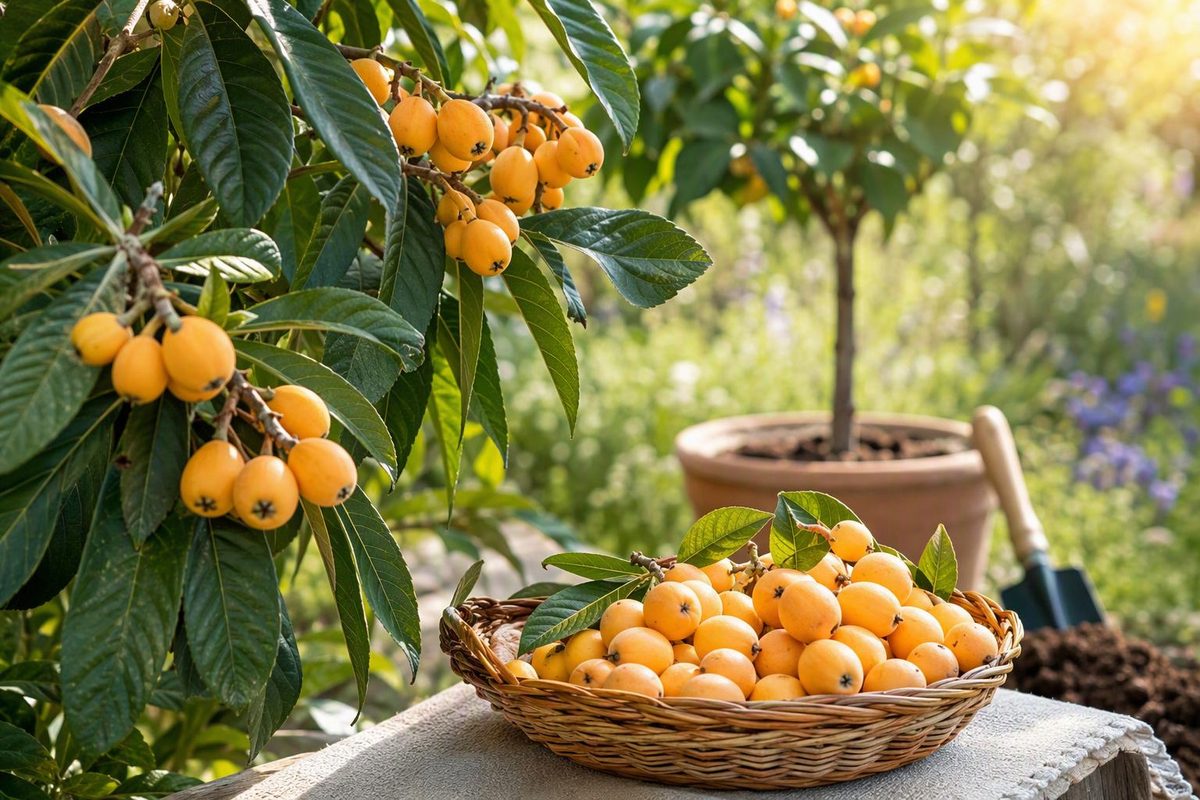
‘Big Jim’ is a named orange-fleshed loquat cultivar, not simply a large seedling tree. Its appeal is large, easy-peeling fruit, but the first buying decision matters most: choose a vegetatively propagated plant labeled ‘Big Jim’—usually grafted or budded. A tree grown from a ‘Big Jim’ seed is genetically variable and cannot be expected to produce the same fruit.
‘Big Jim’ at a glance
| Trait | What to expect |
|---|---|
| Botanical name | Eriobotrya japonica ‘Big Jim’ |
| Habit | Evergreen; vigorous and upright |
| Fruit | Pale orange-yellow skin and orange-yellow flesh; sweet with some acidity |
| Reported fruit size | About 1¼–1½ inches in diameter |
| Reported California season | Midseason, generally March–April |
| Sun | Full sun for best fruiting; partial shade tolerated |
| Soil | Well drained; standing water is unsuitable |
| Pollination | One loquat may set fruit, but another cultivar can improve set and fruit size |
| Main climate limitation | Flowers and young fruit are less cold-hardy than the tree |
The California Rare Fruit Growers cultivar record says Jim Neitzel originated ‘Big Jim’ in San Diego. It describes the fruit as roundish to oblong, easy to peel and excellent in flavor, and the tree as vigorous, upright and highly productive. Its March–April harvest window is a California observation, not a date to apply unchanged in every climate (California Rare Fruit Growers).
Buy the cultivar, not its seed
Look for a nursery label naming ‘Big Jim’ and, on grafted stock, a visible graft union low on the trunk. Ask which rootstock was used and whether the listed mature size assumes regular pruning. Loquat seedling rootstock generally produces a comparatively large tree, while quince rootstock can produce a smaller, earlier-bearing tree (California Rare Fruit Growers).
Avoid listings for “Big Jim loquat seeds” if your goal is the named fruit. UF/IFAS states that loquats do not come true from seed and that seedlings commonly remain juvenile for six to eight years. Vegetatively propagated trees generally start bearing one to two years after planting, although climate and establishment can delay that schedule (UF/IFAS Extension). Seed is useful for growing a new seedling or rootstock, not for reproducing a named cultivar. That distinction also applies when starting other trees from seed.
Before buying, inspect the root ball and trunk. Pass over a tree with severe circling roots, trunk wounds, blackened shoot tips or a cracked, poorly joined graft union.
Make sure the site can ripen fruit
Loquats flower in fall and early winter and carry developing fruit through winter. That unusual calendar is the central site constraint. An established tree may survive much colder weather than its crop: UF/IFAS reports that trees may withstand roughly 8–10°F, while temperatures below 27°F can kill flowers and fruit (UF/IFAS Extension). A gardener may therefore keep a healthy loquat yet rarely harvest it.
Choose:
- Full sun, especially where summers are mild.
- A warm, frost-sheltered position where winter temperatures sometimes fall into the upper 20s.
- Well-drained ground that does not remain flooded after rain.
- Enough overhead and lateral room. Loquat can reach 20–30 feet high, with a spread up to 30–35 feet, although pruning can keep it smaller (UF/IFAS Extension). For an unrestrained fruit tree, UF/IFAS recommends 25–30 feet or more from structures, power lines and other trees; consistently pruned trees can be somewhat closer (UF/IFAS Extension).
Do not interpret a nursery’s “cold hardy” claim as a guarantee of fruit after a freeze. Tree survival and crop survival are separate questions.
Plant with the root flare showing
Plant in cool, mild weather when possible rather than immediately before extreme heat or a hard freeze.
- Water the container thoroughly before removing the tree.
- Find the first structural roots and root flare; nursery mix may hide them.
- Dig a hole at least twice as wide as the root ball but about 2 inches shallower than its measured depth.
- Loosen or cut circling outer roots. Set the tree on firm soil with the root flare slightly above the surrounding grade and the graft union above ground.
- Backfill with the excavated soil. Do not bury the trunk or create a compost-filled pocket.
- Water slowly and thoroughly to settle soil around the roots.
- Apply 2–4 inches of organic mulch over the root zone, keeping it 6–12 inches away from the trunk.
These depth and mulch checkpoints follow the University of California’s guidance for planting container-grown trees (UC Marin Master Gardeners). After planting, the base of the trunk should widen visibly where it meets the soil rather than entering the ground like a straight post.
Establish the tree, then manage its crop
Keep the original root ball and surrounding soil moist during establishment, but check the soil before watering rather than following a fixed calendar. Reduce irrigation when rain supplies enough moisture; loquat does not tolerate flooded soil. Once established, water during prolonged dry periods and fruit development without keeping the root zone continually wet (UF/IFAS Extension).
Prune lightly to build a low, accessible framework. UF/IFAS recommends tipping shoots longer than 2–3 feet during the first two years to encourage branching; mature trees can be maintained at about 6–12 feet for easier care and harvest (UF/IFAS Extension). Do substantial size-control pruning after harvest so terminal flower-bearing growth is not removed just before bloom.
When clusters set heavily, remove some young fruit or part of the most crowded clusters. Thinning can increase the size of the remaining fruit and reduce the load on branch tips; there is no need to force every cluster to an arbitrary fruit count (University of California IPM).
Use fertilizer conservatively. If foliage is pale or growth is weak, consider recent growth, irrigation and a soil test before adding nitrogen. Excessive nitrogen encourages tender growth that is more susceptible to fire blight, a bacterial disease that can blacken flowers and shoots as though they were scorched (Clemson Cooperative Extension).
Pollination and harvest checkpoints
Loquats are generally self-compatible, but UF/IFAS notes that cross-pollination by another cultivar or seedling can improve fruit set, size and production (UF/IFAS Extension). For limited space, one grafted ‘Big Jim’ is a reasonable starting point. Where reliable crops matter and room permits, add a different flowering loquat cultivar rather than a second clone of ‘Big Jim’.
Leave the fruit on the tree until it develops full orange-yellow color and begins to soften. Loquats picked unripe do not ripen properly off the tree and remain excessively acidic. Taste one fully colored fruit before harvesting a cluster because weather and crop load shift the date. Clip individual stems or remove the cluster and then snip off each fruit; pulling can tear the ripe skin (California Rare Fruit Growers).