
How to Grow Peaches From a Peach Seed: 5 Steps
Cold-stratify a peach pit, pot it at the right stage, and move the seedling outdoors while knowing why its future fruit may differ from its parent.
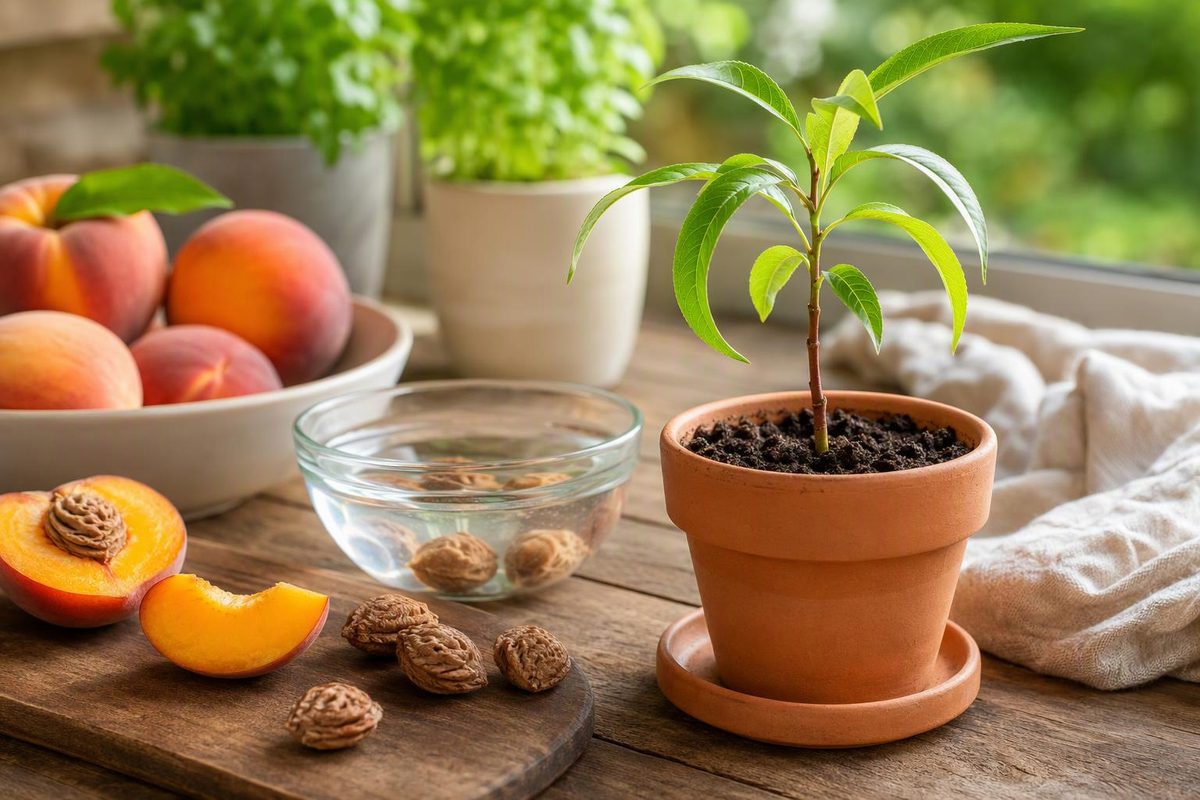
To grow a peach tree from a peach seed, clean the pit, give it 120–130 days of cold, moist storage, and pot it when the shell splits or a white root appears. After the shoot emerges, provide strong light, acclimate the seedling to outdoor conditions and plant it in a sunny, well-drained site.
Enter the pit’s condition, chilling time and temperature to see what to do next.
Peach Pit Next-Step Check
Use the actual refrigerator conditions rather than the planned schedule.
The intact pit has 120 days remaining before the start of the documented 120–130-day range. Keep the medium damp, not dripping, at about 45°F.
Source: Penn State Extension gives 33–50°F as an effective range, about 45°F as best and 120–130 days for peach seed after-ripening.
The resulting tree will be a new genetic individual, not a copy of the peach you ate. Its fruit may differ in size, flavor, ripening time and stone type. Penn State Extension explains that a fruit seed receives genes from both the tree that bore it and its pollen parent; named fruit varieties are propagated vegetatively when an exact copy is required (Penn State Extension). Grow a peach pit as an experiment, not as a dependable way to reproduce a favorite cultivar.
Gather Two or More Peach Pits and a Deep Pot
You will need:
- Two or more pits from fully ripe, sound peaches
- Water and a brush for cleaning
- A labeled food-storage bag or lidded container
- Peat, sand or shredded paper towel
- Refrigerator space
- A deep pot with drainage holes
- Fresh, free-draining potting mix
Starting several pits improves the chance of raising one healthy seedling. Even a pit from local fruit does not guarantee a tree adapted to your winters, spring frosts, diseases or growing-season length.
1. Clean the Peach Pits Without Heating Them
Remove all clinging fruit, rinse the pits and let their surfaces air-dry. Do not roast or otherwise heat them.
You can stratify the hard pit unopened. Cracking the shell allows you to inspect the almond-like seed inside, but it also makes that seed easy to crush or cut. Leaving the shell intact is the simpler first attempt. For a closer comparison of the methods and the signs that chilling has worked, see how to germinate peach seeds.
2. Chill the Pits for 120–130 Days
Peach seeds need cold, moist conditions to overcome dormancy. Penn State lists an effective range of 33–50°F, a best temperature near 45°F and an after-ripening period of 120–130 days for peach seed (Penn State Extension). A refrigerator is more predictable than a mild or erratic winter.
- Moisten peat, sand or shredded paper towel, then squeeze out excess water. It should feel damp but not drip.
- Enclose the pit and medium in a labeled bag or container.
- Refrigerate for 120–130 days unless a root appears sooner. Keep the container away from ripening fruit, which Penn State warns can interfere with stored seeds.
- Check every week or two, increasing to weekly checks late in the treatment. Add a few drops of water if the medium is drying; replace it if extensive mold develops.
A split shell shows progress. A white root means it is time to sow, even if 120 days have not passed; the root becomes harder to handle as it lengthens.
Where winter reliably supplies several months of cold, fall sowing is another option. Plant the pit no deeper than one to two times its longest dimension. Penn State recommends covering the bed with hardware cloth whose edges are pushed into the soil to deter squirrels and chipmunks, then removing it when seedlings emerge.
3. Pot the Seed Without Damaging Its Root
Fill a deep container with moist, free-draining potting mix. A deep pot gives the young taproot room to extend.
If a root has emerged, point it downward and handle the pit by its shell or seed body—not by the tender root. Cover the pit with soil to a depth of roughly one to two times its longest dimension. An intact pit that has completed its chilling period can be sown at the same depth even if it has not split.
Water until excess drains from the pot. Thereafter, keep the mix evenly moist rather than saturated, and do not add fertilizer while waiting for emergence.
Once a shoot appears, give it strong light immediately. Remove any cover that traps humidity. A pale, stretched or sharply leaning stem indicates that the light is insufficient; move it to a brighter position or place it under a grow light, adjusting the lamp without letting it heat or touch the leaves.
4. Acclimate the Seedling Over About a Week
Wait until severe frost has passed before moving the seedling outdoors for the season. Over about a week, expose it to gradually stronger light and wind:
- Begin in a sheltered, shaded location for a few hours.
- Extend its outdoor time each day.
- Add morning sun before exposing it to longer periods of direct sun.
- Bring it under cover if frost or severe weather threatens.
Leaves that bleach or develop pale, papery patches after the move have probably received too much sun too quickly. Return the plant to partial shade and resume the transition more slowly.
5. Plant the Tree in Full Sun and Draining Soil
Choose the permanent location before the seedling becomes badly root-bound. Utah State University Extension recommends at least eight hours of direct sun and well-drained soil for peaches. It reports that managed peach trees commonly reach about 15 feet tall and 20 feet wide, although size varies with the tree and its management (Utah State University Extension).
A seed-grown tree has no size-controlling rootstock and unknown vigor, so do not plan on it remaining dwarf. Leave generous clearance from buildings, overhead lines and other trees. Utah State’s 12–16-foot spacing applies to planted peach trees under managed systems; allowing for the reported mature spread is more cautious where you have room.
Plant the seedling at the same soil level it occupied in the pot. Water thoroughly to settle soil around the roots. During establishment, keep the root zone moist but not waterlogged, and maintain a turf- and weed-free area around the trunk. Utah State notes that keeping new trees irrigated is critical but that excess water can damage roots.
A Seed-Grown Peach Will Not Match Its Parent
Germination proves that the seed was viable; it does not predict fruit quality or local adaptation. Missouri Extension lists two to four years from planting to fruiting for peach trees under typical Missouri conditions, but a seedling’s timing can differ (University of Missouri Extension). Winter injury, spring frost, pruning, disease pressure and the seedling’s genetics may delay or prevent a crop.
Most peaches are self-fruitful, so one tree can generally set fruit, although exceptions exist. Both Missouri Extension and Utah State University Extension note this exception to the usual rule.
Climate fit is the greater unknown. Cold stratification and a mature tree’s annual chill requirement are separate matters: refrigerator treatment wakes this seed, while the future tree must receive suitable winter conditions outdoors year after year. Utah State also distinguishes winter hardiness from chill requirement; a tree may tolerate a region’s lowest temperature yet still have the wrong dormancy needs for that site.
If the tree survives, expect annual pruning, fruit thinning, watering during dry periods and monitoring for local insects and diseases. If known fruit quality, hardiness, disease response or mature size matters more than the experiment, a grafted cultivar recommended for your area is the more predictable choice.