
How to Grow a Cucumber From Seed
Grow cucumbers from seed with warm-soil checks, sowing depth, a short indoor-start schedule, and practical seedling, pollination and harvest cues.
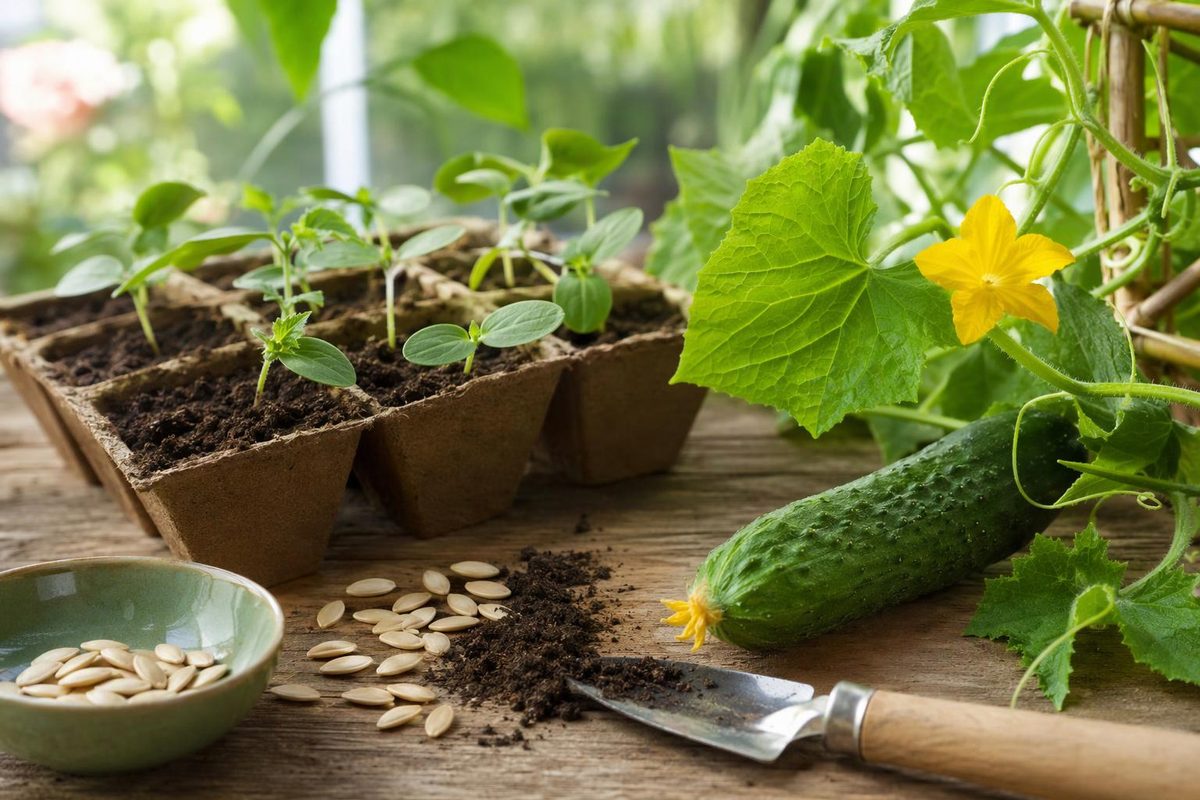
For an outdoor garden, the simplest route is to sow cucumber seeds directly after frost danger has passed and the soil has warmed to 70°F (21°C). Sow about ½ inch deep, keep the seed zone moist, and thin the seedlings so the vines have room. Cucumbers (Cucumis sativus) are sensitive to root damage, so direct sowing avoids a transplanting step. University of Minnesota Extension recommends this approach.
An indoor start can help in a short growing season, but cucumbers need only a brief stay in pots—not the long head start you would give peppers.
Choose the seed and planting date
Choose a slicing cucumber for fresh eating or a pickling type for smaller, blockier fruit; pickling cucumbers can also be eaten fresh. Check whether the variety is a long-vined type that needs spreading room or a trellis, or a compact bush type suited to a smaller space. Clemson Extension explains these distinctions.
For outdoor sowing, use your local last-frost date as a planning reference, then check the forecast and soil rather than planting automatically on that date. Minnesota Extension specifies at least 70°F at a depth of 1 inch. Measure with a soil thermometer: a warm afternoon does not necessarily mean the soil is ready, and seedlings planted into cold soil may barely grow.
If starting indoors, count back about three weeks from the date you expect to plant outdoors, as recommended by University of Maryland Extension. The destination still needs warm soil and frost-free weather.
Sow directly in the garden
- Prepare a sunny, well-drained bed. Work in finished compost where needed and use a soil test to guide fertilizer choices. Cucumbers prefer at least six hours of direct sun, with eight to ten hours better, according to Maryland Extension.
- Sow about ½ inch deep. Minnesota Extension suggests sowing seeds 2 inches apart in a row, then thinning after emergence. Water gently so the seeds remain covered.
- Keep the seed zone moist. Check beneath the surface rather than judging only by its color. Do not let the seed layer dry out, but avoid leaving it waterlogged.
- Thin without pulling. Snip unwanted seedlings at soil level to avoid disturbing neighboring roots. For a typical vining row, leave plants about 12 inches apart and roughly 5 feet between rows; use the packet if your cultivar specifies a different layout. These dimensions fall within Maryland Extension’s spacing guidance.
If you will grow vines vertically, put the trellis in place at planting time so young tendrils have something to grip, as the Royal Horticultural Society advises. Trellising also keeps fruit off the soil and makes it easier to find at harvest.
Starting indoors instead
Use individual pots with drainage holes and fresh seed-starting mix. Avoid a shared tray that will require teasing tangled roots apart later.
A practical method is one seed per 4-inch pot, covered with about ½ inch of mix. The Royal Horticultural Society’s cucumber guide uses this pot size and a sowing depth of ½–¾ inch. It recommends a propagator at 70°F (21°C), with seedlings appearing after about one to two weeks. Treat that as a checkpoint for this warm indoor method, not a promise for seeds in cooler garden soil.
Pre-moisten the mix before sowing and keep it moist while waiting. If you use a clear cover to retain moisture, remove it when seedlings appear. Then shift attention from germination warmth to bright light and steady growth, while continuing to keep the young plants warm. The first paired seed leaves will be followed by true leaves.
A grow light is more dependable than a dim window. Minnesota Extension recommends 12–16 hours of light daily; long, thin stems are a cue that light is insufficient. Drain excess water from the tray rather than leaving pots standing in it. See our indoor seed-starting guide for setup details.
Gradually acclimate seedlings to outdoor sun and wind, starting with a few sheltered hours and increasing exposure. Transplant before they outgrow their pots, keeping the root ball intact. Minnesota Extension’s seed-starting guidance explains hardening off and gentle handling.
Check progress, then grow on
If no seedlings appear within the packet’s stated window, check soil temperature, sowing depth and moisture before adding more water. For broader checks, use our germination timing guide.
Once plants are established, water deeply at the soil surface. Minnesota Extension gives about 1 inch of rain or irrigation per week as a growing-season guide; adjust for soil moisture and drying weather rather than watering by calendar alone.
Most garden cucumbers produce male flowers first. These cannot become fruit. Female flowers have a tiny cucumber-shaped swelling behind the petals and usually need insect pollination. Do not remove male flowers from ordinary outdoor varieties. Remove insect-excluding row covers when flowering begins, unless the variety is specifically described as parthenocarpic—able to set fruit without pollination. Maryland Extension distinguishes these flowering types, and Minnesota Extension explains when to remove row covers.
Harvest at the size recommended for your variety, before fruit becomes oversized or its skin begins to yellow. Cut the stem instead of tugging the vine, and pick regularly: leaving large, overgrown cucumbers on the plant reduces further production. Clemson Extension provides harvest guidance.