
Heat Mat for Seed Starting: Choose and Use One
Find out when seeds need bottom heat, choose a mat and thermostat, position the probe, and know when to move seedlings off the heat.
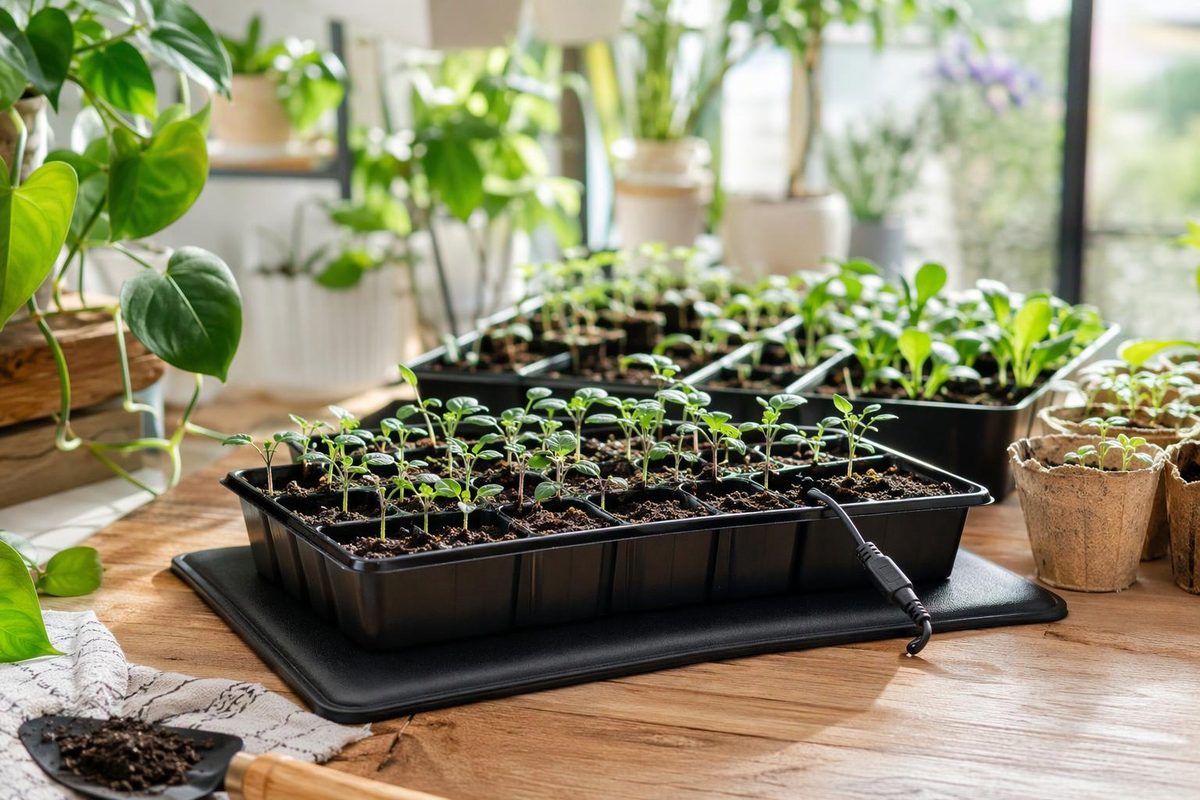
A heat mat for seed starting is useful when the growing mix is cooler than your seeds’ germination requirements. It is not a necessary purchase for every indoor setup. Before buying one, measure the temperature in a filled, moist container where you intend to sow—especially during the coolest part of the night.
Measure the mix, not just the room: University of Minnesota Extension notes that potting mix in indoor containers can be as much as 5°F cooler than the surrounding air. Its indoor seed-starting guide explains how bottom heat can help.
Which seeds benefit?
Tomatoes and peppers are good candidates for bottom heat in a cool room. Cool-season crops such as broccoli, cabbage and spinach may not need it. Utah State University Extension gives 65–75°F as a useful germination range for many plants, while noting that those cool-season crops prefer 55–65°F. These are broad starting points, not one thermostat setting for every packet; follow crop- and variety-specific instructions when available. USU’s germination guide recommends a thermostat to prevent overheating.
Keep seeds with different temperature requirements in separate pots or removable cell packs. That lets you warm one batch without heating everything on the shelf—and remove early sprouters without waiting for slower seeds.
Choose by tray fit and temperature control
For a small home setup, prioritize these features over a large mat or a high advertised maximum temperature:
- Tray coverage. Measure your trays and check the manufacturer’s stated fit. For example, VIVOSUN lists a 10 × 20.75-inch mat for one standard 1020 tray and a 20 × 20.75-inch mat for two side by side. Cell count alone does not tell you which mat fits. Its sizing guide also lists compatibility checks.
- A thermostat with a probe. Check whether it is included or sold separately. Choose a controller whose voltage, plug and rated load match the mat; several connected mats must stay within its total wattage limit.
- Clear operating instructions. Buy equipment intended for seed starting, with instructions for placement and use around water. A “waterproof” label does not mean plugs and controllers can get wet or that the mat can be submerged.
An unregulated mat does not hold one exact soil temperature. Hydrofarm’s instructions describe its mats as raising the root zone approximately 10–20°F above ambient air temperature. That also means a mat is not a substitute for a suitable indoor space: an ambitious thermostat setting cannot make it heat beyond its capacity. Hydrofarm’s mat instructions recommend thermostat control.
Set it up at seed depth
- Lay the mat flat on a stable, dry surface, following its manual. Keep sharp objects away. Put the tray on top of the mat—not the mat inside the tray or directly beneath loose growing mix. Do not place insulating materials over the mat; Hydrofarm warns that this can cause overheating. VIVOSUN’s guidance also says not to stack mats.
- Fill containers with premoistened seed-starting mix. Aim for even moisture, not waterlogging. If you use a humidity dome, keep the covered tray out of direct sunlight, which can overheat it.
- Place the thermostat probe in the mix at seed depth, rather than in the air, drainage water or against the mat. Secure its cable so it cannot pull the probe out. This measures the temperature you are trying to control. The manufacturer’s setup guidance specifies probe placement in the growing medium.
- Set the crop’s germination temperature and check the actual reading. A separate soil thermometer can help you spot differences between the center and edges of the tray. If one controller operates several mats, check every tray: its probe measures only the location where you put it.
- Leave temperature control independent of the light timer. Minnesota Extension specifically advises not plugging heat mats into the seedlings’ lighting timer. The thermostat should manage heat overnight as well as during the day.
Check at least daily for emergence, dry patches and equipment problems. Warmth does not remove the need to monitor moisture; drain excess watering water and keep electrical connections dry.
When to take seedlings off the mat
For an ordinary indoor setup, plan to remove bottom heat once most seeds in a batch have emerged. Do not keep established seedlings hot while waiting for the last few cells. Move removable sprouted packs off the mat and leave only the unsprouted batch under germination conditions.
Germination warmth and seedling growing temperatures are different needs. USU’s seedling-care guide advises removing or unplugging heat pads when conditions are too warm and warns that excessive warmth can produce spindly growth. If the room remains cold, measure conditions and adjust heat rather than treating removal as an absolute rule.
Have your seedling grow light ready when shoots appear. If the mix is already within the crop’s temperature range but nothing emerges, check moisture, sowing depth and seed quality before turning the thermostat higher.