
Grow Light for Seed Starting: Choose One That Fits Your Trays
Choose a grow light for seed starting by tray coverage, fixture type and adjustability, then manage a mixed shelf of vegetable and flower seedlings.
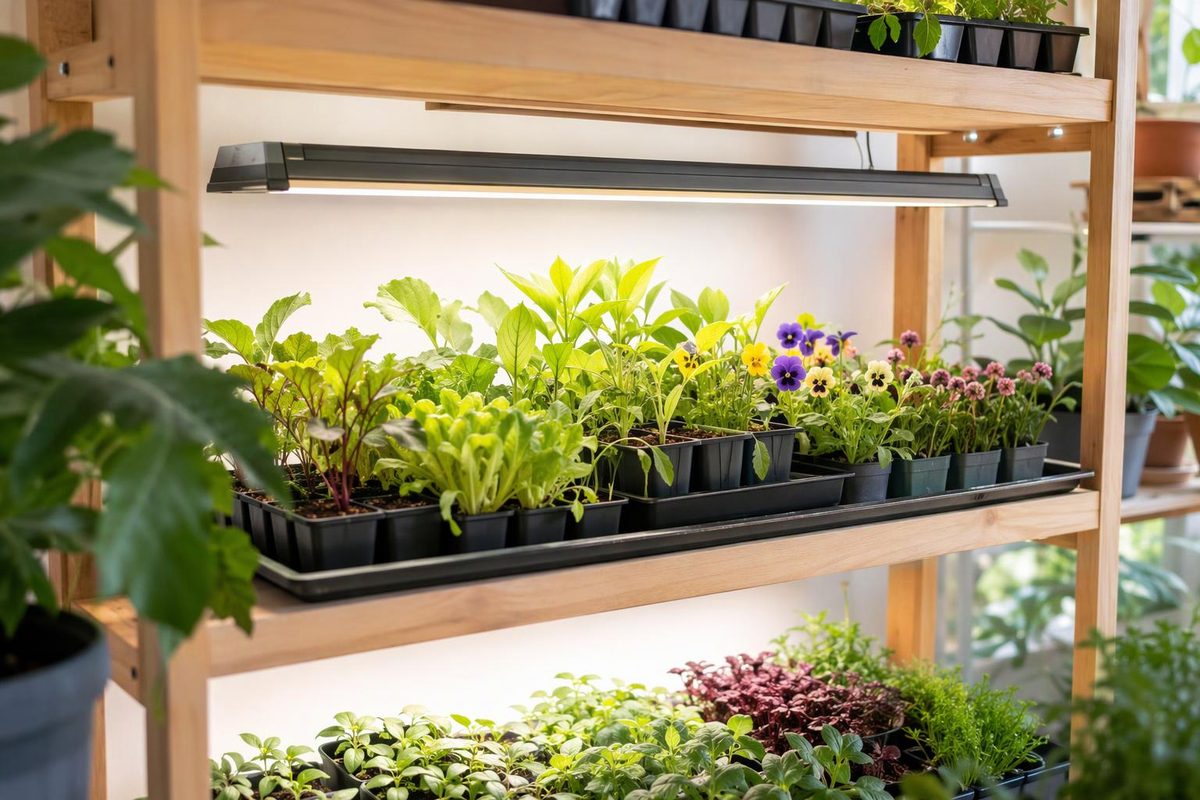
For a shelf of vegetable and flower seedlings, an adjustable white LED bar fixture is a practical first choice. An existing fluorescent shop light can also work. The important question is not whether the box says “grow light,” but whether the fixture delivers enough light across all your plants. Minnesota Extension identifies white or balanced lights as suitable for most plants at any growth stage; Utah State Extension says inexpensive fluorescent shop lights can grow vegetable seedlings. Minnesota lighting guide · Utah State seedling guide
Size the light for plants, not seed packets
Before shopping, arrange your trays where they will grow and measure their combined length and width. Then make a second arrangement using the larger pots you expect to need before transplanting outdoors.
For example, twelve 4-inch-square pots arranged in three rows of four occupy at least 16 × 12 inches, before you leave gaps between them. That is a planning example, not a recommended plant spacing: spreading leaves may need more room. Utah State advises potting up when neighboring leaves begin overlapping or roots form a thick mat at the bottom of their container. When seedlings need more space
Use the larger arrangement as your lighting footprint. A light that covers one crowded sowing tray may not cover the same seedlings once they are separated into pots.
What to compare before buying
| Feature | What to look for |
|---|---|
| Coverage | A stated growing area at a stated hanging height—not just fixture length. Check that it covers the full tray width as well as length. |
| Output information | Prefer PPFD readings across the growing area, including edges, rather than only a bright center reading. |
| Adjustment | Chains or adjustable hangers; dimming is useful if you choose a powerful fixture. |
| Available headroom | Room for pots, growing plants, the recommended lamp-to-leaf gap and the fixture itself. |
| Timer compatibility | A setup that reliably switches on and off without daily attention. |
Watts describe electricity use, not the light arriving at leaves. Lumens describe brightness to human eyes. PPFD describes plant-usable light reaching a surface, so it is more useful for evaluating coverage. The words “full spectrum” alone do not tell you whether the tray edges receive enough light. Minnesota’s explanation of lighting measurements
Shop light or dedicated grow light?
For a shallow shelf, start by comparing bar-style fixtures that fit its shape. Do not assume that every LED shop light has adequate output simply because it looks bright.
- Already own fluorescent shop lights? Try them before replacing them. They are a supported option for vegetable seedling culture. Utah State lighting guidance
- Buying new? LEDs offer long life, energy efficiency and relatively low heat output. Compare coverage and adjustment features, not just the plant label. Minnesota fixture comparison
- Considering a high-output panel? Check its required hanging height against your shelf clearance before buying. More powerful is not automatically more useful in a cramped setup.
Run a mixed seedling shelf without one universal height
Set a timer for 16 hours on and 8 hours off as a practical starting schedule. Iowa State recommends 14–16 hours daily for seedlings. Longer operating time is not a substitute for checking weak or uneven coverage. Iowa State seedling-light setup
Start at the fixture maker’s recommended seedling height. Measure the gap from the highest leaves, not the tray rim. Fluorescent tubes and different LED fixtures need different spacing; do not apply a blanket 2-inch rule to every lamp.
Group similar-height seedlings together. If one tray is much shorter, raise it on stable blocks rather than lowering the light onto taller plants. Iowa State specifically recommends adjustable hangers or removable supports beneath trays. Height adjustment options
Germination light is a separate decision
Have the fixture ready before emergence, but follow each packet’s germination instructions. Not every seed should begin under the same light conditions:
- Petunias need light to germinate: Iowa State advises surface sowing without burying the seed. Petunia germination guidance
- Pansies may call for a dark germination setup: West Coast Seeds recommends darkness until germination, then bright light to keep plants compact. Follow the instructions for your particular seed. Pansy growing instructions
Once seedlings emerge, check each tray rather than waiting for every crop on the shelf to sprout. Utah State recommends adding supplemental lighting after germination if it was not used earlier. Post-emergence lighting
Watch for long, thin stems or leaning, especially at tray edges; check light coverage and crowding. Bleached or scorched leaves beneath the fixture warrant checking excessive light and heat. Slow growth alone does not prove the lamp is too weak—temperature, watering and nutrition also matter. Minnesota light symptoms · Utah State troubleshooting
For measured light targets specifically for tomatoes, see grow lights for tomato seedlings. For sowing schedules and the rest of the setup, use our indoor seed-starting guide.