
Cornflower Seeds: When and How to Sow
Find the right sowing window, planting depth and spacing for annual bachelor’s buttons, plus clear germination and early-care checkpoints.
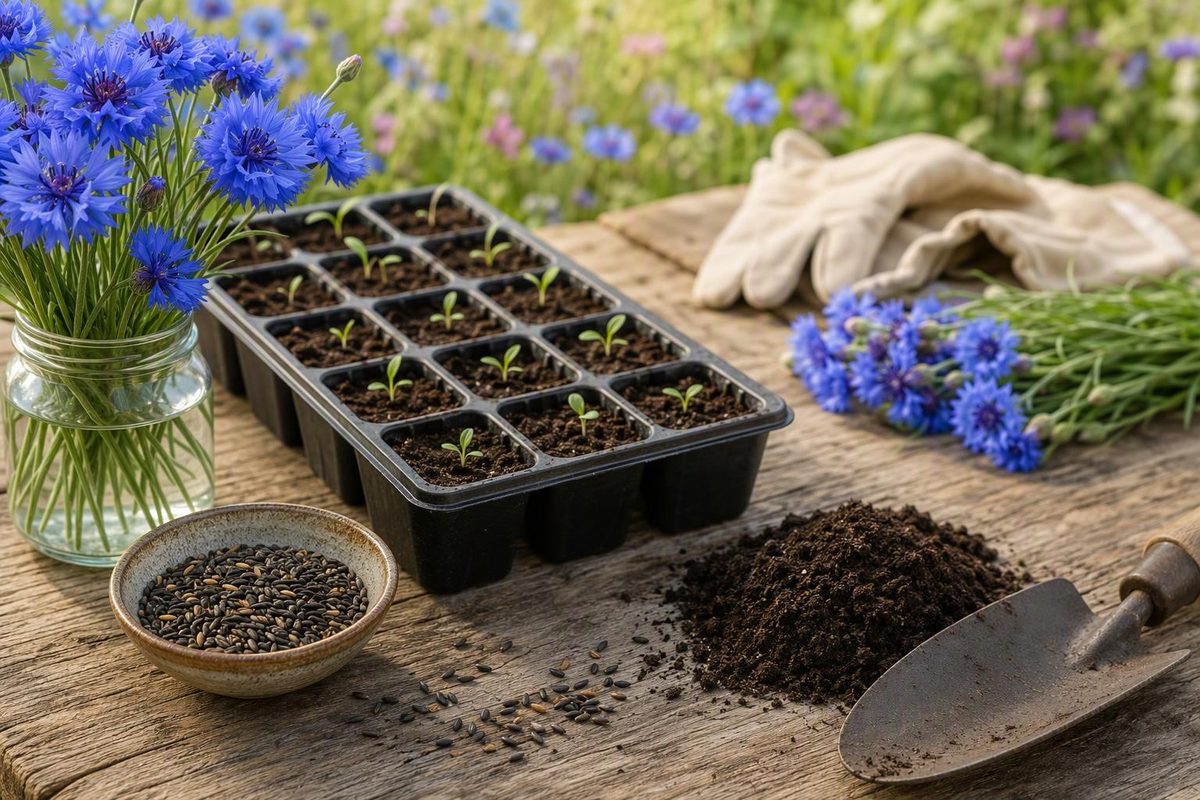
For the familiar blue annual cornflower, buy Centaurea cyanus seeds and direct-sow them in a sunny, well-drained bed during cool weather. Sow 1/4 inch deep around the last spring frost or as soon as the ground is workable, then thin seedlings to 6–9 inches apart. Under the tested temperature range of 60–65°F (16–18°C), germination typically takes 7–14 days.
C. cyanus is also sold as bachelor’s button, with cultivars in blue, pink, red, white and purple. Check the botanical name because “cornflower” can also mean perennial species such as mountain bluet (C. montana) and Persian cornflower (C. dealbata) (Purdue University).
Choose your climate and sowing method; the planner shows the applicable timing, depth and spacing.
Cornflower Sowing Planner
Sow in early spring as soon as the soil is workable.
Use a sunny, well-drained bed. Sow 1/4 inch deep, then thin at the first true leaves to 6–9 inches unless the cultivar packet says otherwise.
| Checkpoint | Guide |
|---|---|
| Depth | 1/4 inch; follow cultivar packet if different |
| Germination | 7–14 days at 60–65°F (16–18°C) |
| Spacing | 6–9 inches practical range |
| Succession | Every 2 weeks in suitable spring weather |
Default shown: direct sowing in a cold-winter climate.
Sources: Johnny’s Selected Seeds, Missouri Botanical Garden and West Coast Seeds; cultivar packet directions take precedence.
Choose The Sowing Window By Climate
Use local frost dates, soil condition and weather patterns rather than a perennial hardiness zone. C. cyanus completes its life cycle in one season, so the immediate growing conditions matter more than the average lowest winter temperature represented by a hardiness zone.
Cold-Winter Climates
Direct-sow in early spring as soon as workable soil is no longer frozen or waterlogged. Do not work a saturated bed merely because the calendar or frost date says it is time. Soil that smears or compresses into a dense clod when handled is not ready.
Sowing around the last spring frost gives the plants cool weather in which to establish. Cornflowers do not need the warm-soil schedule used for heat-loving annuals.
Mild-Winter Climates
Fall sowing is an option where seedlings can overwinter. Missouri Botanical Garden specifically limits this advice to mild-winter areas, so it should not be treated as a general recommendation for every climate (Missouri Botanical Garden).
If local winters regularly kill young cornflower plants, use the early-spring window instead. A packet sold nationally may not account for the winter conditions in a particular garden.
Hot-Summer Climates
Sow early enough for the plants to establish in cool weather. Waiting until the soil has warmed for summer annuals shortens the period before heat arrives.
For a longer flowering period, divide the packet and make additional small sowings every two weeks through spring while conditions remain suitable. This interval comes from West Coast Seeds; in a short or rapidly warming spring, later batches may have less cool weather in which to establish (West Coast Seeds).
Direct-Sow Cornflower Seeds 1/4 Inch Deep
Prepare an open site in full sun. Remove weeds, break the surface into small crumbs and level it. Cornflowers tolerate relatively poor soil, but the bed should drain rather than remain wet.
Make a shallow drill. Johnny’s Selected Seeds specifies a depth of 1/4 inch, while an RHS garden method uses 12 mm, nearly 1/2 inch. Instructions for a named cultivar take precedence; if the packet gives none, use 1/4 inch and cover the seed completely rather than leaving it exposed (Johnny’s Selected Seeds, RHS).
Sow thinly along the drill. Johnny’s uses six seeds per foot of row. Dropping the entire packet into a short stretch creates unnecessary competition and more thinning work.
Cover the seeds and water gently with a fine rose or gentle spray. The goal is to settle the soil without washing shallow seeds out of the row. Keep the seed zone evenly damp, not saturated, until emergence.
Mark the row. Young cornflowers have narrow, slightly hairy leaves and can otherwise be pulled as weeds.
Thin when the seedlings develop their first true leaves. Johnny’s recommends 6–9 inches between direct-sown plants; West Coast Seeds gives 6–12 inches. Follow the packet when it specifies spacing for a dwarf or unusually tall cultivar. Without cultivar-specific directions, 6–9 inches is a practical range.
Do not wait until crowded seedlings are large and intertwined. When thinning, keep the strongest well-positioned plant at the chosen interval and remove its competitors without disturbing its roots. Snipping unwanted seedlings at soil level can cause less disruption than pulling them from a dense cluster.
Expect Germination In 7–14 Days Under Tested Conditions
Johnny’s reports germination in 7–14 days at 60–65°F (16–18°C). This is a conditions-based checkpoint, not a promise that every outdoor sowing will emerge within two weeks. Colder soil can extend the wait.
Check the top 1/4 inch daily while the seeds germinate. Water when it begins to dry, but pause if the soil already feels wet. Constant saturation conflicts with the plant’s need for drainage and can damage seed or seedlings.
Emergence may be staggered along the row. Do not assume the remaining seeds have failed as soon as the first seedlings appear.
If nothing has emerged after 14 days and the seed zone has stayed near 60–65°F, inspect a few places before sowing again. Look for seeds exposed by rain or watering, a crust over the row, or persistently saturated soil. Correct the visible problem before resowing.
If the bed has been colder than the tested range, allow more time instead of treating day 14 as failure. The draft sources do not give a separate germination duration for colder outdoor soil.
Start Indoors Only When The Bed Will Not Be Ready
Direct sowing is usually simpler because cornflowers can establish where they will flower. Indoor sowing is useful when the bed will not be workable in early spring or when precise plant placement matters.
Johnny’s recommends starting seeds 3–4 weeks before planting out. Sow them 1/4 inch deep in a free-draining seed-starting mix, keep them near the stated germination range, and place them in strong light as soon as they emerge.
Move seedlings to cells or larger containers when the first true leaves appear. Johnny’s recommends cool nights of 50–55°F (10–12°C) while the transplants develop a root ball. Cornflowers do not require tomato-like warmth after germination.
Harden the seedlings gradually before planting them outside, using the sequence in the indoor seed-starting guide. Set them at the spacing stated on the cultivar packet or use the same 6–9-inch practical range applied to direct-sown plants.
Full Sun And Drainage Reduce Early Problems
Keep young plants watered while their roots establish, but do not maintain a persistently wet bed. The shallow seed zone needs consistent moisture during germination; established plants need drainage. Those instructions describe different growth stages and are not contradictory.
Full sun is the better position for upright growth. Both NC State Extension and Missouri Botanical Garden note that stems can flop in excessive shade, while tall plants may still benefit from nearby support or staking (NC State Extension).
For cut flowers, harvest blooms when they are about one-quarter to one-half open. Deadhead spent flowers to extend the display and limit self-seeding. If saving seed, leave only selected heads to mature and dry.
Check Local Guidance Before Allowing Seed To Spread
C. cyanus has escaped cultivation and naturalized across much of the United States and southern Canada. Its legal and advisory status varies by location, so a rule from one state does not establish its status elsewhere.
Washington, for example, places bachelor’s button on a monitor list but explicitly says it is not a listed noxious weed in that state (Washington State Noxious Weed Control Board). Check current state or provincial guidance before sowing near a natural area.
In a managed garden bed, remove flower heads before their seeds mature if you do not want volunteers. To save seed without encouraging broad dispersal, select a limited number of heads and collect them once they mature and dry.