
Measure the Soil Before Resowing Fall Lettuce
Measure the seed zone before resowing fall lettuce. See how heat changes germination, then decide whether to wait, shade, or start indoors.
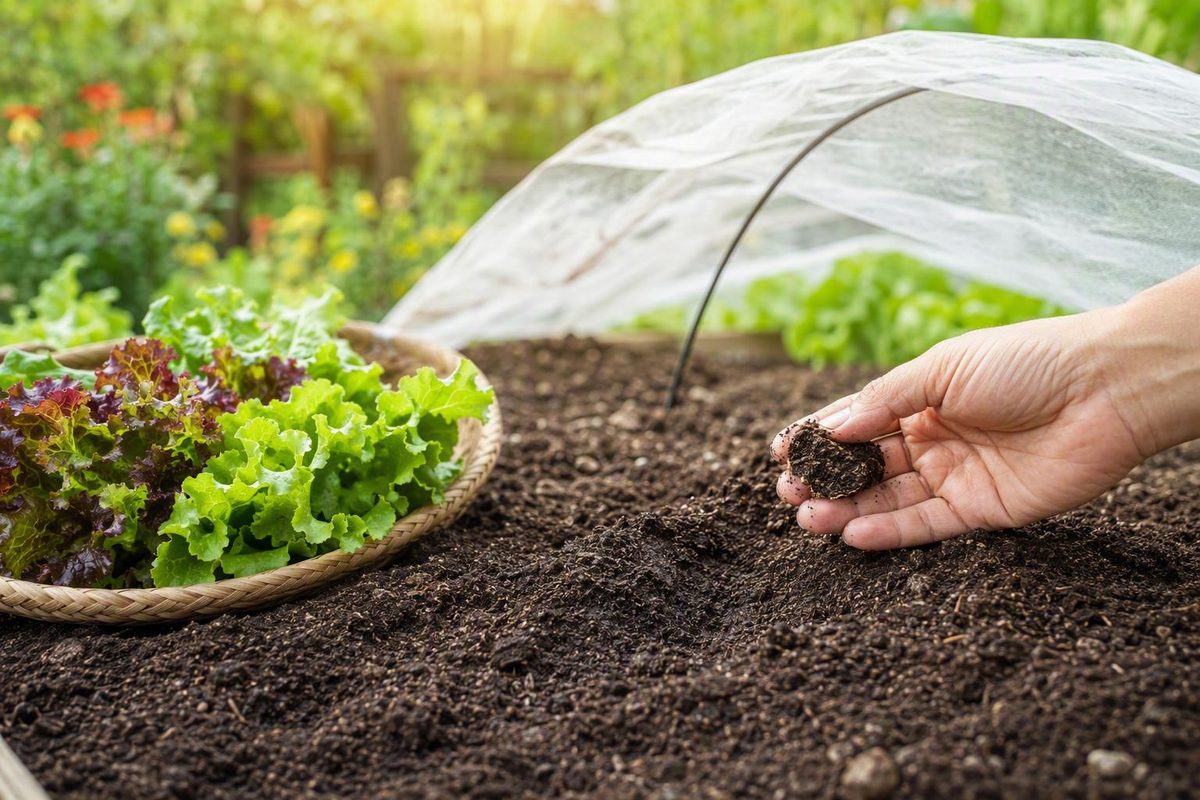
Lettuce seed is probably not the problem when a late-summer row fails in hot soil: controlled trials found 99% germination at 77°F, 12% at 86°F, and 0% at 95°F. In a heat-wave year, a $10 soil thermometer is more useful than a calendar because the sowing date should follow seed-zone temperature, not simply a countback from first frost. The comparative germination table shows the sharp decline above 77°F.
The Calendar Rule Is Useful Until Summer Heat Lingers
The standard advice is reasonable: count back roughly six to eight weeks from the first expected frost, then sow fall lettuce and spinach in mid-to-late August. When a row stays empty, check seed age, watering, planting depth, crusting, and disturbance.
That advice works when historical planting dates still coincide with suitable soil conditions. It is also right that an empty row does not prove heat injury. Shallow seed can dry, seed can be buried or displaced, and seedlings can emerge and disappear between garden checks.
The problem is treating the calendar as evidence that the soil must be ready. The 2026 North American heat wave began in late June, and Philadelphia recorded its first three consecutive days above 101°F. Another near-record heat wave extended from the Southwest toward the East Coast during the week of August 29, directly overlapping customary fall-sowing windows. These regional reports cannot diagnose a particular bed, but they make measuring that bed more necessary. The 2026 heat wave affected multiple regions beginning in June, and near-record heat returned during the late-August sowing window.
A weather app reports air temperature, not the temperature around a seed. Bare surface soil in direct afternoon sun can remain substantially warmer than comfortable evening air. Because lettuce is sown close to the surface, a reading several inches down can also miss the conditions that matter.
Choose a crop, enter the measured seed-zone temperature and packet size, then compare direct sowing with waiting or starting indoors.
The estimate uses linear interpolation between the nearest temperatures in the cited germination trial. Outdoor results vary with cultivar, moisture, depth and daily temperature swings.
| Crop | Soil Temperature | Normal Seedlings |
|---|---|---|
| Lettuce | 32°F | 0% |
| Lettuce | 41°F | 98% |
| Lettuce | 50°F | 98% |
| Lettuce | 59°F | 98% |
| Lettuce | 68°F | 99% |
| Lettuce | 77°F | 99% |
| Lettuce | 86°F | 12% |
| Lettuce | 95°F | 0% |
| Lettuce | 104°F | 0% |
| Spinach | 32°F | 0% |
| Spinach | 41°F | 83% |
| Spinach | 50°F | 91% |
| Spinach | 59°F | 82% |
| Spinach | 68°F | 52% |
| Spinach | 77°F | 28% |
| Spinach | 86°F | 32% |
| Spinach | 95°F | 0% |
| Spinach | 104°F | 0% |
| Carrot | 32°F | 0% |
| Carrot | 41°F | 0% |
| Carrot | 50°F | 61% |
| Carrot | 59°F | 93% |
| Carrot | 68°F | 96% |
| Carrot | 77°F | 96% |
| Carrot | 86°F | 95% |
| Carrot | 95°F | 0% |
| Carrot | 104°F | 0% |
| Onion | 32°F | 0% |
| Onion | 41°F | 70% |
| Onion | 50°F | 99% |
| Onion | 59°F | 99% |
| Onion | 68°F | 98% |
| Onion | 77°F | 90% |
| Onion | 86°F | 73% |
| Onion | 95°F | 2% |
| Onion | 104°F | 0% |
Source: J. F. Harrington vegetable-seed germination table reproduced by Tom Clothier and in the government-hosted Soil Temperature Conditions for Vegetable Seed Germination sheet. Values between tested temperatures are estimates marked ~.
Measure the Shallow Seed Zone Twice a Day
Place a soil thermometer at approximately the depth where the lettuce seed sits. If the seed was barely covered, measure that shallow layer rather than pushing the probe several inches into the bed.
Take a late-afternoon reading when a sunny bed is likely to be warmest, then take another in the early morning or another cooler period. Use the same location and approximate depth. Record the time, moisture condition, direct sun, shade, rain, and irrigation so unlike readings are not casually compared.
This is practical home monitoring, not a formal soil-sampling protocol. Its purpose is to establish whether the seed zone remains hot, stays cold, or swings widely during the day.
Oregon State University Extension lists 40–80°F as lettuce’s optimum germination range and 75°F as the optimum temperature. Its experimental table reports little or no germination at 95°F and 104°F. Those are reference points rather than universal cutoffs for every cultivar and garden. In particular, describing 95°F as a “maximum” does not mean germination there is reliably successful. OSU publishes the temperature and emergence tables.
A government-hosted version of the data, attributed to J. F. Harrington of the University of California, Davis, likewise lists a 40–80°F optimum range, a 75°F optimum, and little or no lettuce germination at 95°F. It says nightly fluctuation to 60°F or below is essential, although the document provides too little context to apply that as a universal requirement for every variety and planting method. The reference sheet also lists 95°F as lettuce’s absolute maximum and 85°F as spinach’s maximum.
Readings within roughly 40–80°F make heat alone a less persuasive diagnosis. Repeated upper-80s readings warrant concern. Measurements approaching 95°F align with little or no germination in the cited trials. Cultivar, moisture, daily fluctuation, and field conditions can still change the result.
Germination Speed Does Not Reveal Germination Percentage
Temperature changes both how long emergence takes and how many seeds produce normal seedlings. Those are separate measurements.
In the OSU experiment, lettuce planted one-half inch deep had these approximate emergence times:
| Soil Temperature | Seedling Appearance |
|---|---|
| 41°F | 15 days |
| 50°F | 7 days |
| 59°F | 4 days |
| 68°F | 3 days |
| 77°F | 2 days |
| 86°F | 2 days |
These are experimental observations, not deadlines for every cultivar or outdoor bed. Depth, soil structure, moisture, seed condition, and fluctuating temperatures can alter the result.
The 86°F figure demonstrates why speed can mislead. The few successful seedlings may appear in about two days even though the comparative trial produced only 12% normal seedlings at that temperature. Quick emergence among survivors does not mean the packet performed well.
A gardener who has waited one week at 41°F may be giving up too soon because the experiment recorded about 15 days to appearance. At a moderate temperature, an empty row well beyond the corresponding interval deserves closer inspection. At very high temperatures, waiting longer without changing the seedbed may simply expose the remaining seed to the same suppressive conditions.
Moisture and Depth Still Matter in Suitable Soil
If measurements do not support heat as the main explanation, inspect the shallow seed zone. Lettuce seed is small, and the surface can dry while soil farther down still feels damp. Watering every morning does not establish that the seed remained evenly moist through a sunny or windy afternoon.
Saturation also warrants investigation, although the cited evidence does not establish a lettuce-specific waterlogging threshold. Wet soil is a clue, not an automatic diagnosis.
Open only a few small sections with a fingertip, plant label, or small spoon. Look for deep burial, a hard crust, channels from rain or overhead watering, displaced soil, compacted patches, bird scratches, and paw prints. Recovered seed must be interpreted cautiously:
- Swollen but intact seed absorbed water, but its appearance does not identify what stopped development.
- Soft or decaying seed does not establish whether decay began before or after environmental damage.
- Missing seed may have washed away, been disturbed, germinated and decomposed, or been eaten.
Depth recommendations vary from surface sowing or barely covering the seed to approximately one-quarter inch, while the temperature experiment used one-half inch. The defensible general approach is shallow sowing with a light covering unless the cultivar packet gives a clearer instruction. Commercial guidance likewise recommends keeping the seedbed moist and using a covering no thicker than the seeds, but that is practical guidance rather than a universal depth rule. Harris Seeds describes its shallow-sowing method here.
Do not add more seed to a row that is still hot, dry, deeply buried, or crusted. Correct the observed condition first, then make a small comparison sowing.
An Empty Row May Have Emerged and Vanished
Failed germination and failed establishment look alike after the seedlings disappear. Search closely for dried seedlings against the soil, pale or brown seed leaves, broken stems, trapped seedlings beneath a thin crust, or uneven gaps accompanied by scratched soil.
Bolting and bitter leaves are later heat effects. Neither explains seed that never produced a visible seedling.
If repeated sowings appear and then vanish, protect a small comparison patch with a non-opaque screen that allows light and airflow. A successful protected patch makes disturbance more plausible but does not prove it was the only cause; the cover may also have changed temperature or moisture retention.
An Indoor Sample Separates Seed Viability From Bed Conditions
Test a counted portion of the packet on a clean, consistently moist paper towel under moderate, stable indoor conditions. Keep the seeds moist without submerging them, check regularly, and record how many sprout.
This is not a certified test, and the supplied evidence does not give an authoritative lettuce-specific stopping point for this home method. A short test cannot prove the packet dead.
If the indoor sample sprouts while the outdoor row remains empty, temperature, moisture, depth, crusting, or disturbance in the bed becomes more plausible. If neither sample sprouts, poor viability becomes more plausible, but unsuitable test conditions remain possible. A weak or slow indoor result can reflect either the seed lot or the home setup.
Keep the packet and cultivar name. Varieties can respond differently to warm germination conditions. A description of warm-germination tolerance is useful when choosing seed for an early fall sowing, but no cultivar should be assumed immune to extreme seed-zone heat.
Hot Soil Calls for a Different Sowing Environment
When repeated readings show that the shallow soil remains very warm, wait for cooler weather, move germination indoors, or alter a small test area before risking the packet.
Light afternoon shade can reduce direct solar heating and slow surface drying. A cooler nursery bed with morning sun and afternoon shade may be more stable than an exposed production bed. Evening sowing gives seed a cooler initial period, while moistening the bed with cool water can moderate the immediate seed zone without saturating it.
Growers also use boards, burlap, or similar temporary covers to cool the surface and retain moisture. Remove an opaque cover promptly when seedlings emerge because it blocks needed light and airflow. Continue measuring beneath any cover; an intervention is not useful if the seed zone remains too hot.
A split sowing provides better evidence than changing everything at once. Put equal portions of the same seed in the original location and under light afternoon shade. Use comparable depth and watering, measure both seed zones, and record emergence separately. Better performance in shade strengthens the heat explanation, although improved moisture retention may also contribute.
Starting a small batch indoors moves germination out of the hot bed. Indoor success does not prove heat caused the first failure, but it preserves the planting window while outdoor measurements show when the bed becomes suitable.
Let the Measurement Choose the Next Step
When the seed zone is cool and the corresponding experimental interval has not passed, maintain even moisture and keep monitoring. At 41°F, that may mean allowing roughly 15 days rather than declaring failure after a week.
When the soil is moderate and the reference interval has passed, inspect moisture, depth, crusting, displaced seed, and evidence of vanished seedlings. Compare a counted indoor sample if viability remains uncertain.
When the soil is in the upper 80s or approaching 95°F, change the environment before resowing. Waiting, shading a trial area, using a cooler nursery site, or starting indoors is more defensible than repeating the same calendar-driven sowing in the same hot row.
The thesis has a defined scope: soil temperature does not explain every empty lettuce row. It does explain why viable seed can fail outdoors during a late-summer heat wave yet germinate well under moderate indoor conditions. Measure first, then reserve enough seed for a controlled comparison instead of sacrificing the packet to an unmeasured bed.