Is This Narrow Eastern White Pine a Good Fit for Your Landscape?
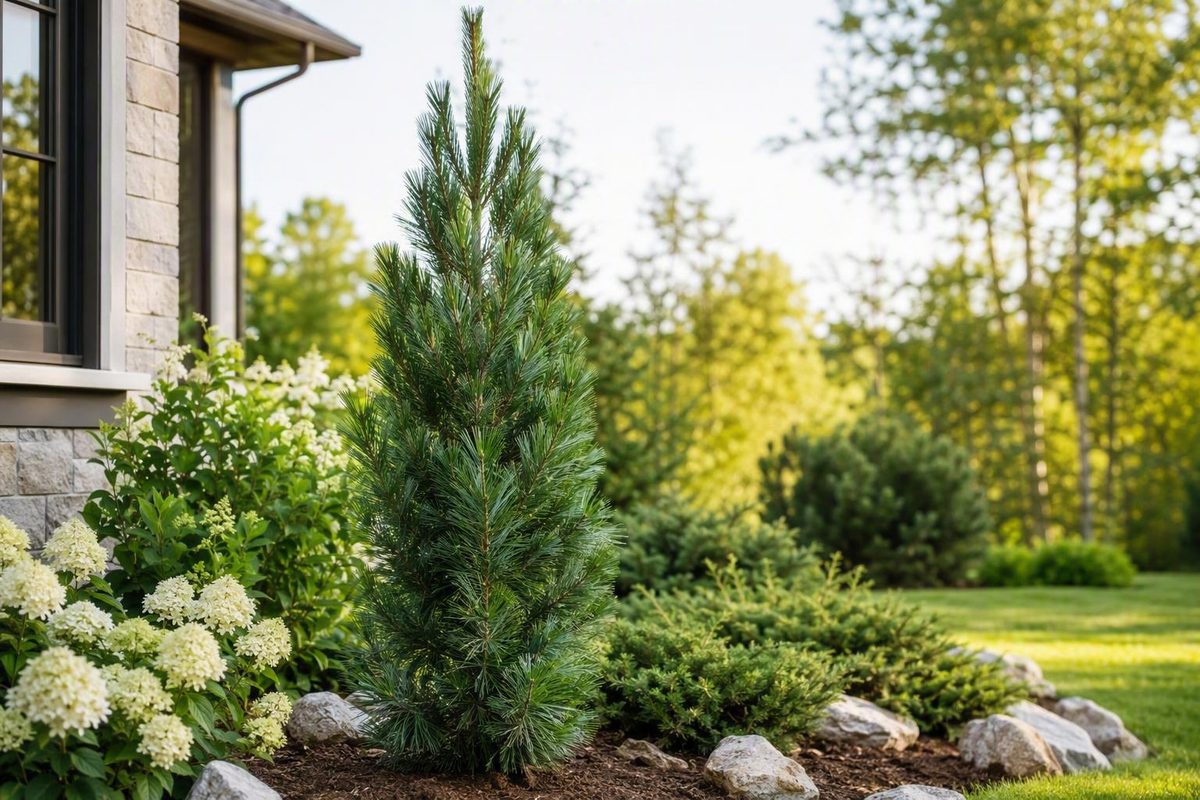
Stowe Pillar white pine is easy to underestimate. A young tree may look slim enough for a tight foundation bed, yet published descriptions range from an approximately 8-by-2-foot tree after 10 years to an eventual specimen several stories tall and as much as 10 feet wide. These figures are not necessarily contradictory: some describe growth at a particular age, while others attempt to predict longer-term landscape size.
The practical question is not simply whether Stowe Pillar is narrow. It is whether your site can support a narrow but potentially medium-height to tall evergreen tree.
This cultivar is most promising where soft-textured evergreen height is wanted in full sun, acidic well-drained soil, and a relatively sheltered position. It is less convincing where the design depends on a permanent two-foot width, deep shade, wet ground, roadside salt exposure, or guaranteed resistance to snow and ice.
Evidence note: Most cultivar-specific dimensions, hardiness ratings, and performance claims available to buyers come from nursery profiles. Long-term independent trials reconciling those claims were not included in the available evidence. This guide therefore compares published estimates rather than presenting any one specification as universally correct.
Stowe Pillar at a glance
Stowe Pillar is Pinus strobus ‘Stowe Pillar’, a selected cultivar of eastern white pine. Instead of developing the broad outline associated with the species, it grows with strong vertical emphasis. Its branches ascend close to the trunk, creating a dense, narrowly upright or columnar crown.
The foliage retains the soft texture associated with eastern white pine. Needles are generally described as green, blue-green, or silvery blue-green and occur in bundles of five. Some nursery profiles also report creamy-white new growth in spring that later darkens to blue-green.
Its principal landscape advantage is not miniature size. It is the ability to provide evergreen height within a substantially smaller footprint than the broad species form. That makes it relevant to entrances, narrow beds, compact gardens, mixed conifer plantings, and screens where a conventional eastern white pine would occupy too much ground.
Quick facts
- Botanical name: Pinus strobus ‘Stowe Pillar’
- Plant type: Narrow, upright cultivar of eastern white pine
- Reported 10-year size: Approximately 8–12 feet tall, with width estimates ranging from about 2 feet to roughly one-third of the height, according to the American Conifer Society cultivar profile
- Conservative planning range: Roughly 20–35 feet tall and 6–10 feet wide; one nursery guide instead lists about 20 by 6 feet in the landscape
- Reported annual growth: Approximately 9–12 inches, around 12 inches, or 15 inches or more, depending on the source
- Commonly published hardiness: USDA zones 3–7 or 3–8, with some narrower or minimum-zone listings
- Preferred light: Full sun
- Core soil requirement: Acidic and well drained, without standing water
- Important limitations: Shade, alkaline soil, saturated roots, wind exposure, road salt, crowding, and heavy snow or ice may affect performance
The narrow habit is well established across the supplied specialist and nursery descriptions. The uncertain points are how large the tree ultimately becomes, how consistently it maintains its shape in different climates, and how much pruning or winter maintenance an individual specimen may need.
How tall and wide does Stowe Pillar actually get?
No single published number adequately describes Stowe Pillar white pine. The frequently repeated 8-by-2-foot estimate is explicitly tied to a 10-year horizon. It should not be read as the tree’s final size.
The most useful comparison separates age-specific measurements from unspecified “garden,” “landscape,” or eventual dimensions:
| Named source | Measurement horizon | Reported height | Reported width | Reported growth rate |
|---|---|---|---|---|
| Conifer Kingdom | After 10 years | About 8 feet | About 2 feet | 9–12 inches per year |
| American Conifer Society | After 10 years | About 8–12 feet | About one-third of height | Around 12 inches per year |
| Gertens Plant Finder | Mature landscape size, age unspecified | About 20 feet | About 6 feet | Described as slow |
| Iseli Nursery | Garden size, age unspecified | About 25 feet | About 6 feet | 15 inches or more per year |
| Bower & Branch | Mature size, age unspecified | About 25–35 feet | About 6–10 feet | Not specified |
| Gertens Garden Center | Eventual size, age unspecified | About 25–50 feet | Not clearly established | Described as slow |
The 25–50-foot figure is a larger outlier, not a settled prediction for every specimen. Even without relying on that upper extreme, the table shows why the 10-year measurements cannot safely be treated as final dimensions.
Several factors may contribute to the discrepancies:
- Different measurement horizons: A 10-year estimate is not equivalent to eventual size.
- Inconsistent use of “mature”: The term may mean a typical landscape size after several decades or an unspecified long-term estimate.
- Climate and growing season: Growth can differ among regions.
- Site conditions: Light, drainage, soil, moisture, and competition can affect vigor.
- Age: A single annual rate should not be projected mechanically throughout the tree’s life.
- Pruning: A managed specimen may differ from one allowed to grow naturally.
- Shared nursery material: Similar wording across sellers does not necessarily represent independent confirmation.
The supplied sources do not resolve these differences. That uncertainty should shape the planting decision.
Where a wall, eave, walkway, fence, utility line, or neighboring tree leaves little margin for error, a practical planning allowance is roughly 20–35 feet of height and 6–10 feet of width. This is not a prediction that every tree will fill that envelope. It is a conservative synthesis of the more substantial landscape-size estimates in the table.
Width must also be considered radially. A projected 6-foot spread places the branch tips roughly 3 feet from the trunk in each direction. A 10-foot spread may extend about 5 feet on either side. A young tree planted 18 inches from a wall does not have adequate long-term clearance merely because it is currently two feet wide.
Height deserves equal attention. Stowe Pillar should not be treated as a compact foundation shrub or placed where overhead clearance is limited.
The safest interpretation is straightforward: 8 by 2 feet describes one possible stage, not the finished tree.
Use a site-fit checklist before buying
Stowe Pillar’s narrow form cannot compensate for an unsuitable growing site. Before comparing prices or specimen sizes, determine whether the proposed location supplies adequate light, drainage, soil conditions, clearance, and shelter.
Favor full sun
Full sun is the most consistent recommendation across the supplied profiles. It is also the safer choice when the design depends on dense foliage and a clearly defined upright outline.
Some sellers list partial shade as acceptable, but the evidence does not establish that trees grown there remain as dense or symmetrical as those in full sun. Mild temporary shade is also different from a position beneath an established canopy.
Nearby trees can create two overlapping problems:
- Canopy competition: Existing branches may reduce direct light for much of the day.
- Root competition: Established roots may compete for moisture and usable soil volume.
An Ask Extension discussion of Stowe Pillar emphasized mature spacing and future shade in a proposed planting between a silver maple and blue spruce. The responder disclosed having no direct experience with the cultivar, so the answer is best used as a site-planning example rather than a cultivar trial.
Watch the proposed position throughout the day. Note when direct sun reaches it and how the pattern changes after nearby deciduous trees leaf out.
Require drainage and favor acidic soil
Recurring nursery guidance calls for acidic, well-drained soil. Some descriptions say the tree tolerates conditions ranging from dry to moist, but that does not mean it tolerates standing water or consistently saturated roots.
Inspect the site after sustained rain. Water remaining around the planting position, a persistently waterlogged bed, or runoff directed from a roof or paved surface should be treated as warning signs.
Several profiles also warn that alkaline soil may produce chlorosis, visible as abnormal foliage yellowing. The evidence does not establish a precise cultivar-specific pH threshold or a universal treatment. If alkaline soil is common in your area—or nearby acid-preferring plants repeatedly yellow—investigate the soil before buying.
Wasco Nursery’s profile combines several of these cautions, recommending full sun and well-drained soil while warning about saturated roots, road salt, heavy wet snow, ice, and air pollution. These remain nursery-provided performance warnings, not results from a controlled comparative trial.
Consider hardiness locally
Published hardiness information is inconsistent. Zones 3–7 and 3–8 appear in retailer listings, while other pages provide only a minimum zone, a local rating such as 3b, or hardiness “through” a particular zone.
Do not select whichever range is most convenient. Confirm regional performance with a local extension office, arboretum, experienced landscape professional, or nursery that has observed established specimens nearby. A zone number alone does not address wind exposure, soil drainage, snow and ice patterns, or de-icing salt.
Pre-purchase site checklist
Use this checklist at the actual planting location:
- [ ] Daily sun: Does the site receive substantial direct sun during the growing season?
- [ ] Drainage: Does water drain after rain rather than pooling around the root zone?
- [ ] Soil acidity: Is the soil likely to be acidic enough to avoid recurring chlorosis?
- [ ] Mature width: Is there room for the conservative planning spread without branches pressing against structures or paths?
- [ ] Mature height: Is there unobstructed overhead room for a medium-height to tall tree?
- [ ] Nearby canopies: Will surrounding trees cast more shade as they expand?
- [ ] Root competition: Is the site already occupied by dense roots from established trees?
- [ ] Wind: Is the position protected from persistent or funnelled winds?
- [ ] Road salt: Can plows, traffic, or de-icing operations throw salty water or spray onto the tree?
- [ ] Snow and ice: Does the site receive roof dumps, drifting snow, or repeated heavy ice accumulation?
- [ ] Regional experience: Can a knowledgeable local source confirm satisfactory performance nearby?
One unfavorable answer does not always eliminate the tree. Several combined problems—such as partial shade, strong root competition, and wet alkaline soil—suggest that the site is asking the cultivar to overcome too many limitations.
Where the narrow form works—and where it does not
Stowe Pillar works best where its vertical line serves a clear purpose. Suitable roles described across the available profiles include:
- A single evergreen accent in a narrow but adequately sized bed
- A feature near an entrance or foundation corner
- A specimen in a compact yard with sufficient overhead room
- A narrow element in a mixed conifer planting
- A soft-textured alternative to more rigid-looking columnar evergreens
- A slim screen where height matters more than immediate solid mass
The phrase to remember is narrow tree, not small tree.
As a single specimen
Near a building, lay out the site according to the larger credible width, particularly where branches cannot be allowed to reach a wall, window, eave, path, fence, or neighboring property.
One useful visualization is to mark both a smaller and larger planning circle around the proposed trunk. Look at what falls within those outlines. If the larger footprint blocks a walk, presses into the façade, or engulfs adjacent shrubs, move the planting point or choose a smaller plant.
At a foundation corner, do not measure only from the trunk to the nearest wall. Account for expansion in every direction and leave access for building maintenance.
As a matched entrance pair
A pair can create a strong formal entrance, but each tree requires room on both sides of its trunk. Young specimens placed tightly against a doorway may look properly scaled at installation and crowded later.
Check clearance from:
- The façade and roofline
- Steps, railings, and handrails
- Doors and visitor movement
- Walkways and snow-clearing routes
- Exterior lights, gutters, and fixtures
- The neighboring tree in the pair
Inspect both specimens before buying. Two plants carrying the same label may not have identical leaders, density, or branch distribution.
As a screen
Screen spacing involves a tradeoff:
- Closer spacing may create visual coverage sooner but can increase crown overlap, competition, and eventual crowding.
- Wider spacing preserves the individual columnar outlines but leaves visible gaps longer.
- Staggered planting can add depth where sufficient bed width exists, but it increases the total footprint.
Because Stowe Pillar is narrow, it may create a sequence of vertical barriers without quickly forming the solid mass of a broad evergreen hedge. That is useful when the goal is filtered screening or architectural rhythm. It is a drawback when immediate, opaque coverage is essential.
Base spacing on the desired long-term effect and local growth experience—not simply on how many young trees fit into the present gap.
Near utilities and power lines
Do not place Stowe Pillar where its expected height will conflict with overhead lines or structures. One retailer describes the cultivar as suitable beneath power lines, but that suggestion conflicts with the same body of published size estimates summarized above.
Before digging, identify underground utilities and other features that must remain accessible. If the proposed site involves utility corridors or uncertain clearances, consult the relevant utility or site professional.
In a container
Several nurseries promote young Stowe Pillar trees for patios, balconies, or entrance containers. That establishes container use as a marketed application, not permanent suitability.
The available evidence does not establish:
- The root volume required by an older specimen
- Long-term irrigation requirements
- Necessary winter protection in different climates
- A repotting or root-management schedule
- How long the plant can remain healthy in a restricted volume
- Whether a particular balcony or elevated surface can accommodate the installation
Container use is therefore best treated as temporary or conditional unless a knowledgeable local grower provides a credible long-term plan. Do not assume that the original nursery pot will remain suitable indefinitely.
Planting, watering, and establishment priorities
Successful establishment starts with site selection. Choose a full-sun position with acidic, well-drained soil and avoid locations where water remains around the roots.
Young plants need regular watering during establishment. This must be distinguished from seller claims that established specimens tolerate some dry conditions.
One seller recommends approximately 1 inch of water per week, but that is general nursery guidance rather than a validated cultivar-specific schedule. Another retailer advises regular establishment watering, later irrigation during drought, and mulch to help manage soil moisture; its care recommendations remain seller guidance.
Use a responsive approach rather than watering mechanically:
- Check the root ball and immediately surrounding soil.
- Water enough to moisten the occupied root zone.
- Allow excess water to drain rather than keeping the soil saturated.
- Check more frequently during hot, dry, or windy conditions.
- Reduce supplemental irrigation when rainfall and soil moisture make it unnecessary.
Descriptions such as “dry to moist” refer to a reported tolerance range. They do not mean a young tree should experience prolonged drought or that any specimen should remain in standing water.
Mulch may help moderate soil moisture and reduce turf competition. No cultivar-specific mulch formula is established by the supplied evidence.
The sources also do not define a fixed establishment period. Do not assume supplemental water can stop after a predetermined number of months or that the tree becomes drought-tolerant after one season. Continue checking the root zone during dry periods.
“Drought resistant” is too strong a promise. The narrower supported conclusion is that some sellers report improved tolerance of dry conditions after establishment.
Does it stay columnar without pruning?
Stowe Pillar was selected for naturally narrow, upright growth. Routine shearing should not be presented as automatically necessary. A healthy tree with a sound leader and balanced ascending branches may need little intervention.
Published recommendations nevertheless disagree:
- One seller says no pruning is required.
- Several nursery profiles recommend minimal, occasional, or light pruning.
- Some advise shortening only current-season growth when pruning is needed.
- The American Conifer Society recommends consistent candling and pruning to control size, reduce winter splaying, and limit the development of bare branches with age.
Neither extreme should be converted into a universal rule. “No pruning required” does not guarantee that every specimen will retain the exact width printed on its nursery tag. Conversely, an active specialist recommendation does not prove that every tree in every landscape must be pruned annually.
Maintenance needs may depend on:
- The owner’s acceptable size range
- Proximity to structures or paths
- Whether the central leader remains sound
- Development of competing leaders
- Snow, ice, or wind damage
- Dieback or physical injury
- The desired degree of formal symmetry
- Loosening of the crown with age
A practical framework is:
Leave it alone when the tree is healthy, structurally sound, well shaped, and comfortably within its allotted space.
Consider selective work on current-season growth when extension exceeds the intended outline but the site still provides sufficient long-term room.
Treat dead or damaged growth separately rather than confusing storm repair with routine size control.
Seek skilled help when the leader or major branch structure has been significantly damaged or the work is beyond safe reach.
Sources that discuss shortening generally limit it to current-season new growth, apart from removing dieback. Gertens provides this limited pruning recommendation, but the available evidence does not support a detailed universal technique.
Pruning should refine a reasonably sited tree, not rescue a fundamentally undersized planting position. If the design works only while the pine remains two feet wide, choose another plant.
Snow, ice, wind, salt, and other site risks
Snow performance is one of the most disputed aspects of Stowe Pillar.
Several nursery descriptions associate its compact, ascending branches with better snow bearing than that of other narrow eastern white pines. Iseli Nursery, for example, says the cultivar’s compact branching helps it hold up under snow. No supplied source presents controlled comparative testing that would justify calling the tree snow-proof.
Other nursery guidance warns that heavy wet snow or ice can bend branches, splay the crown, or open its narrow outline.
One nursery suggests brushing off heavy snow or loosely tying the tree for winter. This should be treated as seller guidance, not a universally validated procedure. A position beneath a roof edge that repeatedly releases compacted snow is questionable regardless of the cultivar’s general reputation.
Wind exposure
Several profiles recommend shelter because exposed plants may experience windburn. Pay particular attention to:
- Open sites without windbreaks
- Corners where buildings funnel wind
- Elevated or exposed slopes
- Locations subject to persistent winter wind
“Sheltered” does not mean deeply shaded. The preferred combination is substantial sun without severe recurring exposure.
Road salt and de-icing spray
Road salt and de-icing spray are recurring nursery warnings. A tree beside a driveway may be exposed through salty slush thrown by traffic, plows, or snow-clearing equipment, not only through salt placed directly near its roots.
Consider where treated snow is stored. A bed that appears separated from pavement in summer may become a winter dumping area. If salt exposure cannot reasonably be avoided, Stowe Pillar is a questionable choice.
Urban and soil-related stress
Some profiles warn of poor performance in polluted urban conditions. The available evidence does not define a pollution threshold, so this is a siting caution rather than a categorical ban on city planting.
A few nursery profiles also flag insects and disease as possible concerns, but the evidence does not establish unusual cultivar-specific susceptibility or support a list of diagnoses and treatments. Inspect plants before purchase and use local diagnostic help if symptoms develop.
Site red flags
Reconsider Stowe Pillar if the proposed location has several of these problems:
- Deep or prolonged shade
- Standing water or consistently saturated soil
- Alkaline soil associated with recurring chlorosis
- Regular exposure to road salt or de-icing spray
- Severe wind exposure
- Roof-dumped snow or frequent heavy ice loading
- Inadequate mature clearance
- Overhead obstructions
- Heavy competition from established tree roots and canopies
- A design requiring guaranteed snow resistance or permanent two-foot width
The more red flags present, the less likely routine watering or pruning is to compensate.
Origin, naming, and a practical buying decision
Greg Williams of Kate Brook Nursery in Vermont reportedly found the original narrow form growing in the wild near Stowe and introduced it to horticulture. The American Conifer Society identifies the cultivar as being of wild origin and RHS registered.
This history requires a naming distinction. Eastern white pine, Pinus strobus, is a North American native species. ‘Stowe Pillar’ is a named selection of that species. It should not automatically be described as locally native everywhere it is sold merely because the species is native somewhere in North America.
The standard name to look for is:
Pinus strobus ‘Stowe Pillar’
One nursery uses the label Pinus strobus ‘Stowe Column Pillar’ and lists a 10-by-3-foot size. The ‘Stowe Column Pillar’ listing does not establish whether that wording is a synonym, an error, or a distinct selection. Ask the seller to clarify the plant’s identity before purchasing it under that name.
Questions to ask the nursery
A knowledgeable seller should be able to discuss more than the current container size. Ask:
- Is the botanical name on the tag Pinus strobus ‘Stowe Pillar’?
- How old is the plant?
- Does its listed size describe the current production size, a 10-year estimate, or an expected landscape size?
- How has the cultivar performed in this region?
- What eventual height and width does the nursery expect locally?
- Does the nursery recommend full sun under local conditions?
- What drainage and soil acidity does it consider suitable?
- Has it observed winter splaying, windburn, or salt injury locally?
- What establishment care accompanies planting?
- What do the return or guarantee terms cover?
Prices, inventory, shipping times, and available specimen sizes change by seller, date, and region. Compare them only when you are ready to buy rather than treating them as durable horticultural information.
Inspect the actual plant
Do not rely solely on generic product photographs. Examine the specimen you will receive whenever possible.
Look for:
- A clear, sound central leader
- Evenly distributed branches
- A naturally upright outline
- No obvious broken, bent, or tied-over top
- No major gaps caused by damage or dieback
- Foliage that appears consistent with a healthy plant
- No severe branch splaying
- An intact, appropriately moist root ball
- No obvious trunk damage
- A tag clearly identifying the cultivar
A weak leader or substantial structural damage is a different matter.
The fit verdict
Stowe Pillar is a credible candidate when you want soft-textured evergreen height in a sunny, acidic, well-drained, relatively sheltered site. Its narrow habit can suit an entrance, mixed conifer border, compact yard, narrow bed, or slim screen better than the broad species form.
It is a poor fit if the design depends on permanent two-foot width, deep shade, standing water, regular de-icing spray, restricted overhead clearance, or guaranteed resistance to every snow and ice load.
Before buying, measure the site against the conservative planning range established from the published landscape estimates. Check local hardiness and soil conditions, account for nearby roots and canopies, and confirm both the botanical name and regional performance with the supplying nursery. Choosing a site with extra room is easier than trying to force a tall pine into a space that was too small from the beginning.
Frequently asked questions
Can Stowe Pillar white pine grow in partial shade?
Some retailers list partial shade as acceptable, but full sun is the more consistent recommendation. Available profiles do not establish that a tree in partial shade will remain as dense or evenly foliated as one in full sun.
A few hours of temporary shade is different from a position beneath mature trees. Existing canopies can reduce light while their roots compete for water and soil space. If the site is substantially shaded or crowded, consider a more shade-tolerant plant rather than relying on Stowe Pillar merely to survive.
How far apart should Stowe Pillar white pines be planted for a screen?
Bower & Branch publishes seller guidance of 6–10 feet apart. Treat that range as a starting point rather than a validated universal formula.
Closer planting may provide coverage sooner but increase crown overlap and competition. Wider spacing better preserves the individual columnar forms but leaves gaps longer. Final spacing should reflect local growth expectations and whether the goal is filtered vertical screening or a continuous barrier.
Will Stowe Pillar white pine withstand heavy snow and ice?
Compact, ascending branches are claimed to help it bear snow, but the cultivar is not proven immune to winter damage. Heavy wet snow and ice may still bend branches, splay the crown, or disturb the narrow outline.
A sheltered site away from roof dumps is the safer choice. Treat snow-removal or winter-tying suggestions as individual nursery guidance, not guaranteed procedures.
Can Stowe Pillar white pine live permanently in a container?
Permanent container performance is not established by the supplied evidence. Nurseries market young plants for patios, balconies, and entrance containers, but those suggestions do not answer long-term questions about root space, irrigation, winter protection, stability, or repotting.
Approach container use as temporary or conditional unless a knowledgeable local grower can provide a credible long-term plan.
Which USDA zones are suitable for Stowe Pillar white pine?
Nursery listings conflict. Published ranges include USDA zones 3–7 and 3–8, while other pages provide a minimum zone or a narrower local rating; Conifer Kingdom, for example, lists zones 3–8.
Because these ratings have not been reconciled by the supplied evidence, confirm suitability with a local extension office or experienced nursery. Ask about established specimens in your region rather than relying solely on a national zone range.