
Is This Fragrant White Hybrid Tea Right for Your Garden?
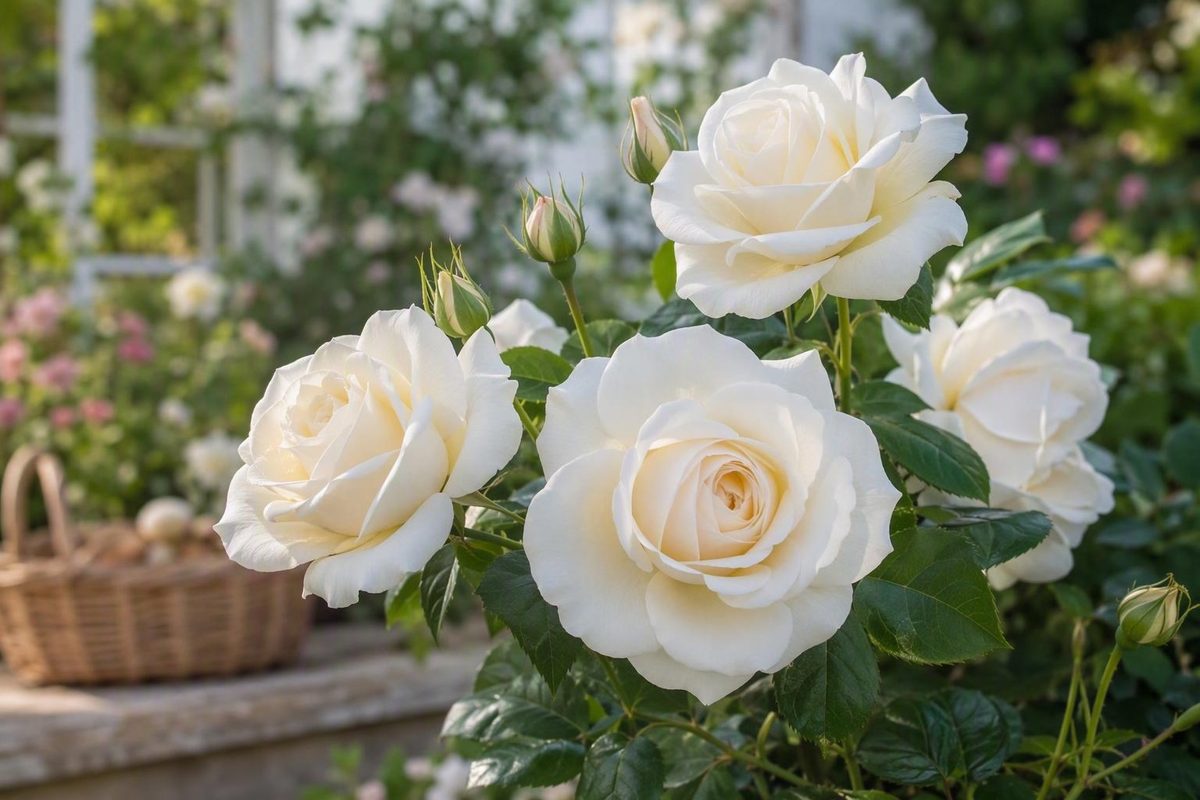
Sugar Moon is a white Hybrid Tea rose known for large, classically shaped flowers, conspicuous fragrance, and long upright stems suitable for cutting. It is a strong candidate for a sunny cutting bed or scent garden, but it is not a compact, carefree rose with fully settled performance data.
Most available descriptions come from commercial nurseries. Those sellers agree on the cultivar’s basic identity and ornamental character, but their mature-size and cold-hardiness figures conflict. Claims of disease resistance also lack support from independent cultivar trials. A sensible buying decision therefore depends on separating Sugar Moon’s well-documented flower qualities from the performance claims that remain uncertain.
Sugar Moon at a Glance: Cultivar Identity and Key Traits
Sugar Moon is consistently sold as the white Hybrid Tea rose Rosa ‘WEKmemolo’. Nursery listings attribute U.S. plant patent PP23,475 to the cultivar, identify Christian Bédard as its breeder, and name Weeks Roses as the introducer. Grace Rose Farm lists the cultivar, patent, breeder, and introducer, while Edmunds’ Roses independently lists ‘WEKmemolo’, patent 23,475, and Bédard.
Its principal appeal is the combination of classical white flowers, strong scent, dark foliage, and long stems. Pointed buds open into the high-centered or spiral form associated with Hybrid Tea roses. The flowers rise prominently on upright canes and can be harvested for arrangements.
| Trait | Practical expectation |
|---|---|
| Rose class | Hybrid Tea |
| Cultivar denomination | Rosa ‘WEKmemolo’ |
| Flower color | Predominantly white |
| Flower form | Full, classically formed blooms opening from pointed buds |
| Fragrance | Strong; usually described as sweet citrus with traditional rose notes |
| Habit | Tall, upright, bushy, and sometimes described as upright-spreading |
| Bloom pattern | Repeats in flushes rather than flowering without interruption |
| Foliage | Dark green, deciduous, glossy to semi-glossy |
| Stems | Long and useful for cutting |
| Thorns | Present |
| Preferred exposure | Full sun |
| Planning size | Approximately 4–6 feet tall and 2–4 feet wide, subject to local variation |
| Strongest uses | Cutting bed, scent garden, sunny border, informal grouping |
| Main uncertainties | Cold hardiness, final size in different climates, and independent disease performance |
As a Hybrid Tea, Sugar Moon is best understood as an upright flowering shrub rather than a low, rounded landscape rose. “Bushy” does not mean compact. The canes can become substantial in favorable conditions, and the thorns affect where the plant can be placed and how easily flowers can be harvested.
The most consistent characteristics across the supplied nursery descriptions are white flowers, strong fragrance, dark deciduous foliage, upright growth, repeat bloom, and suitability for cutting. The weaker points in the evidence are the ultimate dimensions, northern hardiness limit, and reliability of seller-advertised disease resistance.
That distinction matters when shopping. Sugar Moon has a clear cultivar identity and recognizable flower style, but a single seller’s zone label or mature-size estimate should not be treated as a universal guarantee.
Flowers, Fragrance, and the Repeat-Bloom Pattern
Sugar Moon produces elongated, pointed buds that open into full, spiral-centered flowers. Nursery listings generally place the petal count at approximately 30–40 and the flower diameter at up to about 5 inches, although the exact figures differ by seller. RHS Plants lists fully double white flowers reaching about 5 inches across and returning in flushes.
The predominant color is white. Some online image descriptions mention blush tones or a colored center, but the supplied image material is inconsistent and includes at least one apparently unrelated rose reference. That is not adequate evidence for redefining Sugar Moon as anything other than a predominantly white cultivar.
Dark green foliage intensifies the contrast with the flowers. Sellers variously describe the leaves as glossy, semi-glossy, or nearly black-green. Because the plant is deciduous, this foliage display lasts through the growing season rather than providing evergreen coverage.
Even with that limitation, strong fragrance is one of Sugar Moon’s most consistently reported attributes. Nursery descriptions repeatedly combine sweet citrus with an old-fashioned or traditional rose scent; some also add a cold-cream note.
For gardeners comparing white Hybrid Tea roses, that scent may be the deciding feature. Sugar Moon is not generally described as merely faintly fragrant. Its flowers are plausible choices for close-range enjoyment beside a patio, along a regularly used route, or in an indoor arrangement. The evidence does not establish that one bush will perfume an entire large garden.
Sugar Moon is repeat-flowering, but repeat flowering does not mean uninterrupted flowering. Later flushes may differ in timing and prominence from the first.
Published bloom calendars vary. Sellers describe the season as summer, June through September, late spring through fall, or early summer through autumn. These are broad seller expectations, not promises that every plant will flower throughout every listed month.
Newly purchased plants may also make a less dramatic display than established specimens. The supplied grower reports include both slow early performance and vigorous flowering, so first-season results should not be treated as a reliable forecast of every mature plant.
Long stems and large flowers explain why Sugar Moon is frequently promoted as a cutting rose. No independent trial in the evidence pack establishes a standardized vase life, however. “Suitable for cutting” is supported; a precise or exceptional vase duration is not.
The realistic floral expectation is a series of large, fragrant, predominantly white Hybrid Tea blooms separated by quieter periods. Gardeners who need constant color should combine Sugar Moon with other plants that flower between its flushes rather than relying on a single rose for an uninterrupted display.
How Large Does a Sugar Moon Rose Bush Get?
For an ordinary Sugar Moon rose bush, approximately 4–6 feet tall and 2–4 feet wide is a useful planning range rather than a fixed mature size. That range accommodates several conflicting nursery descriptions without implying that every plant will stop at the same dimensions.
Published figures include the following:
- White Flower Farm lists a mature height of approximately 3–4 feet and recommends spacing plants about 3–4 feet apart. Its Sugar Moon profile provides those dimensions and spacing.
- Pike Nurseries lists approximately 5 feet in height and 4 feet in width. The Pike plant profile identifies Sugar Moon as a tall, bushy full-sun rose with those dimensions.
- Edmunds’ Roses gives a taller range of approximately 4½–6 feet. Its listing supplies that height range.
- One UK seller publishes an even larger eventual size, but that estimate is difficult to reconcile directly with the smaller North American figures.
- Gardeners in long-season climates have reported plants reaching approximately 6–7 feet while remaining comparatively narrow or upright.
The grower anecdotes are useful mainly as a warning against assuming compactness. Reports from Alabama, North Carolina, and Florida describe tall, fairly narrow plants. One North Carolina gardener reported approximately 6 feet by 4 feet by the end of a second summer, while a Florida gardener described plants reaching 6–7 feet. These are individual climate-specific observations recorded in a Houzz rose discussion, not controlled measurements that every buyer should expect.
Climate, growing-season length, winter damage, pruning, rootstock, establishment, and site conditions may help explain the spread among published and anecdotal dimensions. The supplied evidence does not isolate those variables, so none should be presented as the proven cause of a particular plant’s size.
The safest placement strategy is to reserve enough vertical room for a plant near the upper end of the ordinary nursery range. Avoid placing Sugar Moon beneath a window, beside a sightline, or under a structure if growth beyond 4 feet would create a problem. In a warm or long-season climate, allow for the possibility of canes exceeding the standard planning range.
For width, roughly 3–4 feet of spacing is a reasonable nursery-supported starting point. Adjust that figure for access, local vigor, and the intended effect. A cutting bed needs enough room to reach the stems without pushing through thorny neighboring plants. An informal hedge may be spaced for eventual visual continuity, but very close planting can make harvesting and routine inspection harder.
Sugar Moon’s habit is better described as tall, upright, bushy, or upright-spreading than compact. It may occupy less horizontal space than a broad arching shrub of equal height, but it still needs room for canes and foliage.
Labels such as one quart, 3 gallons, or 5 gallons describe how the plant is supplied at the time of sale.
Sun, Soil, Water, and Seasonal Care
Full sun is the dominant seller recommendation for Sugar Moon. Heirloom Roses defines full sun on its listing as at least six hours of direct sunlight, making that a useful placement benchmark rather than a guarantee of identical flowering in every climate. The Heirloom Roses listing gives the six-hour minimum for its own-root Sugar Moon.
Where possible, choose an open location with sustained direct light rather than bright shade. Before planting, observe the site at different times of day. A bed that appears sunny at noon may receive much less direct light during the morning and afternoon.
Performance in partial sun remains unresolved. One retailer includes partial shade among possible exposures, and individual gardeners have grown Sugar Moon with part-day sun. The grower reports are mixed, however. Some plants grew and flowered, while a longer-term account eventually concluded that the rose needed more sun. Partial sun should therefore be treated as a compromise, not as an established route to strong repeat flowering.
If two sites are otherwise suitable, favor the sunnier one. Where only limited direct light is available, expectations should be modest: the rose may grow and flower, but the supplied evidence does not support a promise of vigorous, reliable rebloom.
Nursery guidance generally recommends fertile or moderately fertile soil that remains reasonably or evenly moist while draining well. “Moist” does not mean saturated. Multiple sellers explicitly say that the plant does not tolerate standing water.
Watering recommendations should remain equally qualified. RHS Plants advises generous watering until establishment, but the evidence does not justify a fixed schedule such as watering every three days. The practical goal is adequate moisture without persistent saturation.
RHS Plants also recommends applying rose fertilizer in spring and adding a spring mulch while keeping it away from the stems. Its listing places routine pruning in late winter or early spring and advises removing dead, damaged, or weak growth. These are nursery recommendations published for Sugar Moon, not independently tested requirements unique to this cultivar.
Another seller includes late-fall pruning as an option, but that timing should not be generalized to every region. The stronger consensus within the supplied material favors late winter or early spring, after the threat of extreme cold has passed.
Routine seasonal inspection is sensible because Sugar Moon’s disease performance is uncertain. Check foliage, stems, buds, and flowers regularly rather than assuming that a seller’s resistance claim eliminates the need for observation.
The supplied cultivar evidence does not establish universal instructions for planting depth, deadheading, fertilizer formulation or rate, spraying, or winter protection. Those details vary with region and plant form. Gardeners should use locally appropriate rose-care guidance, especially for grafted plants, containers, or sites near the disputed cold-hardiness boundary.
Hardiness and Disease Resistance: What the Evidence Cannot Settle
Cold hardiness is the largest unresolved issue in a Sugar Moon purchase. The nursery labels do not merely differ in formatting; they set materially different expectations for cold-winter gardeners.
The supplied listings include all of the following:
- Armstrong Garden Centers lists Zone 4b. Its Sugar Moon profile gives the Zone 4b label.
- Breck’s publishes a broad range of Zones 4–10. The Breck’s product description supplies that range.
- GardenWorks lists Zone 5a. Its plant database gives the 5a designation.
- White Flower Farm lists Zones 5–9, with an additional specialized warm-zone notation on its page.
- High Country Roses lists hardiness to Zone 6. Its Sugar Moon profile combines the Zone 6 label with a seller-stated size of 4–6 feet by 2–3 feet.
- Grace Rose Farm uses Zones 6–9 for its Sugar Moon listing.
There is no sound basis in the evidence pack for selecting one of these ranges as definitive. Repetition across retailer pages does not equal documented, multi-year winter-survival testing. Some nearly identical garden-center descriptions also appear to derive from shared plant-database material, so counting repeated pages would overstate the independence of the evidence.
Gardeners near the disputed Zone 4–6 boundary should therefore prioritize information that the supplied national product pages cannot provide:
- Regional extension guidance for overwintering Hybrid Tea roses.
- Advice from reputable local nurseries familiar with actual winter survival nearby.
- Documented experience from local gardeners who have grown Sugar Moon through multiple winters.
- Confirmation of whether the plant being sold is own-root or grafted.
- Clarification of what the seller’s warranty covers if the plant fails after winter.
The disagreement among sellers is itself the most important buying information: northern suitability should be verified locally rather than inferred from the most optimistic national range.
Disease performance requires similar caution. Sellers frequently describe Sugar Moon as disease resistant, sometimes using terms such as good, superior, very good, or excellent. The supplied material contains no independent trial demonstrating resistance to black spot, powdery mildew, rust, or canker.
Grower anecdotes complicate the promotional picture. Individual accounts mention black spot, canker, thrips, slow establishment, transplant setbacks, sparse flowering, and plant loss. The same discussion also contains favorable reports of strong fragrance, vigorous growth, attractive flowers, and relatively easy care. The Houzz accounts are personal experiences from several climates, not diagnoses or controlled cultivar comparisons.
Customer reviews on a specialist nursery page are similarly mixed, including both vigorous, healthy plants and reports of few flowers, thrips, slow establishment, or failure to survive an early season. High Country Roses publishes these individual customer reports alongside its seller description.
Those anecdotes do not prove that the reported problems are typical or unique to Sugar Moon. They also do not establish that wind, rootstock, shade, or another single factor caused a particular case of canker or decline. A gardener’s suspected explanation may identify a question, but it is not evidence of causation.
The defensible conclusion is uncertain disease performance. Do not assume immunity, but do not infer exceptional susceptibility from scattered reports either. If independently demonstrated resistance to a prevalent local disease is an essential buying criterion, the supplied seller claims are not enough to show that Sugar Moon meets it.
Where Sugar Moon Works Best in the Landscape
Sugar Moon’s clearest roles are in a cutting garden and a scent garden. Large flowers, long upright stems, repeat bloom, and strong fragrance directly support both uses. The rose makes the most of those qualities when its flowers can be approached, smelled, and harvested.
In a cutting bed, allow space to reach around the plant. Sugar Moon is spiny, so squeezing it between other thorny roses can make harvesting and pruning awkward. An access path may provide more practical value than fitting one additional shrub into the bed.
For a scent garden, place the rose near regular foot traffic while leaving clearance around its canes. A sunny position near a patio, gate, or broad path can bring the flowers within smelling distance. Avoid crowding a thorny plant directly against narrow passages, play areas, or frequently used seating.
The upright habit may suit a narrow border where vertical flowers are wanted without the arching spread of a broad shrub. “Narrow” remains relative: the ordinary planning range is still several feet wide, and climate-specific anecdotes indicate that the canes can exceed 6 feet in favorable long-season conditions.
Retailers also recommend Sugar Moon for mass planting, hedging, and screening. Armstrong Garden Centers, for example, lists massing and screening among its suggested landscape uses and also characterizes the plant as deciduous and spiny. Its product profile documents those seller-suggested uses and limitations.
As a hedge, Sugar Moon is better suited to an informal flowering boundary than a tightly clipped architectural form. Its rewards are flowers, fragrance, and seasonal height.
Large-container culture is possible because retailers explicitly market Sugar Moon for pots. The container should be proportionate to a tall Hybrid Tea and stable enough for an upright plant. The supplied evidence supports attentive moisture management but does not establish a Sugar Moon-specific container-watering schedule or winter-protection protocol.
The evidence pack does not establish how much protection a potted Sugar Moon requires in any particular zone. Cold-climate gardeners should seek regional advice before treating a container as a permanent year-round placement.
Some retailer pages say Sugar Moon attracts bees or other pollinators. That supports describing it as a plant that may receive insect visitors, but it does not establish comparative ecological value. The available evidence does not show that its densely petaled flowers are especially accessible or more valuable than open, single-flowered roses.
The placement tradeoff is straightforward.
Reasons to choose Sugar Moon
- Strong fragrance
- Large, classical white flowers
- Long stems for cutting
- Upright growth
- Dark foliage that emphasizes the blooms
- Repeat flowering in seasonal flushes
Reasons to place it cautiously
- Thorny stems
- Variable mature height
- Deciduous winter appearance
- Potential need for substantial vertical room
- Unresolved northern hardiness boundary
- Disease performance that has not been independently established
Sugar Moon works best where a taller-than-expected plant would still fit and where its flowers can be seen, smelled, and cut.
Bush, Bare Root, Own Root, Grafted, or Tree Rose?
Sugar Moon is sold in several commercial forms:
- Own-root potted rose
- Grafted or budded bare-root rose
- Gallon-size or larger potted bush
- Grafted tree rose, also called a standard
These descriptions refer to how the plant is propagated, trained, or supplied.
Bare root means the dormant plant is supplied without a potful of growing medium. Potted means it arrives in a container.
The supplied evidence does not directly compare own-root and grafted Sugar Moon plants for vigor, winter recovery, mature dimensions, longevity, or disease outcomes. Neither form can be declared universally superior.
The practical choice may depend on regional availability, the planting season, shipping method, and whether the buyer wants a dormant plant or a more developed garden display. Ask the seller to identify the root system when the listing does not state it, but do not assume that this detail overrides stock health or local suitability.
A tree rose is fundamentally different in architecture from the ordinary bush. The result is a formal, lollipop-like outline rather than a shrub with canes arising near ground level.
Breck’s lists Sugar Moon in several forms, including ordinary bare-root or potted plants and a 36-inch tree rose. Its product page documents these different commercial forms. The 36-inch designation describes the standard form or stem specification; it is not the completed tree rose’s final overall height.
Conversely, ordinary shrub dimensions displayed on a tree-rose product page do not establish the finished size of the complete elevated crown-and-stem structure. Ask for measurements that apply to the specific form being purchased.
Tree roses can serve as formal accents, paired entrance plants, or container specimens. Their raised crown should not be mistaken for a compact alternative to the bush, however. Product pages should explicitly identify whether the offering is an ordinary shrub or a standard; flower photographs alone cannot make that distinction.
Before ordering, confirm the following:
- Cultivar identity: Does the label state Sugar Moon and ‘WEKmemolo’?
- Plant form: Is it an ordinary bush or a grafted tree rose?
- Root system: Is it own-root, budded, or grafted, if disclosed?
- Supply format: Will it arrive bare root or potted?
- Shipped size: Does the measurement describe the container, root grade, stem, plant age, or complete plant?
- Regional suitability: Is there credible evidence that Sugar Moon survives local winters?
- Stock condition: What should a healthy plant look like on arrival?
- Shipping season: Is the expected delivery timing appropriate for local planting conditions?
- Guarantee: What is covered, for how long, and what documentation is required?
- Available space: Can the site accommodate a tall, upright rose with several feet of spread?
- Maintenance fit: Are thorns, pruning, moisture monitoring, and uncertain disease behavior acceptable?
Do not select a retailer solely from a displayed headline price. Plant form, root system, shipped size, freight costs, discounts, inventory, and guarantee terms can differ and may change. Compare the complete offer rather than treating superficially similar listings as equivalent.
Frequently Asked Questions
How tall and wide does a Sugar Moon rose bush grow?
Use approximately 4–6 feet tall and 2–4 feet wide as a qualified planning range, not a guaranteed mature size. Some nursery listings are smaller, while others place the height near 6 feet. Warm- or long-season grower reports occasionally describe narrow upright plants reaching 6–7 feet. Pike Nurseries’ estimate of about 5 feet by 4 feet illustrates the middle of the published range.
How many hours of sun does Sugar Moon need?
Full sun is the dominant recommendation. Some sellers define that as at least six hours of direct sunlight per day. Part-day sun may permit growth and flowers, but reliable long-term rebloom under reduced light has not been established. Heirloom Roses specifies the six-hour full-sun benchmark.
What USDA zones are suitable for Sugar Moon roses?
There is no dependable single range in the supplied evidence. Seller labels begin variously at Zone 4, 4b, 5, 5a, or 6, while upper boundaries extend as far as Zone 10. GardenWorks’ Zone 5a listing is one example of the conflicting retailer guidance. Gardeners near the disputed Zone 4–6 boundary should rely on regional extension guidance, knowledgeable local nurseries, and documented nearby survival.
Does Sugar Moon bloom continuously throughout the season?
No. Sugar Moon is described as repeat-flowering in flushes. Concentrated periods of flowers are followed by quieter intervals as the plant develops another round of growth and buds. Published seasonal calendars vary, and none guarantees open flowers every day.
What is the difference between a Sugar Moon bush and a Sugar Moon tree rose?
The bush is the ordinary shrub form, with canes growing from near ground level. A tree rose is a grafted standard with the flowering Sugar Moon crown elevated on a straight stem. The listed stem specification is not the tree rose’s final total height, and ordinary shrub dimensions do not establish the completed size of the standard.
Is Sugar Moon the Right Rose for You?
Choose Sugar Moon when fragrance, classical white flowers, and long cutting stems matter more than compact dimensions or independently established disease resistance.
For an ordinary bush, reserve approximately 4–6 feet of height and 2–4 feet of width, while accepting that plants in favorable long-season climates may grow taller. Give it a sunny, well-drained position, verify winter suitability locally, and choose the plant form deliberately rather than confusing an ordinary bush with a grafted tree rose.
Sugar Moon’s scent, white flower form, and cutting stems are its clearest strengths. Its final size, cold boundary, and disease performance are the reasons to buy cautiously rather than relying on nursery promotion alone.