
When to Plant Onion Seeds: Spring and Fall Sowing
Plan onion seed sowing for spring or mild-winter growing. Choose the right day-length type, calculate indoor dates, and check when to plant outside.
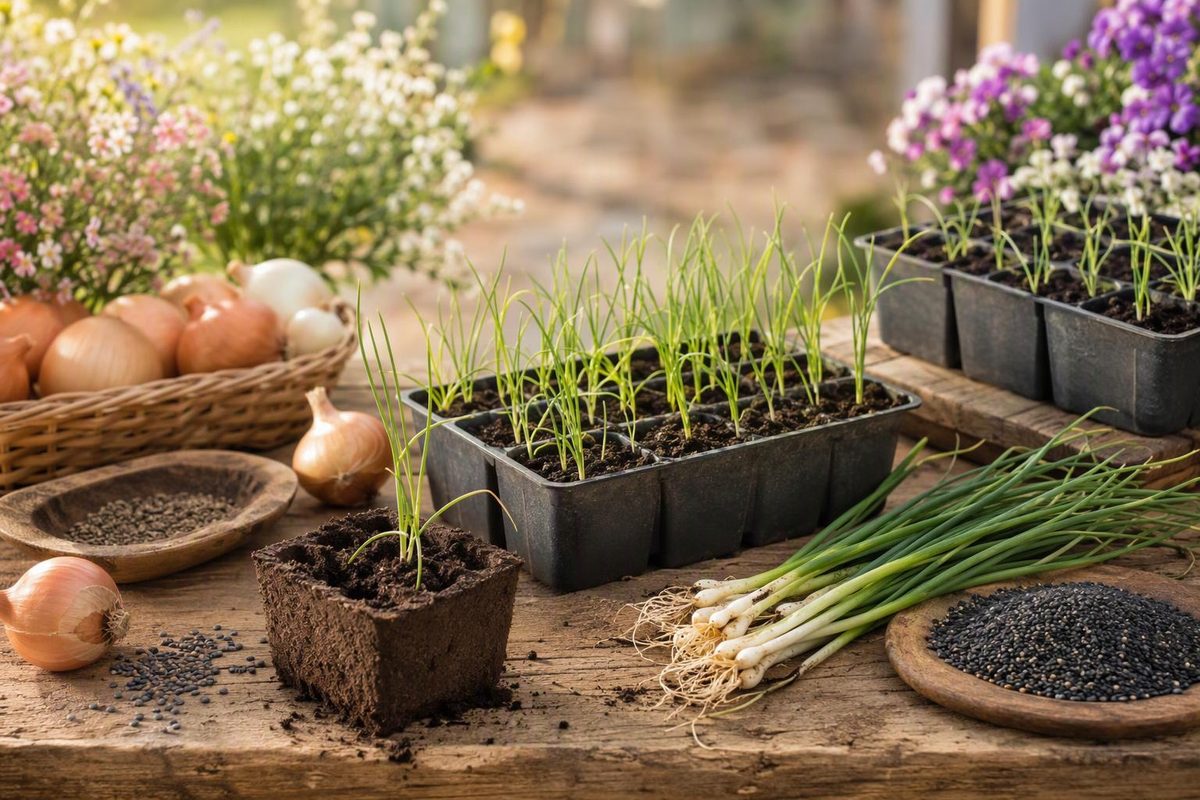
For spring-grown bulb onions, choose your local transplant window first, then count backward to sow indoors. University of Minnesota Extension recommends starting seeds 10–12 weeks before planting outside, with February sowing for May transplanting in Minnesota. In mild-winter areas, onions may instead be sown in fall and grown through winter. There is no single sowing month that fits every climate and variety. University of Minnesota Extension; Texas A&M AgriLife Extension
This guidance is for seed-grown bulb onions (Allium cepa), rather than onion sets—the small bulbs sold for planting—or bunching onions grown mainly for their green leaves.
Choose the onion type before choosing the date
Bulb formation responds to day length. Starting early gives plants time to grow leaves before the daylight threshold triggers bulbing; sowing earlier cannot compensate for an unsuitable variety.
For U.S. gardeners, these are useful starting points:
| Packet description | General regional fit | Daylight that triggers bulbing |
|---|---|---|
| Short-day | Southern regions, often grown through mild winters | About 10–12 hours |
| Intermediate-day | Middle latitudes, overlapping northern and southern ranges | About 12–14 hours |
| Long-day | Northern regions | About 14–16 hours |
These regions overlap, so check the packet’s location recommendations rather than choosing by onion color or sweetness. Day-length type describes the bulb’s response to seasonal daylight—not a recommended seedling grow-light schedule. Botanical Interests onion guide
Calculate a spring indoor sowing date
First find the recommended onion transplant window for your area, then count backward using the seed-starting guidance for that region or variety. Under Minnesota Extension’s 10–12-week schedule, a May 1 planting-out target gives a sowing window of approximately February 6–20. Onion transplants tolerate light frost, so their outdoor date can be earlier than that of frost-tender vegetables. University of Minnesota Extension
Published schedules differ. If you have only an average last-frost date, Seed Savers Exchange offers another planning approach: sow indoors 8–10 weeks before average last frost and transplant about two weeks before it, after hardening off. Use that as a complete schedule rather than mixing its sowing date with another source’s transplant date. Check the forecast and whether the bed is workable before moving seedlings outside. Seed Savers Exchange
Do not move onions into muddy soil just to meet the calendar. A suitable bed drains well and can be worked without wet soil sticking to tools. Texas A&M AgriLife Extension
When to sow outdoors or in fall
For spring direct sowing, plant as soon as the soil can be worked. Botanical Interests gives a soil-temperature checkpoint of at least 45°F, generally four to six weeks before average last frost. That is an outdoor sowing threshold, not a target temperature for fast indoor germination. In northern gardens, indoor starts give bulb onions a head start during a limited growing season. Botanical Interests; Seed Savers Exchange
For mild-winter growing, use a local fall schedule rather than counting backward from spring frost. Texas A&M’s home-garden guide recommends direct seeding for bulbs during October–December, with harvest the following May–July. Those dates are a Texas example, not a nationwide fall window. Texas A&M AgriLife Extension
If starting indoors for a mild-climate fall planting, Botanical Interests recommends sowing 6–8 weeks before a late-summer or early-fall transplant date. Confirm the outdoor window locally before counting back. Botanical Interests
Earlier is not always better: North Carolina Extension warns that planting too early in fall can increase bolting—the premature formation of a flower stalk. Follow regional dates and choose a variety suited to overwintering there. NC State Extension
From sowing date to usable seedlings
For indoor sowing, Seed Savers Exchange recommends ¼-inch depth in sterile potting soil or seed-starting mix; follow your packet if it specifies otherwise. Keep the mix moist but not waterlogged. Its indoor emergence window is 4–10 days, though actual timing depends on conditions. Seed Savers Exchange
Once green shoots appear, remove any humidity dome and germination bottom heat. Give seedlings strong supplemental light and airflow, and water when the surface begins to dry rather than keeping the tray saturated. Gradually introduce outdoor sun, air and cool nights before transplanting. Seed Savers Exchange
For the tray setup and hardening-off routine, see how to start seeds indoors. Keep both dates on your label—the sowing date and intended planting-out date—so the seedlings’ progress, not just the calendar, guides your next step.