
How to Germinate Lavender Seeds: Light, Moisture and Chilling
Start English lavender seeds with shallow sowing, steady moisture and measured warmth. Learn when chilling helps and what to check if sprouts are slow.
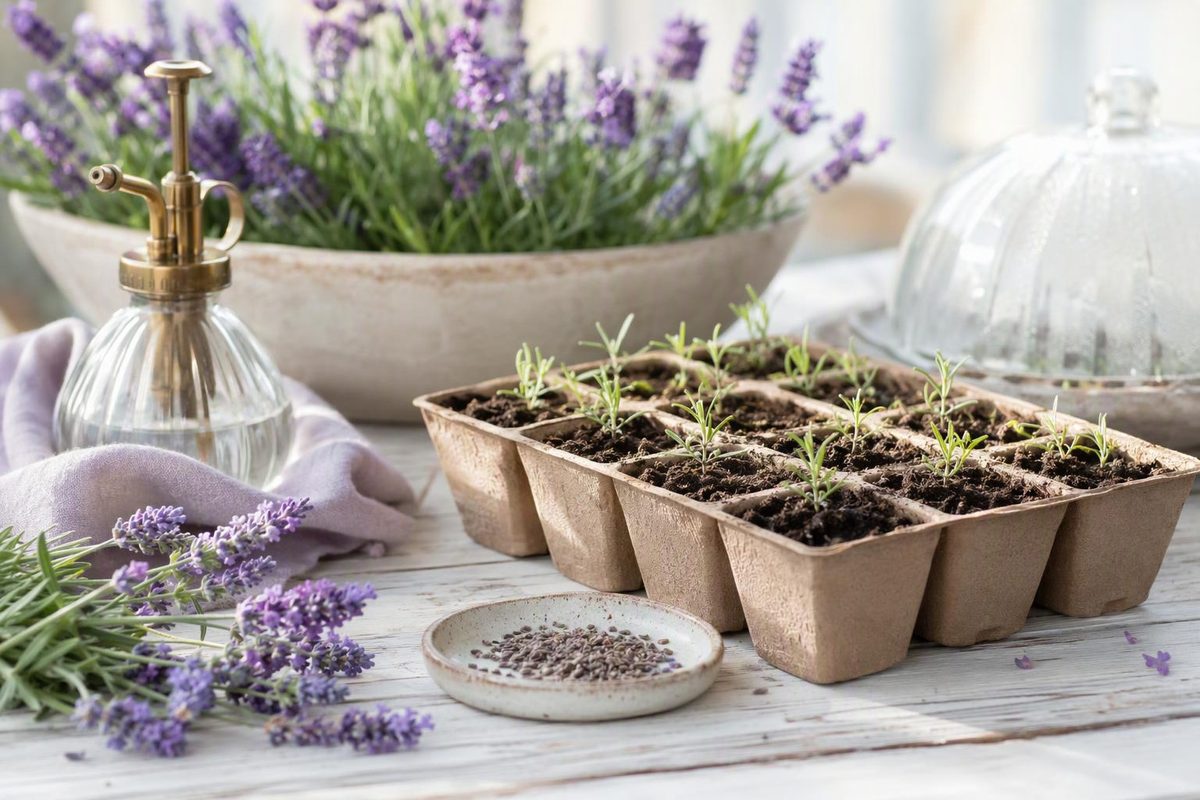
To germinate English lavender (Lavandula angustifolia), sow shallowly in pre-moistened seed-starting mix, provide light, and keep the mix moist at about 65–70°F (18–21°C). Johnny’s Selected Seeds lists 14–21 days to germination under those conditions, but lavender can emerge unevenly. Cold-moist chilling may help; it is not a universal requirement for every packet. Select Seeds’ ‘Munstead Strain’ instructions describe chilling as optional.
The method below is for English lavender. If your packet names another species or gives variety-specific treatment instructions, use those rather than assuming all lavender behaves alike.
Decide whether to chill first
Check the packet before adding a refrigerator treatment. Select Seeds says a brief moist chill can improve ‘Munstead Strain’ germination but is not required. Johnny’s English lavender directions give a sowing method without a chilling step.
If the supplier recommends chilling—or you want to try it on part of a batch—use the refrigerator portion of Jung Seed’s method:
- Fill small pots with pre-moistened, gently firmed seed-starting mix.
- Press seeds onto the surface.
- Enclose the pots in a closed zip-top plastic bag and refrigerate for about 30 days.
This is cold-moist stratification: the seeds are chilled while in contact with damp medium, rather than stored dry in their packet. After chilling, open the bag and follow the light, temperature and watering steps below. These use Johnny’s germination conditions, not Jung’s full post-chilling protocol. Chilling does not ensure every seed sprouts; Jung describes lavender germination as slow and sporadic.
For spring planting, Johnny’s recommends indoor sowing 8–10 weeks before your local last frost. If you choose a separate 30-day refrigerator treatment, allow that extra time before the warm-growing period. Treat the calendar as a planning aid, not a deadline for planting undersized seedlings.
Sow shallowly and keep conditions steady
For seeds that do not need chilling, start here. For chilled pots, continue with the light, temperature and watering steps.
- Prepare a draining container. Use clean pots or cells with drainage holes and a commercial soilless seed-starting mix. Moisten the mix throughout before sowing; it should be damp, not sitting in water. (University of Minnesota Extension)
- Press seeds into contact with the surface. Avoid a thick covering. Select Seeds recommends surface sowing to barely covering ‘Munstead Strain’; Johnny’s specifies 1/8 inch and notes that seeds need some light. Follow your packet’s shallow-sowing direction rather than the usual “twice the seed’s width” rule.
- Provide light from the start. Put the tray under a grow light rather than in a dark cupboard. A clear cover can slow moisture loss without blocking light.
- Measure the mix temperature. Aim for Johnny’s 65–70°F range. Utah State University Extension also identifies 70°F as a good sprouting temperature. Use a heat mat if needed to reach that range, rather than adding heat without measuring.
- Check moisture daily. Gently mist if the surface is drying, or bottom-water and drain away the excess. Check beneath the surface too: repeated light misting can leave the lower mix dry. (UMN Extension’s watering guidance)
Watch for sprouts, then change the care
Label the tray with the variety, sowing date and any chilling dates. Check for emergence through the full expected window; one early seedling does not mean the rest have failed.
Once seedlings emerge, provide strong light and avoid keeping them in a wet, sealed enclosure. Bottom-water as needed, then empty the tray. Jung warns against overwatering because damping-off is a danger for lavender seedlings.
If nothing appears, check elapsed warm time, covering depth, actual mix temperature and moisture before adding more heat or water. A deeply buried seed, dry surface or saturated pot calls for a different correction. For an unchilled batch, a supplier-recommended moist chill is another option—not a guarantee of success.
Pot seedlings individually when they are large enough to handle. Lift them with the rootball supported; do not grip the stem. Use our indoor seed-starting guide for lighting and hardening-off steps. Move established seedlings outdoors after the last spring frost into full sun and well-drained soil. Mature lavender tolerates dry conditions, but that is not a reason to let germinating seeds or tiny seedlings dry out. (USU Extension)