
Brad's Atomic Grape Tomato: Growing Guide and Ripeness Cues
Sowing dates, a 70–80-day harvest window from transplant, spacing and support for Brad's Atomic Grape, plus the color and firmness cues that signal ripeness.
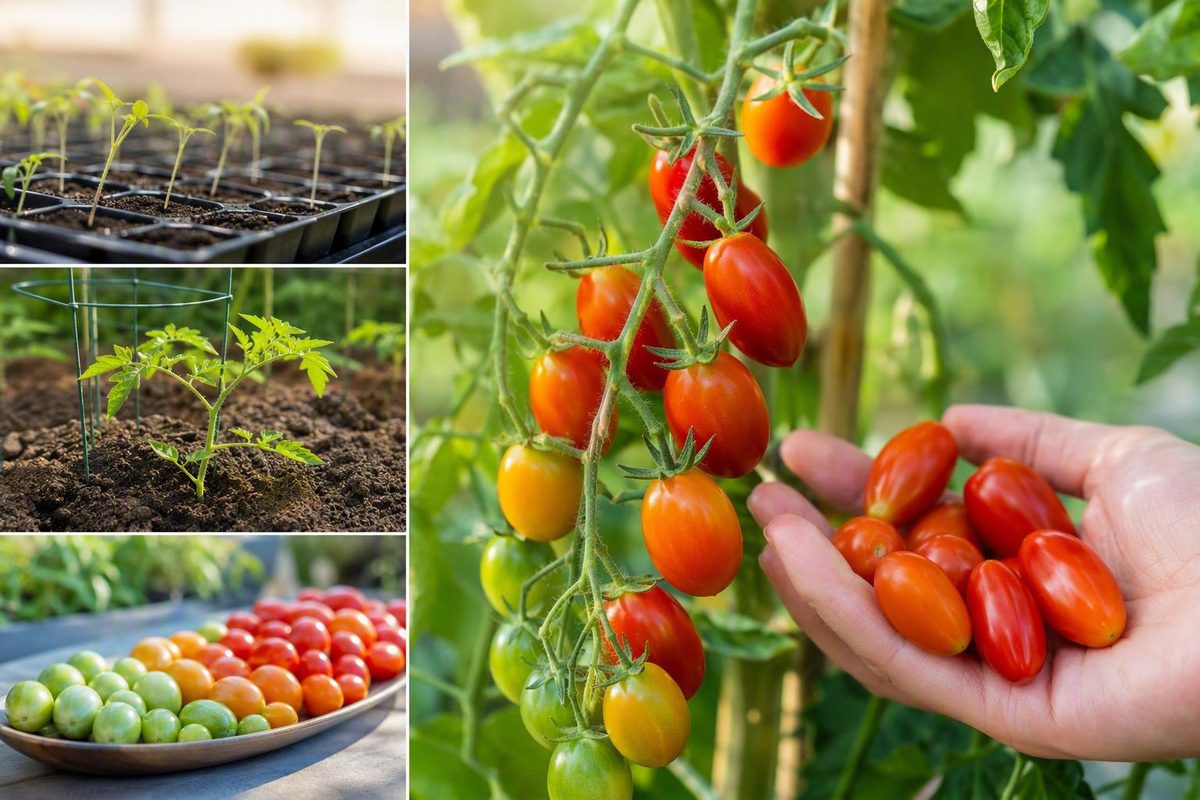
Brad’s Atomic Grape is an open-pollinated, indeterminate tomato bred by Brad Gates of Wild Boar Farms. Sow it six to eight weeks before your transplant date, give the vine sturdy support from day one, and expect the first ripe fruit roughly 70–80 days after transplanting. That figure is a seller estimate that weather and plant establishment can shift (True Leaf Market).
Ripe fruit never reaches one uniform color. The elongated, clustered tomatoes move from lavender and purple striping to a mix of green, olive, red-brown, and blue-toned stripes. Pick when the green background turns more olive, warm red or brown streaks develop, and the fruit gives slightly while staying fairly firm. Taste one from the cluster before harvesting the rest.
First Ripe Fruit Comes About 70–80 Days After Transplanting
Tomato days to maturity are counted from transplanting, not from the day the seed is sown. Johnny’s general tomato guidance defines them that way (Johnny’s Selected Seeds).
For this variety, published figures cluster around 70–80 days after transplanting. The listings give no comparable trial locations, weather records, transplant sizes, or training methods, so treat the range as a calendar estimate rather than a deadline.
Enter your target transplant date; the sowing, hardening, and first-ripening dates update below.
Sowing-to-Harvest Dates for Brad’s Atomic Grape
Nominal first ripe fruit
~July 29 – August 8
Example shown: a May 20 transplant. Enter your own date to recalculate.
| Stage | Approximate date |
|---|---|
| Sow indoors, 8 weeks ahead | March 25 |
| Sow indoors, 6 weeks ahead | April 8 |
| Begin hardening off | Around May 13 |
| Transplant | May 20 |
| 70-day point | July 29 |
| 80-day point | August 8 |
What can push the window later
- Slow germination or an undersized transplant
- Transplant shock, or a leggy, root-bound seedling that stalls
- Extended cloud cover, cool soil or an unusually cool summer
- Nights below 50°F or days above 95°F, which can abort flowers
- Excess nitrogen, which delays fruit set and ripening
Source: 70–80 days from transplanting per seller listings (True Leaf Market); 6–8 weeks sowing lead and about a week of hardening from general tomato guidance. A calendar estimate, not a cultivar trial.
A May 20 transplant works out to sowing between March 25 and April 8, hardening off from about May 13, and a nominal first-ripening window of July 29 to August 8.
The calculation does not account for slow germination, an undersized transplant, transplant shock, extended cloud cover, cool soil, or an unusually cool summer. Record the actual sowing, emergence, transplant, flowering, and first-harvest dates so next season’s schedule reflects your garden.
Set the transplant date only after frost danger has passed and persistently cold nights are no longer expected. General sources vary: some advise avoiding consecutive nights below 45°F, while some seller instructions use nights consistently above 50°F. The 50°F threshold is the more conservative benchmark for an unprotected transplant.
Do not sow excessively early to chase an earlier crop. An old transplant that is leggy, root-bound, or already flowering may stall after planting. If your safe outdoor date moves later, pot the seedling into a larger container and keep it under strong light rather than letting roots circle in a small cell.
The full workflow for scheduling, lights, watering, airflow, and hardening is in Garden Seed Source’s indoor seed-starting guide.
What the Listings Establish and What They Leave Open
The descriptions below come from breeder or seller listings. The planning implications are general tomato guidance, not results from a controlled Brad’s Atomic Grape trial.
| Trait | Published Description | Planning Implication |
|---|---|---|
| Species | Solanum lycopersicum | Grow as a warm-season tomato |
| Seed type | Open-pollinated | Seed saving is possible; crossing still has to be managed |
| Habit | Indeterminate | Continuing vine growth and ongoing support |
| Fruit | Elongated, clustered, large cherry to small plum | Expect some size variation |
| Color | Lavender and purple when immature; green, olive, red-brown, and blue-toned stripes when ripe | Judge ripeness from several cues |
| Maturity | About 70–80 days from transplanting | A planning range, not a deadline |
| Disease resistance | No formal resistance codes found | Do not assume blight resistance |
Indeterminate tomatoes keep extending their vines and setting fruit over a long period instead of ripening one compact crop. They can sprawl, but a stake, cage, or trellis keeps fruit accessible and stems off the ground.
A third-party cultivar reference also describes the variety as open-pollinated and sold without formal disease-resistance codes (Tomato Almanac). A missing code does not prove the plant is unusually susceptible. It means no formal code or controlled cultivar-specific evidence of dependable blight resistance turned up in the reviewed material. Use ordinary tomato disease prevention and diagnose symptoms rather than assuming protection.
Flavor and performance are less settled than appearance. Commercial descriptions emphasize sweetness, productivity, crack resistance, and holding quality. Gardener reports range from bland fruit with tough skin to excellent flavor and heavy production. Treat sweetness, skin thickness, cracking, yield, and earliness as traits to evaluate in your own conditions, not purchase guarantees.
Ripe Fruit Turns Olive With Warm Streaks and Stays Fairly Firm
This tomato does not follow the green-to-uniform-red progression, and a ripe fruit may stay relatively firm. Use several cues together:
- Background color. Bright or lime green moves toward olive.
- Warm undertones. Red, orange, bronze, or red-brown streaks become more noticeable.
- The whole pattern. A mature fruit usually shows a fuller mix of green or olive, purple, red-brown, and blue-toned striping.
- The cluster. Note which tomatoes reached full size first and how long each has been on the vine.
- Firmness. Look for a slight give; do not wait for the fruit to go soft.
- Taste. Sample one representative tomato before stripping a cluster.
These are not validated cultivar standards. They combine breeder descriptions with a small number of grower observations. Contributors to Cornell’s citizen-science variety database report that warmer streaking becomes more visible at ripeness and that ripe fruit can remain fairly firm. Those entries are gardener reviews hosted by Cornell, not Cornell trials or institutional recommendations (Cornell Vegetable Varieties for Gardeners).
The breeder describes an extra-ripe fruit as having a green interior with a red blush. That works as a confirmation after cutting, but it is not a standard every ripe tomato must match (Wild Boar Farms).
Calibrate the First Cluster to Your Garden
- Choose a cluster with several full-size fruit at different color stages.
- Photograph it and record the date.
- Pick one fruit when the bright green background begins moving toward olive.
- Pick another after red, bronze, or red-brown streaking becomes more prominent.
- Leave a third sound fruit on the vine longer.
- Cut and taste the samples side by side.
- Record the exterior color, interior color, firmness, skin texture, and flavor of the stage you preferred.
This comparison will not prove an objective peak-ripeness point. It shows you the harvest stage that works in your garden. Grower reports suggest sun exposure, weather, and vine time may influence color and flavor, but those influences have not been quantified for this cultivar.
Flavor reports vary the most. Some gardeners favor fully vine-ripened fruit, while others describe the result as bland or thick-skinned. Use the first cluster as a tasting trial before deciding when to harvest the rest.
Sow 1/8–1/4 Inch Deep at 75–85°F, Then Grow Seedlings Cooler
Sow in sterile seed-starting mix and cover the seed shallowly. Cornell’s general tomato guide specifies 1/8 inch, while Johnny’s and some cultivar sellers specify 1/4 inch. The practical range is about 1/8–1/4 inch; neither figure is the only workable depth (Cornell Garden-Based Learning).
Keep the mix warm and moderately moist, not saturated. Johnny’s general guidance recommends 75–85°F and reports typical emergence in 5–7 days. Cornell gives a broader general range of 6–12 days, and Baker Creek’s listing for this variety gives 7–14 days. The seller figure is a specification rather than a documented cultivar trial, but it is a reasonable outer planning range (Baker Creek).
Once seedlings emerge, take the tray off bottom heat, give strong light for about 14–16 hours a day, and hold the plants around 60–70°F. Adjust the light as they grow so they do not stretch, pot up when roots fill the container, and begin gradual hardening about a week before transplanting.
Utah State University Extension recommends germinating tomato seed at about 80°F, growing seedlings at 65–70°F, and providing 14–16 hours of light daily. These are general tomato recommendations, not cultivar-specific findings (Utah State University Extension).
Some sellers and gardeners describe the foliage as naturally wispy. That can keep a healthy plant from being discarded just because its leaves look narrow or delicate. It does not make yellowing, dark lesions, persistent wilting, or distorted new growth normal. A plant that is becoming progressively pale, spotted, limp, or distorted needs investigation whatever the cultivar usually looks like.
If emergence is slow
Measure the temperature inside the mix rather than relying on room temperature. Confirm the mix is moist but not waterlogged, check that the seed was only shallowly covered, and consider its age and storage history. Correct the conditions and allow for the published germination range before reseeding. No cultivar-specific germination failure rate has been established.
Install Support at Planting and Space by Training Method
Choose a well-drained site in full sun. A commercial cultivar listing specifies 6–8 hours, while Cornell’s general tomato guidance recommends at least eight hours of direct sun. In a cool climate or a partly shaded garden, give this variety the sunniest suitable position.
Put the stake, cage, or trellis in at planting. Adding support after the vine has sprawled can damage roots and forces long, tangled stems back into position. Because the plant is indeterminate, keep tying or guiding new growth all season.
| Training Method | In-Row Spacing | Caveat |
|---|---|---|
| Closely staked and pruned | 14–20 inches | Needs regular tying and pruning |
| Caged or lightly pruned | 24–36 inches | Better for a broad vine |
| Minimally supported or sprawling | At least 24–36 inches | Allow room for access and airflow |
| Multiple rows | Depends on layout | Keep working aisles around supports |
Cornell gives 14–20 inches for staked indeterminate tomatoes and 24–36 inches for unstaked indeterminate plants. These are general ranges, so widen them where a large cage, multiple leaders, limited airflow, or awkward harvesting access calls for it.
Several gardeners describe the stems as brittle. That is anecdotal rather than a demonstrated cultivar trait, but it supports a low-risk precaution: secure stems progressively with soft ties. Do not wait until a long stem carrying fruit has fallen outward and then force it sharply back into a cage.
Pruning is a tradeoff. A staked and pruned vine is easier to inspect, tie, and harvest, fruit stays cleaner off the soil, and pruning may hasten the first harvest. Cornell cautions that staking and pruning usually reduce total yield and can increase susceptibility to sunscald and blossom-end rot. A sturdy cage with selective pruning is a practical middle course where space permits.
If a transplant is leggy but otherwise healthy, remove the lowest leaves and set it more deeply; tomatoes form roots along a buried stem. Do not plan around a fixed mature height. The reviewed material does not establish a dependable height under standardized conditions.
Steady Moisture and Modest Nitrogen Keep Ripening on Schedule
Keep the root zone consistently moist with good drainage. As a general in-ground benchmark, make up the difference when rainfall is below one inch per week. That is not a fixed prescription: sandy soil, raised beds, containers, wind, and hot weather may need more frequent watering, while heavy soil stays wet longer. Water deeply enough to moisten the root zone rather than repeatedly wetting the surface.
Avoid excessive nitrogen. Too much drives foliage while delaying fruit set and ripening. If the vine is lush but carrying few flowers or fruit, review fertilizer, sunlight, watering, and temperatures before blaming the cultivar.
Cool or cloudy weather can push harvest past a catalog estimate, and temperature extremes interfere with fruit set. Utah State reports that tomato flowers may abort when nights fall below 50°F or daytime temperatures exceed 95°F. The same guide recommends consistent moisture and warns that excessive fertilizer can delay fruit set and maturity.
In a short-season garden, the controllable steps are sowing on time rather than early, a warm germination mix, compact seedlings under strong light, potting up before roots bind, gradual hardening, and transplanting only into warm conditions. Use row covers when cold threatens, and vent or remove them before temperatures become excessive.
Some gardeners report that Brad’s Atomic Grape starts slowly and then produces more heavily late in the season. Treat that as a possible pattern, not a dependable schedule. A delayed plant may reflect cool conditions, limited light, transplant stress, or excess nitrogen.
It Suits Gardeners Who Want Color More Than Predictability
| Garden Condition | Likely Fit | Caveat |
|---|---|---|
| You value unusual fruit color | Strong | Judging ripeness takes practice |
| You can provide sturdy vertical support | Strong | New growth needs continuing training |
| Your season fits a midseason tomato | Reasonable | Weather may extend the published timeline |
| Your summers are short or cool | Uncertain | Some gardeners report delayed or late-heavy production |
| You need predictable flavor or thin skins | Uncertain | Flavor and skin reports conflict |
| You have only a small container | Weak to uncertain | The vine needs root room, steady moisture, and stable support |
| You want proven disease resistance | Weak | No documented cultivar-specific resistance |
Baker Creek says the plant can be grown in a container of at least five gallons, but the listing offers no independent trial showing that five gallons is reliably enough for a productive indeterminate vine. In a pot, favor more root volume where possible, excellent drainage, consistent irrigation, and a support that cannot tip as the plant gains height and fruit weight.
The variety is a stronger candidate for a gardener who prizes unusual appearance and enjoys learning how a variety behaves. It is less certain for anyone who needs uniform ripening, documented disease resistance, a guaranteed early crop, or consistently thin-skinned fruit.
If space allows, evaluate it for more than one season. Weather, sunlight, transplant quality, watering, fertility, and training all change tomato performance, so one exceptional or disappointing summer is an incomplete test.
Open-Pollinated Seed Can Be Saved, but Purity Is Not Automatic
Because the variety is open-pollinated, saving seed that produces similar plants is possible in principle. That status does not mean every home-saved seed is uncrossed or guaranteed to reproduce the expected type. Pollen from another tomato variety can affect the next generation.
Choose healthy plants and fruit representative of the variety rather than selecting only for the most extreme size or color. Keep a seed record with the original source, the year grown, plant habit and foliage, typical fruit size, shape, and color, the ripeness stage at seed harvest, nearby tomato varieties, any unusual traits, and relevant weather or cultivation notes.
The reviewed material does not establish an authoritative cultivar-specific isolation distance or blossom-bagging protocol, and a seller’s purity percentage is not a guarantee. A full protocol should rest on authoritative tomato-pollination research and the purity level you need.
Fruit Size, Heirloom Status, and Ripening Off the Vine
Oversized Fruit Alone Does Not Prove a Cross or Packet Error
The expected fruit is an elongated large cherry to small plum, but gardeners have reported larger examples. Size by itself cannot identify the cause. Crossing and a packet error are possibilities, not diagnoses.
Photograph the fruit, foliage, and whole plant. Weigh several representative tomatoes rather than the single largest one, keep the packet and lot information, and compare the complete plant with the cultivar description.
It Is Open-Pollinated, Not Clearly an Heirloom
Open-pollinated describes how a sufficiently stable variety reproduces, provided unintended crossing is managed. “Heirloom” usually adds an age or historical-continuity requirement, and definitions vary. The reviewed listings support open-pollinated status but do not give enough evidence to apply a historical heirloom label with confidence.
Fruit Picked at Color Break Will Ripen After Harvest
Johnny’s general tomato guidance states that fruit showing a color break will ripen postharvest. If frost, cracking, pests, or stem damage forces an early harvest, choose full-size fruit that has begun showing a background-color change or warmer streaking.
This cultivar’s precise color stages have not been validated for postharvest ripening, so test a few fruit before picking a large quantity early. When conditions are safe, leaving sound fruit on the vine longer may allow fuller color development.