How to Raise Black Prince Tomatoes from Seed to Ripe Fruit
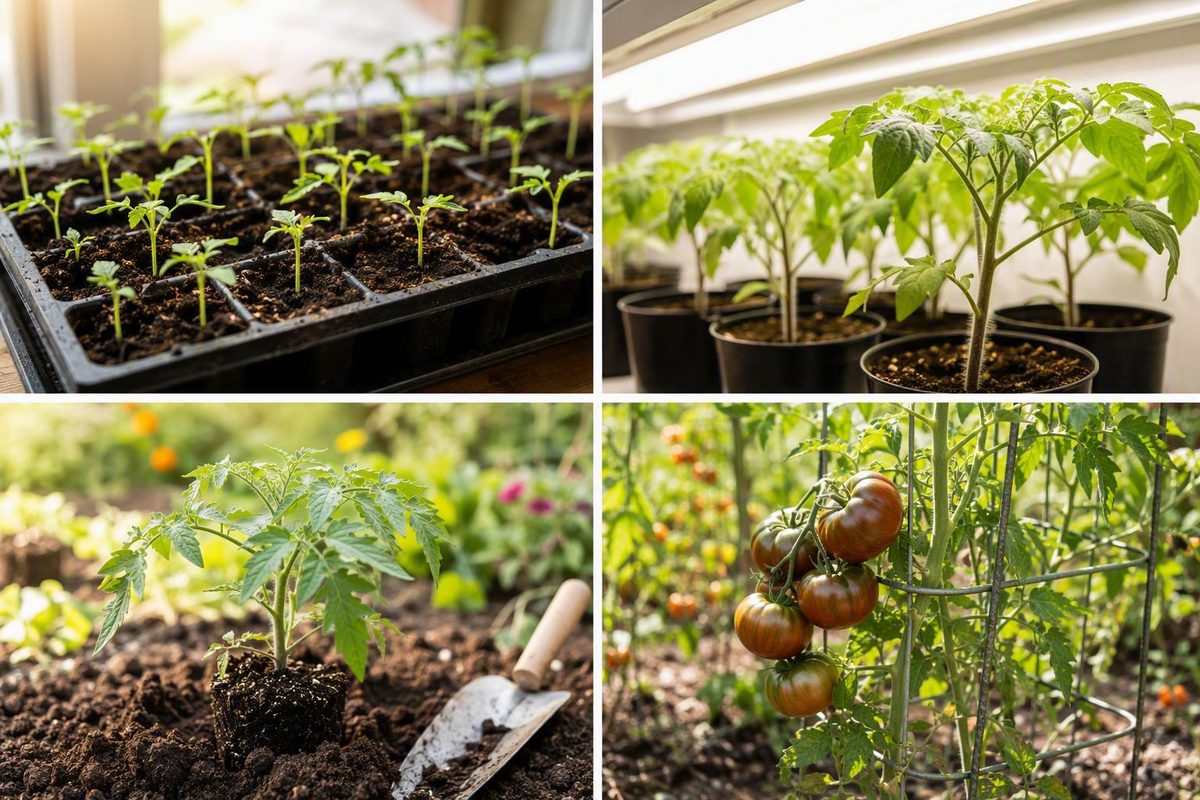
Start the seeds in warm mix, move emerging seedlings promptly into strong light, transplant only after frost danger has passed, and install substantial support before the vines begin to sprawl.
Catalog descriptions disagree about Black Prince’s mature height, fruit size, color, maturity, yield, and climate performance. Those conflicts make precise promises unreliable. A sound growing plan should instead emphasize the requirements that recur across the available guidance: frost-free weather, full sun, drainage, adequate space, consistent root-zone moisture, and sturdy support.
Black Prince tomato at a glance
Black Prince is sold botanically as Solanum lycopersicum and is consistently described as an indeterminate heirloom tomato. Plan for a strong cage, stake, or trellis rather than a small, self-supporting patio plant.
| Growing decision | Practical guideline |
|---|---|
| Indoor sowing | Approximately 5–8 weeks before the local average final frost; about six weeks is a useful midpoint |
| Sowing depth | Approximately 1/4 inch |
| Germination-medium temperature | Roughly 75–85°F |
| Expected emergence | Commonly about 3–10 days, although some listings allow longer |
| Outdoor transplanting | After frost danger has passed and outdoor conditions have warmed |
| Sun | At least six hours of direct sunlight daily |
| Plant spacing | At least 24 inches; 2–3 feet is a common range |
| Growth habit | Indeterminate; support is necessary |
| Estimated maturity | Commonly listed around 70–75 days, but the counting point is inconsistent |
| Fruit appearance | Generally medium-small to medium and dark red, brown, or mahogany, with variable shoulder color |
These are planning ranges, not guarantees. San Diego Seed Company, for example, lists a 1/4-inch planting depth, emergence in 3–10 or more days, final spacing of at least 24 inches, a height of 36–90 inches, and maturity in 70 or more days. Its product table does not clearly define where the maturity count begins (San Diego Seed Company’s Black Prince specifications).
Reported height varies even more across the full set of listings—from approximately 3 feet at the low end to 9 feet at the high end. Do not design the support around the shortest estimate. Use a tall, firmly anchored structure capable of carrying a vigorous vine and developing fruit, then guide new growth onto it throughout the season.
Fruit descriptions also conflict. Depending on the seller, Black Prince may be described as small or medium, round or slightly pear-shaped, and dark red, brown, green-shouldered, mahogany, or orange-red near the blossom end. The safest expectation is medium-small to medium fruit that develops a dark red-to-brown or mahogany cast. Once the first fruits ripen, the recurring pattern on your own plant will be more useful than a catalog photograph.
Treat descriptions of rich flavor, low acidity, heavy yields, crack resistance, or exceptional cool-climate performance as seller claims rather than independently established characteristics. Flavor is subjective, while yield, cracking, and maturity can vary with weather, soil, moisture, season length, plant health, and cultivation.
Build the planting calendar from your final frost date
Do not choose a universal sowing month or rely on a USDA hardiness-zone number. Find your area’s average final spring frost date and count backward approximately five to eight weeks. General tomato guidance supports that flexible range, with about six weeks indoors as a practical target for producing transplant-sized seedlings (A Way to Garden’s tomato seed-starting guidance).
For example:
- Average final frost: May 15
- Count back six weeks: approximately April 3
- Begin preparing to harden seedlings: early May
- Transplant: after frost danger has passed and current outdoor conditions are suitable
May 15 is not an automatic planting appointment. Check the current forecast and assess the soil, nighttime conditions, and seedlings before transplanting.
The five-to-eight-week range is intentionally flexible. A gardener with limited indoor space or weak lighting may get better results by starting four or five weeks ahead and setting out younger, stockier plants. Starting seven or eight weeks ahead can work when there is strong light, room for individual pots, and enough space to pot seedlings up as their roots fill the original cells. An early start without those resources can produce crowded, stretched, or root-bound plants.
Keep three temperature decisions separate:
- Germination temperature: The seed-starting mix needs warmth for emergence.
- Seedling-growing temperature: After emergence, the warm, enclosed germination environment is no longer desirable.
- Transplanting conditions: Outdoor soil and weather must be suitable, with frost danger behind you.
A warm seed tray does not mean the garden is ready. Likewise, a mild afternoon does not mean that cold soil or cold nights are appropriate for tomato transplants.
Black Prince is frequently associated with Siberia and is sometimes promoted for cooler climates. That origin story does not make it frost tolerant. A third-party plant guide that describes it as a Siberian heirloom still classifies tomatoes as unable to tolerate frost and gives 60°F as a minimum outdoor soil temperature (Smart Gardener’s Black Prince overview).
Direct sowing is an option only where the frost-free season is long enough for seeds to emerge, plants to establish and flower, and fruit to ripen before cold weather returns. Indoor sowing followed by transplanting is the more consistently recommended method in the available Black Prince guidance.
Gardeners who need a broader checklist for trays, lighting, heat mats, watering, and scheduling can consult Garden Seed Source’s indoor seed-starting guide alongside this cultivar-specific plan.
Sow and germinate Black Prince seeds indoors
Use clean containers with unobstructed drainage holes and fresh, well-draining seed-starting mix. Avoid using dense garden soil in small indoor cells. The available general tomato guidance favors fresh soilless or seed-starting mix because it is easier to keep evenly moist and aerated.
Pre-moisten the mix before filling the cells. Fill the containers without compressing the material into a hard block.
Sow Black Prince seeds approximately 1/4 inch deep. Place each seed on the surface, cover it with about 1/4 inch of mix, and press very gently to establish contact between the seed and damp medium. Label the tray with the variety and sowing date.
Target approximately 75–85°F in the germination medium. Recommendations in the supplied sources extend from about 70°F to 90°F, but the narrower range is a practical overlap. Annie’s Heirloom Seeds specifies 75–85°F, a 1/4-inch sowing depth, and germination in 6–10 days for Black Prince (Annie’s Heirloom Seeds planting instructions).
A thermostatically controlled heat mat can help keep the root zone warm in a cool room. Its purpose is to maintain the desired medium temperature, not to heat the tray indefinitely.
Keep the mix consistently moist while the seeds germinate, but do not leave the cells waterlogged. A humidity dome or loose clear cover can slow evaporation, but it does not replace regular inspection. If the surface begins to dry, add water gently enough that the seeds are not displaced or washed deeper into the mix.
Under suitable conditions, emergence commonly begins within approximately 3–10 days, although another listing allows 7–14 days. Temperature, seed age, storage, sowing depth, and moisture can all affect the result. Do not discard the tray merely because it has not sprouted on the earliest advertised day.
As soon as seedlings emerge:
- Remove the humidity cover.
- Take the tray off bottom heat.
- Move the seedlings into strong light.
- Continue checking moisture without keeping the mix saturated.
- Provide room for air to move around the tray.
The supplied evidence does not establish a reliable tomato-seed float test. In particular, it does not support discarding every floating seed as certainly dead. If seed is scarce or questionable, sow it in a labeled cell and evaluate whether it germinates under appropriate conditions.
Grow stocky seedlings instead of leggy ones
Once seedlings emerge, the priority changes from encouraging germination to controlling growth. These are general tomato-seedling practices applied to Black Prince; the cultivar has no established special indoor-light or fertilizer requirement.
Place newly emerged seedlings under strong light immediately. A common artificial-light schedule is approximately 14–16 hours on, followed by darkness. Continuous lighting is unnecessary. Using a timer makes the schedule easier to maintain.
Keep the fixture close enough to discourage stretching while following its manufacturer’s heat and clearance instructions. In one experienced grower’s fluorescent-light system, young tomato seedlings are kept about 1–2 inches below the fixture and later moved farther away. That distance should not be transferred automatically to hotter or more powerful equipment (Farm to Jar’s indoor tomato-seedling system).
Raise the light as the seedlings grow. Do not allow leaves to rest against the fixture. If stems are stretching rapidly, review light intensity, fixture distance, crowding, and excessive post-emergence warmth rather than assuming the plants need more fertilizer.
Post-emergence conditions can be cooler than the germination medium. Published examples include daytime temperatures in the mid-60s and cooler nights, but these are growing-system examples rather than a precise Black Prince requirement. The practical objective is to stop maintaining the hot, enclosed conditions used for sprouting while avoiding cold stress.
Water the root zone when the mix needs moisture instead of repeatedly misting only the surface. The mix should remain moist but aerated. Persistently wet cells and crowding are associated with damping off, in which young seedlings collapse near the soil line. Clean mix, containers with drainage, controlled watering, thinning, and airflow are sensible risk-reduction measures, but no method guarantees that every seedling will remain unaffected.
Provide gentle airflow around the seedlings rather than a strong blast directly at them. Space trays so leaves are not pressed against walls or neighboring plants. If several seedlings emerge in one cell, thin or separate them before the stems and roots become badly entangled.
Pot up according to plant development, not a fixed date. Useful cues include:
- Several true leaves have formed.
- Roots are filling the original cell.
- Seedlings are becoming crowded.
- The cell dries much faster than before.
- Plants are approximately 3–4 inches tall and need more root room.
Move seedlings into clean pots with fresh growing mix. Handle them gently and avoid crushing the stem. Potting up should preserve steady growth, not create an oversized indoor tomato. The goal is a short, stocky, well-rooted transplant rather than a tall, weak, severely root-bound, or flowering plant.
Fertilizer is conditional. The seed supports initial emergence. After true leaves appear, a diluted feed may be appropriate when the growing mix contains no fertilizer. If the mix already includes nutrients, additional feeding may be unnecessary and could stress young plants. Read the labels for both the mix and the fertilizer rather than feeding solely because a certain number of days has passed.
Harden off and transplant without rushing the season
Wait until danger of frost has passed. Several Black Prince guides also recommend transplanting when outdoor conditions have warmed, with soil near or above 60°F. A personal growing guide similarly recommends about one week of hardening and avoiding cold or very windy conditions during the transition (Black Prince transplanting guidance).
Begin hardening with short periods in sheltered or dappled shade. Indoor foliage has not experienced direct outdoor sun, wind, or rapid temperature changes, so moving plants immediately into an exposed, all-day location can damage them.
A practical progression is:
- Place seedlings outside briefly in sheltered, dappled shade.
- Return them to protection before conditions become cold or harsh.
- Increase outdoor time gradually each day.
- Introduce gentle morning sun before stronger midday or afternoon exposure.
- Increase wind exposure cautiously.
- Continue protecting plants from cold nights until transplanting conditions are appropriate.
Pause or extend the process during an abrupt cold spell, severe wind, or unusually intense heat. Hardening is gradual acclimation, not a test of how much stress a seedling can survive.
A transplant-ready Black Prince should be stocky, well rooted, and actively growing. Do not select a plant solely because it is the tallest. Weak, crowded, severely root-bound, or already flowering plants may be less balanced than smaller seedlings with sturdy stems and healthy roots.
Water the seedling before planting so the root ball is evenly moist rather than severely dry. Prepare the hole and support before removing the plant from its pot.
Several Black Prince sellers recommend deep planting. Remove leaves that would otherwise be below the final soil line, bury part of the stem, and keep healthy upper foliage above ground. Annie’s instructions recommend burying the stem deeply and leaving the top leaves exposed (Annie’s Heirloom Seeds transplanting directions).
Install the cage, stake, or trellis at planting time.
Space plants at least 24 inches apart; 2–3 feet is the more common range in the supplied Black Prince guidance. Use the wider end—or more room—when growing in broad cages, retaining several leaders, or working in a site with limited airflow. A carefully trained plant may fit more closely, but closer spacing requires consistent tying and growth management.
Do not let a hardiness-zone label replace local timing. For an annual tomato crop, the average final frost, current weather, soil warmth, summer conditions, and frost-free season are more useful than a broad zone designation.
Choose the site, spacing, and support system
Select a site receiving at least six hours of direct sunlight each day. Avoid sites shaded for much of the day by buildings, fences, or taller crops.
The soil should be fertile, well drained, and able to retain useful moisture without remaining saturated. Some sellers describe slightly acidic soil as preferable, but the evidence does not establish a precise pH requirement unique to Black Prince. Improve the soil according to its actual condition rather than trying to create an unverified cultivar-specific formula.
Plan for substantial growth. Smart Gardener lists a height of 72–108 inches and a spread of 24–36 inches, while other Black Prince listings give lower estimates. That inconsistency makes the support requirement more dependable than any exact mature height (Smart Gardener’s reported plant dimensions).
Choose a support system that matches the way you intend to manage the vine:
| Support system | Best suited to | Main tradeoff |
|---|---|---|
| Broad, sturdy cage | A minimally pruned plant with several leaders | Needs more horizontal space and a cage strong enough for a large vine |
| Tall stake | A plant trained to one main leader or possibly two | Requires frequent tying and monitoring |
| Anchored trellis | One or more leaders guided vertically | Requires secure posts and regular attachment of new growth |
The supplied evidence does not validate exact support dimensions specifically for Black Prince. The practical requirement is a tall, stable, firmly anchored structure capable of carrying the vines and developing fruit without leaning or collapsing. A short decorative hoop may hold a young transplant but is unlikely to manage a vigorous plant for an entire season.
Leave room for growth and inspect older ties periodically. Position young stems while they remain flexible rather than forcing thick, rigid vines back onto the support.
Spacing and support should be planned together. A broad cage holding several leaders requires more width than a vertically trained plant. At least 24 inches may work for carefully managed upright plants, while 2–3 feet or more is more appropriate for broad cages and minimal pruning.
Pruning is optional management, not a Black Prince requirement. Minimal pruning retains more foliage and reduces that labor, but it calls for a larger cage and more room. The supplied evidence does not establish that sucker removal improves Black Prince yield, accelerates ripening, or prevents disease.
Water, mulch, feed, and monitor plants through the season
Aim for reasonably consistent root-zone moisture rather than following a rigid calendar. Watering frequency changes with soil texture, rainfall, heat, wind, plant size, root development, mulch, and whether the tomato is growing in a bed or container.
Inspect the soil rather than judging only by its surface.
Apply water at soil level or use drip irrigation. This puts water near the roots and avoids wetting the foliage every time irrigation is needed. It does not make a tomato immune to disease.
After the soil has warmed, add surface mulch to slow drying and reduce abrupt moisture changes.
Uneven moisture may contribute to cracking or blossom-end rot, but the appearance of either problem does not prove that irrigation is the only factor. Review moisture consistency, drainage, root-zone conditions, container restriction where applicable, and the plant’s overall care before changing the watering routine. Smart Gardener specifically connects uneven watering with both disorders while recommending even moisture after flowering begins.
Begin with fertile soil and adjust feeding according to plant growth, soil condition, the growing medium, and the fertilizer label. The supplied material does not establish one nutrient ratio or fixed schedule as uniquely correct for Black Prince. Dense foliage with limited flowering should prompt a review of feeding, sunlight, temperature, and general stress rather than an automatic application of more fertilizer.
In-ground plants in fertile, prepared soil may need less intervention. In either case, follow product rates and observe the plant instead of adopting an unsupported weekly or biweekly schedule.
Continue guiding new vines onto their support. Tender growth is easier to position than a long stem that has already fallen sideways. Decide early whether the plant will retain several leaders in a cage or be trained to fewer leaders vertically; changing systems after the canopy becomes dense is difficult.
In very hot locations, temporary afternoon protection may reduce visible stress where reflected heat is intense. Treat that as a site-specific adjustment, not a universal Black Prince requirement. The plant still needs sufficient direct sunlight to grow and fruit.
Keep a simple garden log recording:
- Sowing date
- First emergence
- Potting-up date
- Start and end of hardening
- Transplant date
- First flower
- First developing fruit
- First ripe harvest
That record will provide a more useful local timeline than a catalog maturity number with an unclear starting point.
Grow Black Prince in a container
Black Prince can be grown in a container, but a pot does not turn it into a compact patio tomato. It remains an indeterminate vine requiring root room, regular moisture checks, feeding as conditions warrant, and substantial support.
Choose the largest practical, stable container with free drainage. Fill it with fertile, well-draining potting mix rather than dense garden soil. Add surface mulch after conditions have warmed, and anchor the support so the combined weight of foliage and fruit cannot overturn the container.
Published dimensions should be treated as general recommendations, not proven Black Prince minimums. One guide suggests a container approximately 24–48 inches deep and 18–36 inches in diameter, while San Diego Seed Company recommends at least 20 inches of depth in its general container guidance. Neither figure establishes a validated minimum volume for this cultivar (San Diego Seed Company’s container guidance).
| Care factor | In-ground plant | Container plant |
|---|---|---|
| Root space | Can extend into surrounding soil | Confined by the container |
| Horizontal spacing | Commonly 2–3 feet, adjusted for training | One plant still needs room around its canopy |
| Moisture checks | Based on soil, rainfall, weather, and plant size | Often more frequent; daily checks may be needed during hot weather |
| Feeding | Influenced by native soil and amendments | More deliberate because the nutrient reservoir is limited |
| Mulch | Helps moderate soil drying | Especially useful for slowing surface drying |
| Support | Anchored in the bed or adjacent structure | Must be secured without making the pot unstable |
Water thoroughly enough to moisten the root zone and let excess drain from the bottom. Do not leave the container continuously saturated. At the other extreme, avoid waiting for severe wilting before every irrigation.
Check the mix frequently during hot or windy weather. Daily checking does not mean automatic daily watering; inspect the mix and respond to its condition.
Feed responsively. The appropriate interval depends on whether the potting mix already contains fertilizer, the product formulation, container size, watering frequency, weather, and plant condition. Follow the fertilizer label and account for all products being applied rather than combining them casually.
Support anchoring needs particular attention. A trellis inserted only shallowly into loose potting mix may become unstable as the canopy catches the wind. Use a sturdy cage fitted to the container, secure the support to an appropriate fixed structure, or design the container and trellis as one stable unit.
Where patio or balcony width is limited, one- or two-leader training can reduce the plant’s spread. It does not eliminate the need for vertical room, root space, water, nutrients, or secure support. A narrow plant can still become tall and top-heavy.
Estimate harvest, judge ripeness, and troubleshoot cautiously
The most common maturity estimate for Black Prince is approximately 70–75 days, but that number is not a guaranteed harvest deadline. Catalogs do not consistently explain whether the count begins at sowing or transplanting. Plant Good Seed Company instead lists 80–95 days specifically from seed, showing how a different starting point produces a longer figure (Plant Good Seed Company’s Black Prince listing).
Record both the transplant date and the first ripe harvest. Weather, transplant age, plant health, and growing conditions may move the result earlier or later than an advertised estimate.
Judge ripeness by combining several cues:
- The fruit has developed the dark red, brown, or mahogany coloration typical of that plant.
- The shoulders have changed from their immature appearance.
- The fruit yields slightly to gentle pressure.
- The surface no longer looks uniformly hard and green.
Some show brown shoulders with an orange-red blossom end; others mention red, brown, green, mahogany, or deep-red coloring. Watch several fruits mature and learn the recurring pattern on your plant.
For common problems, review the growing conditions before blaming the cultivar.
Poor germination: Check the medium temperature, moisture, sowing depth, seed age, and elapsed time. Make sure the tray has neither dried completely nor remained waterlogged. Correct unsuitable conditions before reseeding.
Leggy seedlings: Review light intensity, fixture distance, post-emergence warmth, crowding, and airflow.
Seedlings collapsing near the soil line: Review container cleanliness, drainage, saturation, crowding, and airflow. Remove affected seedlings and correct the environment. These measures reduce risk but cannot guarantee prevention.
Cracked fruit or blossom-end rot: Review moisture swings and the general condition of the root zone. Do not add more water automatically if the soil is already saturated.
Flowers fail to produce fruit: Review whether the problem coincided with unfavorable weather or visible plant stress, then check sunlight, moisture, nutrition, and overall plant condition. The supplied evidence does not support diagnosing the cause remotely from a symptom alone.
Low yield or weak growth: Review the plant’s full history, including seedling quality, transplant timing, weather, root-zone conditions, water, fertility, support, pests, disease symptoms, and light. The evidence does not establish a typical Black Prince yield against which every plant can be judged.
Pseudonymous forum accounts illustrate variability but cannot establish normal performance. In one discussion, a gardener reported two seasons without fruit, while another reported approximately five or six fruits per plant. The conditions were not controlled or fully documented, so the reports cannot prove either typical productivity or an inherent varietal defect (Houzz gardeners’ Black Prince anecdotes).
The dependable requirements remain straightforward: plant after frost, provide full sun, allow adequate space, install strong support, maintain drainage, and manage the root zone consistently. Claims about superior flavor, exceptional yield, crack resistance, or special cool-climate performance remain less certain.
A compact action plan is enough:
- Count back about six weeks from the local average final frost.
- Sow approximately 1/4 inch deep in warm, damp seed-starting mix.
- Move emerged seedlings immediately into strong light and off bottom heat.
- Pot up as true leaves and roots develop, aiming for stocky plants.
- Harden seedlings gradually for about one week.
- Transplant only after frost danger has passed and conditions have warmed.
- Install a sturdy cage, stake, or trellis at planting.
- Maintain sun, root space, drainage, and reasonably consistent moisture.
- Judge maturity from the plant and fruit rather than a catalog deadline alone.
Frequently asked questions
Is Black Prince tomato determinate or indeterminate?
Black Prince is consistently listed as an indeterminate heirloom tomato. Its vines continue growing through the season, so the plant needs a sturdy cage, stake, or trellis. Do not plan for it as a compact, self-supporting patio variety.
How long does a Black Prince tomato take to grow?
Most listings give an estimated maturity of approximately 70–75 days, but they do not consistently state whether that period begins at sowing or transplanting. One seller lists 80–95 days from seed. Record the sowing date, transplant date, and first ripe harvest to establish a useful timeline for your location.
Can Black Prince tomatoes grow in containers?
Yes. Use a large, stable, freely draining container, fertile potting mix, surface mulch, and securely anchored support. Check moisture frequently because a container has limited root space and may dry quickly during hot or windy weather. The supplied evidence does not establish a validated minimum container volume specific to Black Prince.
How can I tell when a Black Prince tomato is ripe?
Use color and feel together. A ripe fruit should have developed the dark red, brown, or mahogany coloration characteristic of your plant, including mature shoulder color, and should yield slightly to gentle pressure. Because seller descriptions differ, learn the pattern shown by successive fruits on your own plant.
Does Black Prince grow better in cool climates?
Some sellers associate Black Prince with Siberia and market it as suited to cooler climates, but the available evidence does not independently demonstrate that it outperforms comparable heirloom tomatoes in cool summers. It remains frost tender and should be planted only after frost danger has passed and conditions have warmed. Local frost dates, sunlight, summer temperatures, and season length are more useful planning tools than the variety’s origin story.