
Black Strawberry Tomato: Growing and Ripeness Guide
Start Black Strawberry tomato seeds, support the indeterminate vines, interpret the 60-day estimate and recognize ripe multicolored fruit.
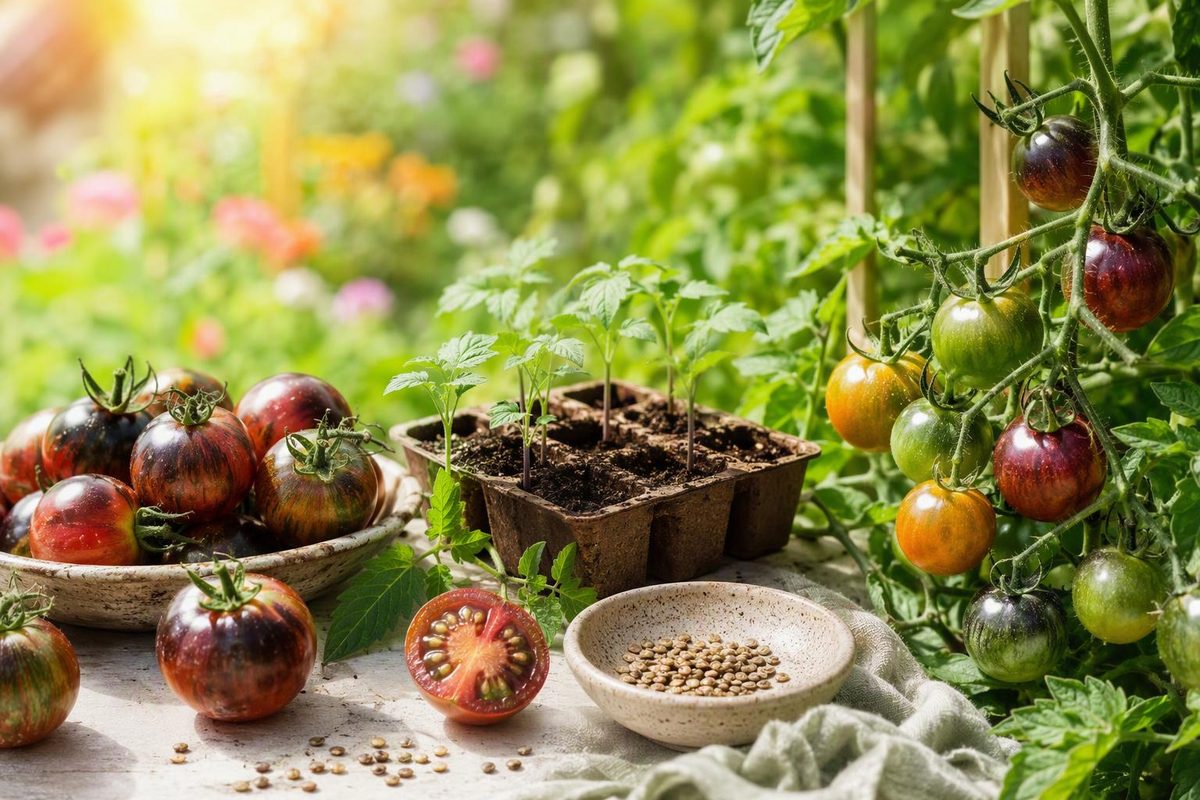
Black Strawberry is an early, indeterminate tomato with small, multicolored fruit—not a tomato crossed with a strawberry. J&L Heritage Seeds identifies its parents as ‘Bosque Blue’ and ‘Strawberry Tiger’ and describes a large, regular-leaved vine producing fruit in about 60 days. Its catalog first listed the variety in 2015 (J&L Heritage Seeds).
Fruit appearance is not completely uniform. Baker Creek describes roughly 2-ounce fruit marbled purple, pink, green and gold, while noting that some plants produce grape-shaped tomatoes (Baker Creek). Treat the packet photograph as an example, not a precise ripeness chart.
Black Strawberry at a glance
- Species: Solanum lycopersicum
- Growth habit: Indeterminate
- Fruit: Cherry or cocktail type, often listed at about 2 ounces
- Catalog maturity: About 60 days from transplant under favorable conditions
- Support: Tall cage, stake or trellis
- Light: Full sun
- Seed status: Open-pollinated, according to Victory Seed Company
The “60 days” figure is for comparison with other varieties, not a countdown from sowing. Tomato maturity estimates generally begin at transplanting, and cool, cloudy weather can delay the first ripe fruit (Cornell Garden-Based Learning). Add the indoor seedling period and hardening time when planning your season.
Start the seeds warm, then grow the seedlings cooler
Sow indoors six to eight weeks before you expect to transplant. Base that transplant date on local conditions rather than the average last frost date alone; tomatoes can still be stressed by cold soil and nights after frost risk has declined.
- Fill cells with damp, sterile seed-starting mix.
- Sow one or two seeds per cell, 1/8 to 1/4 inch deep. Cornell specifies 1/8 inch, while Victory Seed Company specifies 1/4 inch, so either shallow covering is reasonable.
- Keep the seed zone at 75–90°F if possible. Cornell reports emergence in 6–12 days and best germination within this range.
- Once seedlings emerge, remove them from supplemental bottom heat and place them under strong light.
- Grow the seedlings near 70°F. Warm conditions without sufficient light encourage thin, stretched stems.
- Thin to one plant per cell. Move a seedling to a larger pot when roots fill its cell or it has at least two sets of leaves.
For light placement, watering and hardening checkpoints, see the indoor seed-starting guide.
Transplant after the soil and nights warm
Gradually expose seedlings to outdoor sun, wind and drier air before planting. Bring them under cover if frost threatens.
Transplant after frost danger has passed and the soil has warmed. Cornell advises waiting until nighttime temperatures remain above 45°F. Choose well-drained soil and a site with at least eight hours of direct sun where the climate and site permit.
Space plants about 24 inches apart when training them upright. Give them more room when using broad cages or retaining several stems. Set each plant deeply, with the soil just below the lowest remaining leaves; tomato stems can form roots along their buried portions.
Install the support at planting. Black Strawberry is not a compact patio variety: Baker Creek says its vines can reach 5–7 feet. Use an anchored tall cage or trellis rather than a short decorative tomato ring.
Keep growth steady
Water deeply at soil level as needed to keep the root zone evenly moist but not waterlogged. Mulch after the soil warms to reduce moisture swings and soil splash. Cornell notes that consistent moisture helps prevent cracking and blossom-end rot; avoiding wet foliage and crowding also lowers the risk of common leaf diseases.
Pruning is optional. A cage can carry several stems with less weekly attention. Where space is tight, train one or two main stems and remove small suckers regularly. There is a tradeoff: Cornell reports that staking and pruning can hasten harvest and produce larger fruit, but usually reduce total yield and make fruit more vulnerable to sunscald. Do not remove leaves simply to darken the tomatoes.
Avoid excess nitrogen. Dense foliage with few flowers is a reason to review fertilizer use, not add more automatically. Base amendments on a soil test and the fertilizer label rather than a fixed calendar.
How to tell when Black Strawberry is ripe
Do not pick solely because the shoulders have turned purple-black. Victory Seed Company notes that direct sunlight makes the fruit darker, so exposed areas can color before the tomato is ready to eat.
Use these cues together:
- Background color: Watch the initially green areas, especially near the blossom end, for a change toward red, rose or deep burgundy.
- Feel: The fruit should give slightly under gentle pressure rather than remain hard.
- Attachment: A ripe tomato generally releases without a hard pull.
Seed Savers Exchange similarly advises harvesting tomatoes when they remain firm but give a little and pull easily from the vine (Seed Savers Exchange). With an anthocyanin-rich tomato, that feel and the changing background color are more useful than waiting for the entire fruit to turn black.
The dark skin may look dull purple at maturity. Illinois Extension describes the same general pattern in “blue” tomatoes: sun-exposed skin becomes almost black, while shaded portions that remain green eventually ripen red (Illinois Extension). Black Strawberry’s final mix of colors can still vary from plant to plant.
Very hot weather can slow tomato ripening. Cornell Cooperative Extension reports an optimum ripening range of 70–75°F, with the process slowing markedly above 85–90°F. If a fruit has begun changing its background color during persistent heat, it can finish indoors at room temperature; do not refrigerate it before it ripens (Cornell Cooperative Extension).
Black Strawberry suits a gardener who wants an early, unusual snacking tomato and has room to support a full-size vine. For another indeterminate multicolored variety, compare its growth and ripeness cues with Brad’s Atomic Grape.