Feature
Choose the Right Raspberry Canes and Give Them a Strong Start
June Albright ·
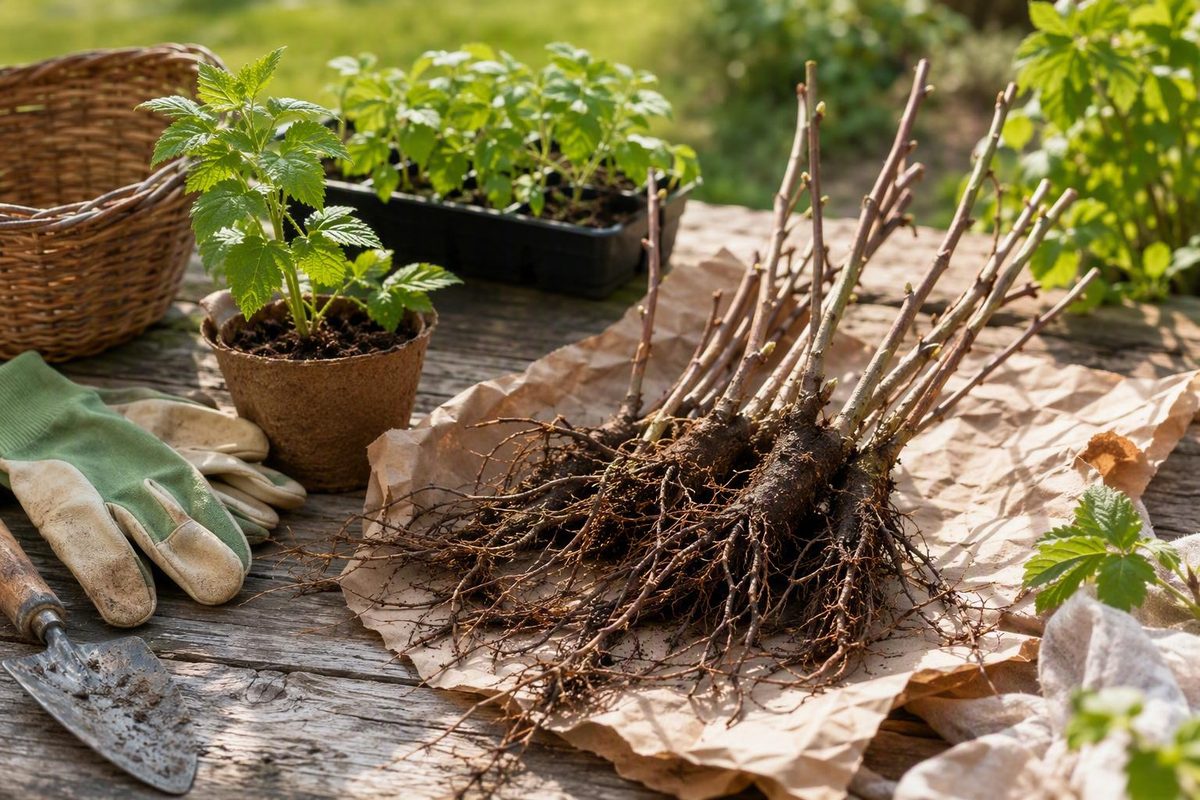
Bare root raspberry bushes can be economical when bundle price, shipping cost, plant count, and cultivar suitability compare favorably with potted stock. The cheapest bundle, however, is not necessarily the best buy. A successful planting begins with four decisions: confirm that the product really is bare root, choose a fruiting habit suited to your harvest and pruning plans, match the cultivar to local conditions, and prepare a site where dormant roots can establish without drying out or sitting in water.
The word “bushes” is convenient shopping language. Raspberries grow as perennial root-and-crown systems that continually produce new canes. Understanding that growth cycle makes it easier to compare listings, handle dormant stock, and know what to expect after the short shipping cane develops into a row.
Cultivation guidance below prioritizes university Extension sources. Retailer examples are limited to verifiable listing details rather than claims about flavor, yield, vigor, or disease resistance. Prices, inventory, promotions, location-based fit labels, and shipping dates are snapshots accessed on August 11, 2026 and should be checked again before ordering.
What a bare-root raspberry plant actually is
A bare-root raspberry is dormant nursery stock supplied without a pot or soil around its roots. It commonly consists of a modest root system attached to a short, leafless cane with dormant buds. Depending on the nursery and packing method, the roots may arrive wrapped in damp paper or another moisture-retaining material.
That package can be underwhelming if you expected a leafy “bush.” The cane may resemble a stick, and the root system may look small compared with the eventual planting. Dormancy explains the lack of leaves, but appearance alone cannot prove that a plant is viable. The supplied evidence does not establish a reliable home test for determining whether every leafless cane will grow.
Raspberry roots and crowns are perennial, while individual canes generally live through two growing seasons. A first-year cane is a primocane. After winter dormancy, it becomes a second-year floricane, which dies after completing its fruiting cycle. Some cultivars can also fruit on first-year growth, so cane age affects both harvest timing and future pruning (University of Minnesota Extension).
New growth does not necessarily appear only on the visible shipping cane. Buds on that cane may break, but the root system can also produce basal shoots from below ground. Mark the planting position so that a new raspberry shoot emerging beside the original stub is not mistaken for a weed.
Bare roots differ from plugs and potted raspberries:
- Bare-root plants are dormant, soil-free, and normally sold for planting during the dormant season.
- Plugs are small plants with actively growing roots and leaves in a compact root ball.
- Potted plants have a soil-filled root ball and may arrive in active growth.
University of Minnesota Extension describes dormant bare-root raspberries as having a small root system and several inches of cane with live dormant buds, while plugs have actively growing leaves and roots. Bare roots must be protected from drying and planted in workable soil; actively growing plants require handling appropriate to their nursery conditions (University of Minnesota Extension’s comparison of bare roots and plugs).
Anatomy of a dormant bare-root raspberry
| Part | What to look for |
|---|---|
| Roots | Multiple woody or fibrous roots extending away from the cane |
| Crown or root–cane transition | The junction where roots meet the upright cane |
| Approximate former soil line | A faint color or texture change that can help with placement |
| Cane stub | The short section supplied above the roots |
| Dormant buds | Small buds positioned along the cane |
| Basal-shoot zone | The below-ground area from which new shoots may emerge |
The former soil mark is a reference, not proof of one universally correct crown position. Nursery grades and instructions differ, so use the diagram supplied with the plants when deciding final depth.
Choose by fruiting habit, climate fit, color, and growth traits
Start with fruiting habit rather than berry color or promotional language. Fruiting habit determines which canes bear the main crop, when harvest is likely to occur, and which canes must remain during pruning.
Traditional summer-bearing raspberries produce their principal crop on second-year floricanes. Their first-year primocanes grow, overwinter, and fruit the following season. Cutting every cane to the ground annually would remove the canes needed for the next summer crop.
Primocane-bearing raspberries, often marketed as fall-bearing or everbearing, can fruit on current-year growth. Depending on the cultivar, climate, and pruning system, gardeners may manage them for one later crop or preserve part of the cane for another crop. “Everbearing” does not mean that the plant fruits continuously throughout the year.
A row containing summer-bearing and primocane-bearing cultivars can broaden the harvest window, but it also creates different pruning requirements. Keep each cultivar labeled and grouped in a known section rather than mixing unidentified plants throughout the row.
The following table reports retailer classifications rather than independent performance recommendations. It is based on the Hand Picked Nursery and Burpee category pages accessed August 11, 2026. A blank zone entry means that the relevant captured listing did not provide a zone, not that the cultivar lacks a hardiness range (Hand Picked Nursery; Burpee).
| Cultivar | Listed fruit color | Listed fruiting habit | Thornlessness explicitly stated? | Advertised hardiness zone | Retailer supplying the listed detail |
|---|---|---|---|---|---|
| Boyne | Red | Early summer | Not stated | 3–7 | Hand Picked Nursery |
| Nova | Red | Summer-bearing | Yes | 3–8 | Hand Picked Nursery |
| Heritage | Red | Everbearing or fall-bearing | Not stated | 4–8 on Hand Picked Nursery | Hand Picked Nursery and Burpee |
| Joan J | Red | Everbearing | Yes | Not supplied in the compared category entries | Hand Picked Nursery and Burpee |
| Prelude | Red | Dual-season, with summer and fall harvests | Not stated | 4–8 on Hand Picked Nursery | Hand Picked Nursery and Burpee |
Use those labels as shopping filters, not as proof that one cultivar will yield more, taste better, resist local diseases, or perform best in your soil.
Color can provide a secondary filter. The retailer material includes yellow or gold choices such as Anne and Double Gold, black raspberries such as Jewel and Bristol, and the purple raspberry Brandywine. Black and purple raspberries should not automatically be given the same spacing or management as red and yellow types.
Do not confuse ordinary raspberry cultivars with products identified as raspberry-blackberry crosses. Burpee explicitly describes loganberry and tayberry as crosses rather than ordinary raspberry cultivars. Similar retail categorization is not a reason to assume that every bramble has the same growth, support, spacing, or pruning requirements.
After choosing a fruiting habit and color, screen candidates for:
- USDA hardiness zone
- Local winter minimums and freeze-thaw patterns
- Summer heat and sun exposure
- Humidity and rainfall
- Locally important root, cane, and virus problems
- Available row length
- Support requirements
- Thorn tolerance
- Preferred harvest period
- Willingness to follow cultivar-specific pruning
A retailer’s zone range or ZIP-code fit label can eliminate obviously unsuitable choices, but it is not an independent regional trial. Confirm the shortlist through a regional Extension office or university fruit guide, especially where winters are marginal, summers are very hot, or raspberry diseases are common.
Treat thornlessness just as carefully. Do not infer it from a photograph or from a smooth-looking shipping cane. In the compared listings, Joan J and Nova were explicitly called thornless. For other cultivars, consider the trait unspecified unless the exact product listing states it.
How to evaluate listings, prices, bundles, and seasonal stock
A category page titled “raspberries” does not establish that every product on it is supplied bare root. Retailers may mix bare roots, potted plants, hybrids, collections, and products whose supplied form is not stated. Burpee’s category page, for example, explicitly labeled Prelude, Joan J, Anne, a Favorite Collection, and Polana as bare roots, but did not apply that designation to every raspberry shown.
Before ordering, verify:
- Plant form: Does the exact product say “bare root”?
- Cultivar: Is the plant named, or is it an unidentified color or assortment?
- Plant count: Is the displayed price for one plant, a bundle, or a collection?
- Age or nursery grade: Is either stated?
- Root or cane specification: Does the listing give dimensions, grade, or minimum size?
- Fruiting habit: Is it summer-bearing, primocane-bearing, fall-bearing, or dual-season?
- Hardiness information: Does the stated range include your zone?
- Shipping window: Is it a fixed date, regional estimate, or weather-dependent period?
- Stock status: Is the product available, on preorder, or sold out?
- Replacement policy: What proof and reporting deadline are required?
- Collection contents: Are all included cultivars identified?
- Location restrictions: Can the nursery ship that plant to your address?
The available evidence does not support ranking nurseries by root grade, guarantee quality, or regional cultivar performance. Use listings to verify what the seller promises to send, then use independent regional guidance to decide whether the plant belongs in your garden.
Bare-root inventory is highly seasonal. When accessed August 11, 2026, Burpee’s products explicitly labeled as bare roots were marked out of stock. Most visible Indiana Berry entries were marked sold out for the 2026 season. Food Forest Nursery displayed a March 15, 2027 shipping date for the entered ZIP code 20120; that location-specific date should not be assumed to apply elsewhere (Food Forest Nursery).
To compare bundles, divide the displayed price by the number of plants:
Per-plant cost = package price ÷ number of plants
When accessed August 11, 2026, Hand Picked Nursery listed a four-plant collection at $39.95, equal to approximately $9.99 per plant. Indiana Berry listed a nine-plant collection at $52.65 and a 12-plant collection at $70.20; each calculates to $5.85 per plant, although both visible collection listings were out of stock (Indiana Berry).
A lower unit price matters only when the plants fit the plan. A 12-plant color collection may be poor value for a short row. A mixed summer-and-fall collection may complicate pruning, while a collection containing black or purple raspberries may require different spacing. Also account for trellis materials, aisle space, shipping, and the risk of buying more plants than the site can support.
Individual starting prices visible in the supplied retailer pages commonly fell around $13 to $19 when accessed August 11, 2026. That is not a stable market-wide range. “Starting at” or “as low as” pricing may depend on quantity or variant, and shipping can materially change delivered cost.
Promotions, free-shipping thresholds, guarantees, inventory, fit labels, and dispatch dates are retailer- and time-specific. Recheck all of them at checkout and save a copy of the policy that applies to the order.
Keep listing facts separate from marketing claims. A page can establish the seller’s cultivar name, plant form, plant count, displayed price, and shipping status. Statements about exceptional sweetness, heavy yields, rapid establishment, superior disease resistance, or first-season production require independent support before they should drive a comparison.
Buy named, disease-free plants from a reputable nursery rather than digging unidentified suckers from a planting of unknown health. University of Minnesota Extension warns that infected stock can introduce viruses into a raspberry planting and that infected plants cannot be cured.
When to order, plant, and temporarily store dormant canes
Choose planting time from plant condition and soil condition rather than one nationwide date. A dormant bare-root raspberry is ready to plant when:
- The soil has thawed
- It can be dug without smearing into saturated clods
- The planting area is not holding standing water
- The roots can be covered promptly and watered in
University of Minnesota Extension places bare-root planting in April or May for home gardens and specifies May once the soil is workable in its commercial planting guidance. Those are regional examples for Minnesota, not universal instructions to wait until May everywhere (University of Minnesota Extension).
Ordering frequently occurs before planting. Nurseries may accept orders while plants are dormant and ship while the buyer’s garden remains frozen, flooded, or covered by snow. Do not leave an unopened parcel in a warm room while waiting for the site to improve.
If immediate planting is impossible, keep dormant plants refrigerated with the roots moist and wrapped. “Moist” means protected from drying, not submerged indefinitely. Avoid exposing roots to moving air or leaving them in standing water.
The evidence does not establish one safe maximum refrigeration period for every nursery grade and packing method. Plant promptly and ask the supplier how long its packaging is intended to protect the roots. Check the replacement-policy deadline at the same time.
A plant that arrives with leaves or actively elongating shoots is not equivalent to fully dormant stock. Do not automatically apply a dormant-storage routine. Ask the nursery for product-specific directions concerning storage, frost protection, and outdoor acclimation.
Use this decision path:
- Dormant plant and workable, unsaturated soil: Plant promptly.
- Dormant plant and frozen or saturated soil: Refrigerate it with the roots moist and wrapped.
- Plant with active leaves or shoots: Follow the nursery’s instructions for frost protection and acclimation.
- Roots arrive frozen, severely dried, soft, or extensively decayed: Photograph the plant and packaging and contact the seller before altering or discarding anything.
Prepare a sunny, well-drained site with room for the row to spread
Raspberries produce the most fruit in full sun. Partial shade may keep plants growing, but it generally reduces production. Favor a site with good airflow and enough access to weed, inspect, tie, prune, and harvest the canes.
Drainage is equally important. New roots need moisture during establishment, but standing water deprives roots of oxygen and raises the risk of decline and disease. Improve the drainage or choose another site before the plants arrive.
Test the soil before trying to alter its pH. The supplied guidance broadly favors acidic to mildly acidic soil, but its exact recommended ranges differ. Soil texture, existing pH, buffering capacity, and product concentration determine how much sulfur or another amendment would be appropriate.
Use the same restraint with fertilizer, manure, and compost. Organic matter may improve some soils, but no fixed dose is suitable for every site. Base amendments on a soil test and product-specific directions.
For general home-garden planning, allow approximately 2 to 3 feet between many red and yellow raspberry plants. Black and purple raspberries often need more room; University of Minnesota Extension recommends about 4 feet between black and purple plants. Its home-garden guidance also recommends support for all raspberry types.
Commercial-style raspberry rows may place centers 6.5 to 8 feet apart because mature foliage and fruiting laterals extend into the aisle. A home gardener with one row need not reproduce a field layout, but should preserve enough room to walk, harvest, prune, and reach both sides.
Think beyond the first-year cane. Red and yellow raspberries can produce shoots that fill the spaces between plants and extend beyond the original row. Define the intended cane strip before planting. A narrow, managed row is easier to support, harvest, inspect, and keep weed-free than an unrestricted thicket.
Plan support early, even when the shipping canes look too short to need it. Posts and wires are easier to install before roots and long canes occupy the space. A trellis can keep fruiting canes upright, improve access, and help separate productive canes from new growth without implying that every cultivar requires the same design.
Example row layout
                   6.5–8 ft between row centers where multiple rows are used

Harvesting aisle
────────────────────────────────────────────────────────────────────────────

        post      wire-supported managed cane strip                post
          │    ●────────●────────●────────●────────●                 │
          │      selected in-row spacing; wider for some types      │
          │    ← suckers redirected into or removed from strip →    │

────────────────────────────────────────────────────────────────────────────
Harvesting aisle or access from the opposite side
For a single home row, preserve access from both sides where space permits. Keep the managed strip narrow enough that its center does not become unreachable.
Planting day: inspect, hydrate, position, backfill, and water
Planting is mainly an exercise in preventing root exposure, avoiding unnecessary root damage, and positioning the plant shallowly enough for shoots to emerge while keeping the roots covered after settling.
1. Open and inspect the package
Open the parcel promptly and confirm:
- Cultivar names
- Promised plant count
- Presence of labels
- Whether the roots are still moist
- Whether canes or roots broke in transit
- Whether the plant differs materially from the nursery’s description
The supplied evidence does not provide a validated home protocol for diagnosing viability, mold, freezing injury, or decay. Photograph anything concerning before soaking, trimming, or planting it, preserve the packaging, and contact the supplier promptly.
Keep the roots covered while organizing tools and labels. Do not leave them exposed to sun or drying air.
2. Hydrate the roots without prolonged immersion
Stark Bro’s recommends soaking only the roots for up to about two hours before planting. Other supplied guides give different limits, so the defensible principle is to restore moisture and prevent desiccation rather than impose one exact soak time on every nursery grade (Stark Bro’s bare-root planting guide).
Keep the cane out of the bucket. Do not treat overnight soaking as a universal requirement, and do not leave the plant submerged merely because the site is not ready.
3. Prune only where necessary
Use clean pruners to remove clearly broken or badly damaged root ends. A particularly long or unruly root may be shortened enough to fit naturally, but do not routinely remove healthy root mass. Widening the planting hole is generally preferable to aggressively cutting the root system.
4. Spread the roots naturally
Dig a wide hole or shallow trench that accommodates the roots without wrapping them around the cane. Arrange them outward in a natural fan or horizontal spread.
Do not coil long roots tightly into a narrow hole or force them straight down into a compact shaft. If the roots do not fit, enlarge the planting area.
5. Resolve depth using the plant and nursery instructions
Depth language is not uniform across the supplied guidance. Some instructions refer to keeping the crown above grade, while others describe covering the upper roots with an inch or more of soil. The consistent principles are:
- Roots must remain covered after the soil settles.
- The cane stub and transition area should not be deeply buried.
- The former soil mark can help with placement.
- The supplying nursery’s diagram should take priority for its stock.
University of Minnesota Extension’s bare-root method lays roots horizontally in a shallow trench, leaves the cane stub above the surface, and covers the roots with several inches of soil so they remain covered after settling. That is a shallow-planting method, but another nursery may define the crown position differently.
6. Backfill and water
Return soil around and between the spread roots so that large voids do not remain. Settle it gently with your hands rather than crushing the roots or compacting wet soil underfoot.
Water immediately to settle soil around the roots. After watering, check that the roots remain covered and that the plant has not sunk too deeply. Level any basin that retains standing water around the cane.
7. Follow supplier guidance on the shipping cane
Some nursery instructions recommend cutting the shipping cane to about 2 inches above ground after planting. The available evidence does not establish that this step is appropriate for every cultivar, cane grade, or production method.
Follow the directions supplied with the plants. If the nursery is silent, ask before cutting a healthy cane merely to match a generic guide.
8. Label the cultivar
Install a durable label when planting. Record the cultivar, fruiting habit, source, and planting date. These details will matter when deciding which canes to retain or remove in later seasons.
Care during establishment: moisture, weeds, mulch, support, and cane management
New bare roots need reliable moisture, but they do not need continuously saturated soil. Check moisture within the root zone rather than judging only from the surface.
There is no useful universal first-month watering schedule. Frequency changes with rainfall, temperature, wind, soil texture, drainage, and whether the row is raised or at ground level. Water enough to moisten the root zone, then reassess before watering again. Correct drainage defects rather than trying to manage standing water through a calendar.
Keep the planting row weed-free. Maintain the aisle as well, but avoid cultivating so deeply that tools damage the raspberry root system.
Mulch is a site-dependent choice rather than a universal requirement. A moderate organic layer can:
- Slow moisture loss
- Reduce temperature swings
- Suppress annual weeds
- Protect bare soil from crusting
It can also cause or worsen problems when:
- The soil already drains poorly
- Rainfall is frequent
- Rodents shelter under thick cover
- Mulch is piled against the cane
- A dense layer obstructs emerging shoots
- Irrigation continues as though the soil were bare
University of Minnesota Extension favors bare establishment rows to encourage cane emergence and avoid excessively wet conditions, while some gardening guides recommend moderate mulch for moisture conservation. In a hot, fast-draining garden, a light layer may be helpful. In a wet or heavy site, use caution. In either case, control weeds and check moisture below the surface.
Install or complete the trellis before the canes become long and difficult to handle. New shoots can then be guided into the intended strip rather than allowed to lean across paths.
Monitor more than the original stub. Leaves may emerge from buds on the shipping cane, but basal shoots can also appear nearby. Keep the planting position marked until growth is unmistakable.
As the planting matures, keep it from becoming an impenetrable mass. Redirect or remove shoots outside the intended strip and thin excessive canes according to the cultivar and regional pruning system. The goal is enough healthy growth for future crops without sacrificing light, airflow, or harvesting access.
Set measured expectations for fruit. A primocane-bearing cultivar may behave differently from a summer-bearing plant whose principal crop depends on overwintered floricanes. Plant condition, planting date, climate, and management also affect the first meaningful harvest. Do not plan around guaranteed first-season berries.
Troubleshoot delayed growth without making premature assumptions
A dormant cane may remain leafless while soil and air conditions delay growth. That does not automatically prove failure. Conversely, a cane is not guaranteed to be alive merely because it was sold as dormant.
If growth is delayed, work through the likely variables in order:
- Confirm the expected dormancy window. Compare the planting date and recent conditions with the nursery’s expected emergence period.
- Review arrival condition. Note whether the roots were moist or had been exposed to drying.
- Check moisture below the surface. Do not rely on the appearance of the top layer.
- Look for saturation. Inspect after rain or irrigation for persistent standing water.
- Check planting depth. Make sure the cane and transition area were not buried deeply and that roots did not become exposed after settling.
- Look beyond the shipping cane. Search carefully for basal shoots nearby.
- Review nursery instructions. Confirm whether stock-specific planting or initial-pruning steps were required.
- Check the claim deadline. Do not let the replacement window expire during an open-ended wait.
Drought and waterlogging are opposite establishment hazards. Hot, dry conditions can desiccate a shallow root zone, while heavy rain and slow drainage can deprive roots of oxygen. Garden-forum reports illustrate how variable outcomes can be, but anecdotes cannot prove the cause of failure in a particular garden.
Do not repeatedly add fertilizer, sulfur, manure, or stimulants to force a dormant plant to grow.
Keep a record containing:
- Order and delivery dates
- Cultivar and quantity
- Photos taken immediately after unpacking
- Root and cane condition
- Storage method and duration
- Planting date and approximate depth
- Watering and major rainfall
- Emergence or decline dates
- Communications with the nursery
The evidence does not define a universal date by which every leafless raspberry should be declared dead. Climate, cultivar, storage, and nursery grade differ. The seller’s replacement window is therefore the practical deadline that matters most.
Contact the nursery promptly if roots arrive frozen, severely dried, soft, extensively decayed, or otherwise materially different from the seller’s description. Send photographs before trimming, soaking, or discarding the plant.
A compact buyer-to-planting sequence
Select fruiting habit and regional fit first. Then verify the exact plant form, cultivar, package quantity, shipping window, stock status, and replacement terms.
Schedule dormant stock for thawed, workable, unsaturated soil. If it arrives too early, protect the roots from drying and use the supplier’s storage directions. At planting, spread the roots naturally, keep them covered without deeply burying the cane transition, and water immediately without creating standing water.
Allow room for future shoots, harvesting access, and suitable support. Label every cultivar so later pruning matches its fruiting habit. Where depth or initial cane-pruning instructions differ, follow the nursery’s directions for that plant grade. Careful selection, drainage, and root handling matter more than promotional promises of instant growth, exceptional yield, or first-season fruit.
Frequently asked questions
How long should bare-root raspberry roots soak before planting?
A brief soak of only the roots is commonly recommended to restore moisture. Stark Bro’s allows up to about two hours, but the supplied recommendations vary, so no single duration should be treated as universal. Keep the cane out of the water, avoid prolonged immersion, and move moist roots into prepared soil promptly.
How far apart should bare-root raspberry bushes be planted?
Plan on roughly 2 to 3 feet between many red and yellow raspberries. Black and purple raspberries may need wider spacing; Minnesota Extension recommends about 4 feet. Also preserve an accessible aisle and enough room for new canes to fill a controlled strip rather than judging spacing only from the size of the dormant plants (raspberry spacing guidance).
Should I cut a bare-root raspberry cane back after planting?
Only when the supplying nursery instructs you to do so. Some nursery guidance recommends reducing the shipping cane to about 2 inches above ground, but the evidence does not show that this is appropriate for every cultivar or nursery grade. Check the enclosed directions before cutting a healthy cane, and use clean pruners if pruning is required.
Can I refrigerate bare-root raspberries if I cannot plant them immediately?
Yes, if the plants are still dormant. Keep the roots moist, wrapped, and refrigerated until the soil is workable, then plant promptly. Do not leave roots exposed, submerged indefinitely, or in warm storage. Ask the nursery for its product-specific storage limit because the evidence does not establish one safe maximum for every package (University of Minnesota Extension).
How soon will a bare-root raspberry produce fruit?
University of Minnesota Extension says raspberry plants generally begin producing about one year after planting, but that is not a guaranteed timetable. Summer-bearing plants depend mainly on overwintered second-year floricanes, while primocane-bearing cultivars can fruit on current-year growth. Plant condition, planting date, climate, and management can advance or delay the first meaningful crop.