
Which Penny Seed Packets Will Grow Next Spring
Most penny seed packets can grow next spring. Compare crop longevity, choose safer winter storage, and calculate germination before you sow.
Yes. Most Dollar Tree one-cent seeds bought in August should still germinate next spring if they are kept consistently cool and dry. Prioritize onion, parsley, parsnip, and pelleted seed for early use or testing; raw tomato and squash seed commonly remains viable for several years. The price does not prove that a packet is fresh, expired, defective, or dead.
Reports of the August 2026 markdown drew attention after a gardener posted about buying 957 packets. No supplied first-party statement from Dollar Tree or the packet supplier guarantees a particular germination rate for those discounted lots. Crop type, biological age, moisture exposure, temperature, treatment, and storage history matter more than the checkout price.
Choose your storage and packet condition, then sort the crops or calculate how much tested seed to sow.
The default view assumes intact raw seed stored in a sealed refrigerator jar and planted next spring. Change the controls to match your haul.
Result: Sow raw bean, squash, and tomato next spring. Test onion, parsley, parsnip, and pelleted seed first.
| Crop or Packet | Average Range | Next-Spring Action | Reason |
|---|---|---|---|
| Onion | 1–2 years | Test first | Relatively short-lived raw seed |
| Bean | 2–4 years | Sow next spring | Multi-year average under suitable storage |
| Squash | 3–6 years | Sow next spring | Longer-lived candidate when kept dry |
| Tomato | 3–7 years | Sow next spring | Longer-lived candidate when kept dry |
| Parsley | — | Test first | Identified as relatively short-lived |
| Parsnip | — | Test first | Identified as relatively short-lived |
| Any Pelleted Seed | Use within 1 year | Use or test first | Pelleting reduces longevity |
Showing 7 packet groups.
Result: 8 of 10 is 80% germination. Sow at least 10 seeds to target 8 germinated seedlings under the same test conditions.
Sources: Johnny’s Selected Seeds storage ranges and pelleted-seed guidance; University of New Hampshire Extension germination-test guidance; Penn State Extension temperature-and-humidity storage guidance. Ranges are averages, not guarantees; — means no numerical range was supplied.
Crop Type Determines Which Packets Need Attention First
Different species age at different rates. A one-year-old tomato packet and a one-year-old onion packet should not receive the same level of confidence.
Johnny’s Selected Seeds gives these average storage ranges for raw vegetable seed under suitable conditions in its seed viability and storage guidelines:
| Crop | Average Storage Range |
|---|---|
| Onion | 1–2 years |
| Bean | 2–4 years |
| Squash | 3–6 years |
| Tomato | 3–7 years |
These are average ranges, not expiration dates or guarantees. Variety, original seed quality, moisture, and storage history can shorten or extend the useful life of an individual lot. Viability and vigor may decline gradually rather than disappearing at the end of a stated range.
Onion, parsley, and parsnip are relatively short-lived. Test those packets first, use them next spring, or pass along unneeded packets before another storage season. Tomato and squash are stronger candidates for saving, provided the packets remain dry. Beans fall between those groups.
Pelleted seed is a special case. Johnny’s recommends using it within one year because pelleting reduces longevity. Check labels for pelleted, coated, film-coated, or treated rather than trying to identify treatments by appearance. Natural seed varies considerably in color, shape, and texture.
A purchase date also does not reveal when the seed crop was harvested, how long it remained in storage before packaging, or whether it encountered heat and humidity during shipping and display. Proper storage at home prevents additional avoidable deterioration, but it cannot reverse earlier damage.
The Penny Markdown Does Not Measure Viability
The one-cent price establishes only what the packet cost at checkout. Available evidence does not establish why Dollar Tree applied the markdown or show that the price predicts germination.
Third-party coverage characterized it as an apparent seasonal markdown and collected gardeners’ experiences with inexpensive Dollar Tree seed. One gardener reported approximately 80% germination from 50-cent packets planted that spring, while another reported good results that year. Those anecdotes lack controlled conditions, complete variety and storage records, and representative sampling, as the coverage of the Dollar Tree seed experiences acknowledges.
That approximately 80% result concerned packets planted during the same spring. It cannot establish how a different lot will perform after winter storage.
A separate story about flowers originating from a Dollar Tree packet bought five years earlier involved saving newly produced flower heads from one generation to the next. It showed successful seed saving, not five years of viability in the original commercial packet.
Dates and lot codes can help identify packets, but the supplied evidence does not establish what any particular printed date means. Record the complete label and contact the named supplier if its meaning is unclear.
Before storage, note the crop, variety, purchase year, printed date or lot code, treatment, package damage, and intended storage location. Tears, open seams, moisture staining, or mold justify closer inspection and early testing. A clean-looking packet still cannot prove that its seed is alive.
Airtight Refrigerated Storage Gives the Haul Its Best Chance
The practical goal is consistent, cool, dry storage. A tightly sealed glass jar or comparable airtight container in a stable refrigerator location is a conservative home option.
Keep packets closed or fold open tops securely. Label them before placing them in the container. An appropriate desiccant packet can be added while remaining separate from loose seed.
Penn State Extension gives a storage rule of thumb under which temperature in degrees Fahrenheit plus relative humidity should not exceed about 100. It also explains the effects of temperature and moisture in its overview of seed and seedling biology. The rule is guidance rather than a guarantee for an individual packet.
Johnny’s describes a more controlled target of approximately 42°F with low humidity and recommends a sealed glass jar in the refrigerator, preferably with desiccant. A household refrigerator does not reproduce professional storage, but an airtight container protects packets from much of its fluctuating humidity.
A cool, dry indoor drawer can work for one winter if its conditions remain stable. A humid garage, greenhouse, or shed is less dependable because daytime warming, cool nights, and damp weather can produce repeated temperature and humidity changes.
Do not open a refrigerated container while it is cold. Remove the sealed jar and let the entire container reach room temperature before opening it. This reduces the chance that warm, humid air will condense on cold packets or seeds.
Avoid opening the jar merely to inspect the collection. Inventory the packets first, then retrieve them in planned batches. A note such as “purchased 2026; packet intact; refrigerated in sealed jar” preserves useful history even when pre-purchase conditions remain unknown.
A Counted Germination Test Settles the Question for Your Packet
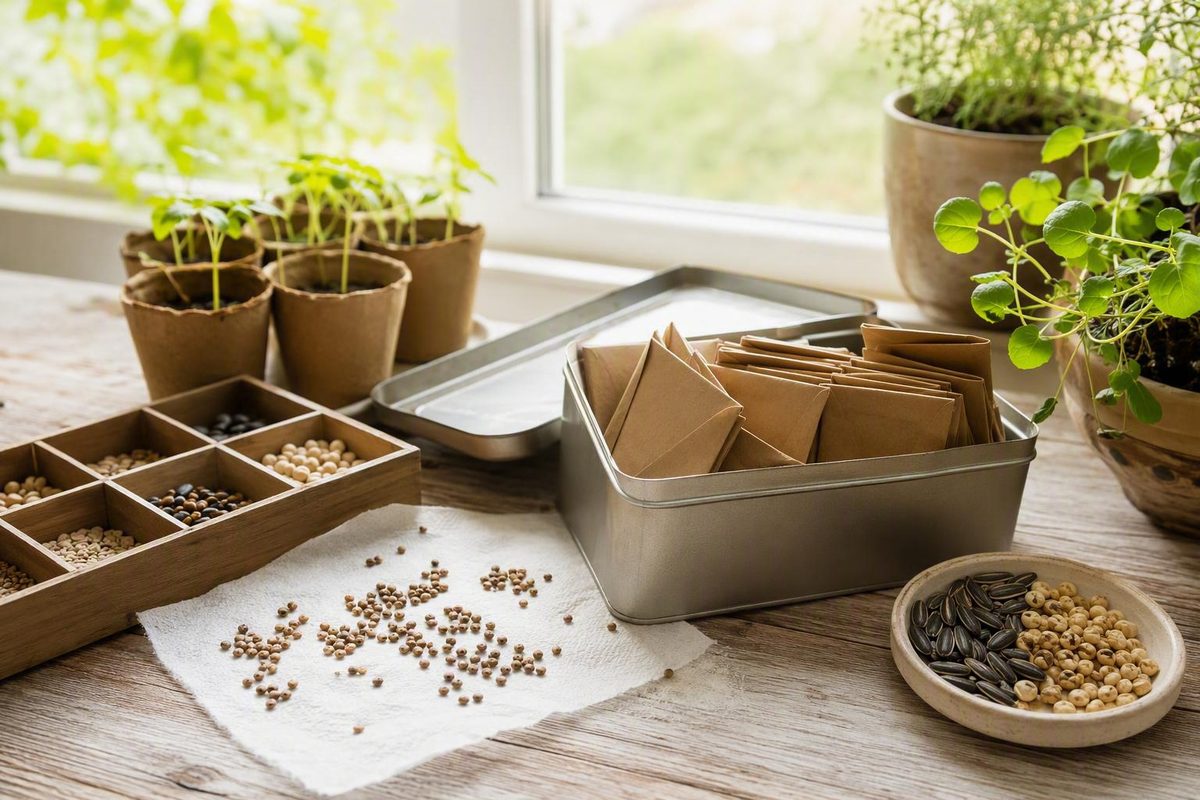
Run a paper-towel test early enough to replace important seed without missing its planting window. University of New Hampshire Extension recommends using 10 or more seeds in its home germination-test instructions.
- Count at least 10 seeds if the packet contains enough to spare.
- Dampen a paper towel until it is evenly moist but not dripping.
- Space the seeds apart, then fold or roll the towel without compressing it tightly.
- Put it in an unsealed or loosely closed plastic bag or loosely covered container.
- Label the crop, variety, test date, and number of seeds.
- Keep it under crop-appropriate temperature and light conditions.
- Check moisture regularly and add water gently if the towel begins to dry.
- Make an initial inspection after three to five days, then continue through the crop’s normal germination period.
Some tests take five to ten days, while slower or dormant species can need longer. Temperature, light, moisture, oxygen, and dormancy requirements vary by species. A test conducted under unsuitable conditions does not necessarily prove that the entire packet is dead.
Germination percentage equals the number sprouted divided by the number tested, multiplied by 100. If 8 of 10 seeds sprout, the result is 80%.
Ten seeds make the arithmetic easy, but the estimate remains rough because each seed changes the result by ten percentage points. A larger sample reduces the influence of each success or failure, provided the packet contains enough seed to sacrifice.
Record seedling quality as well as root emergence. Strong, normally formed seedlings provide more confidence than sprouts that are delayed, weak, stunted, deformed, discolored, or decaying. A seed can germinate without producing a vigorous plant.
If only a few seeds remain, direct sowing may be more useful than consuming much of the packet in a test. Keep fresh backup seed available when the crop is important. For crops being started in trays, follow How to Start Seeds Indoors: Timing, Light & Water and retain the strongest seedlings.
Test Results Guide Sowing, Not a Universal Pass Mark
There is no evidence-supported germination percentage at which every old packet should automatically be kept or discarded. The decision depends on how many plants are needed, whether gaps are acceptable, the crop’s planting window, the number of seeds remaining, seedling vigor, and whether replacement seed is readily available.
When most tested seeds germinate within the crop’s normal period and the seedlings look strong, the remaining seed is a reasonable planting candidate. Moderately reduced germination can often be handled by sowing more heavily and thinning if emergence exceeds expectations.
Fresh backup is more sensible when few seeds germinate, seedlings are weak or abnormal, or a failed sowing would cost the crop its planting window. Onion, parsley, parsnip, pelleted seed, packets with uncertain heat or humidity exposure, and indispensable varieties deserve the most caution.
Indoor germination can exceed outdoor emergence. A moist towel at a stable temperature is more forgiving than soil exposed to cold nights, drying wind, heavy rain, crusting, pests, or irregular moisture. An 80% towel result describes the test conditions; it does not promise that exactly eight of every ten seeds will emerge outdoors.
If no seeds sprout, inspect the test before discarding the packet. Confirm that the towel remained moist but not saturated, the temperature suited the crop, the setup allowed air exchange, and the full expected germination period passed. Some flowers, herbs, and native plants also require specific light conditions or dormancy treatments. Repeat a visibly flawed test when enough seed remains.
Unopened Packets Still Carry Unknowns
An unopened packet avoids handling and spills, but it is not necessarily airtight. It also does not reveal the seed’s age, vigor, or pre-purchase storage history. Save intact packets under stable conditions and test short-lived or important crops first.
Visible fading does not prove that seed is dead, just as an undamaged packet does not establish viability. Moisture staining, mold, or an open seam warrants isolation and closer evaluation rather than giving the packet to another gardener.
Small Packets Can Be Planted Without Testing
When a packet contains too few seeds for a useful sample, sowing them directly under suitable conditions is reasonable. Accept the possibility of gaps and reserve space or fresh seed for a replacement sowing.
One sprouted seed proves only that the individual seed was viable. It cannot establish the germination percentage of the packet. Small samples are highly sensitive to chance.
Old Seed Can Germinate but Produce Weak Plants
Germination, seedling vigor, outdoor emergence, and eventual harvest are separate outcomes. A packet can contain living seeds while giving a reduced germination percentage. Those seeds can sprout indoors yet emerge poorly in cold, saturated, dry, or crusted soil.
Assess the speed and quality of growth along with the count. Strong seedlings from a properly run test support using the packet. Slow or abnormal seedlings justify heavier sowing or fresh backup, especially for a crop with a narrow planting window.