
Types of Guava: Fruit, Climate and Species Guide
Compare tropical, strawberry and pineapple guavas by fruit type, cold tolerance, pollination, propagation and invasive risk before choosing plants.
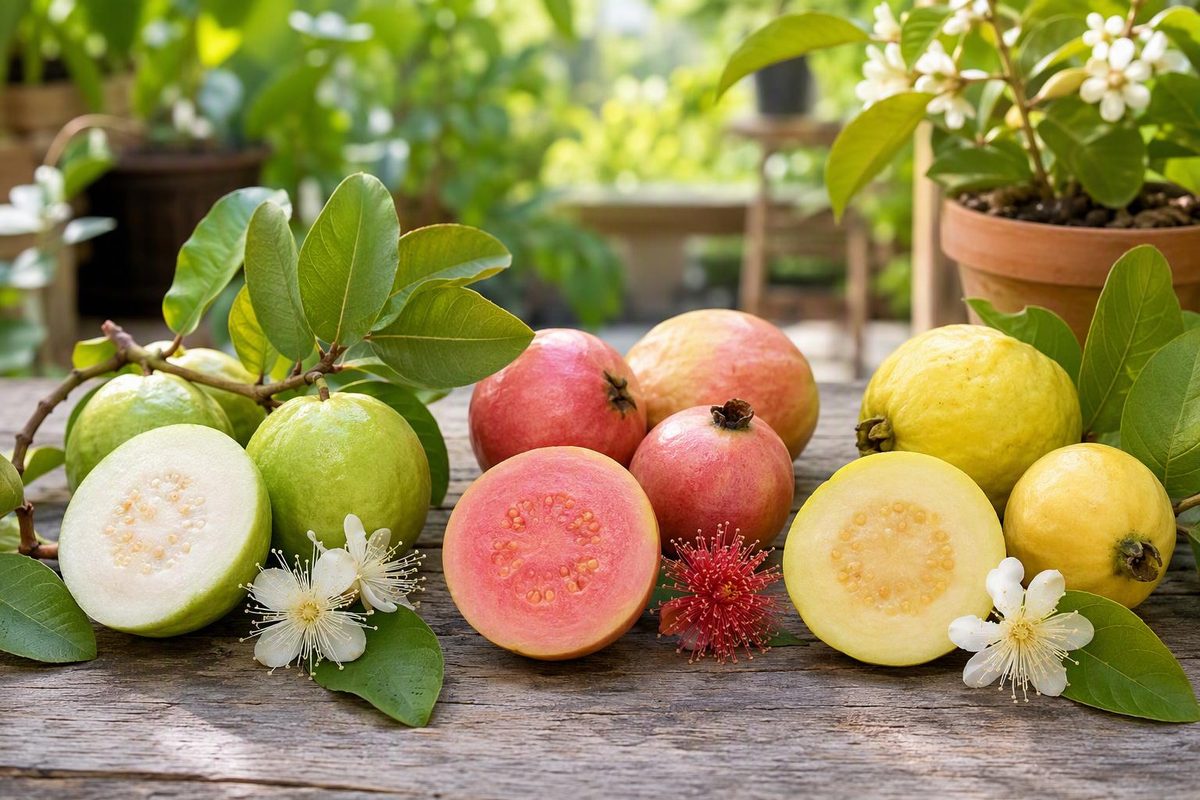
The main types of guava are common or tropical guava (Psidium guajava), strawberry guava (Psidium cattleianum) and pineapple guava (Acca sellowiana). Choose pink or white common guava for nearly frost-free gardens, pineapple guava for greater cold tolerance, and strawberry guava only after confirming that it is permitted and not invasive where you live. Pink and white guavas are fruit-color groups within common guava, while pineapple guava belongs to a different genus.
Select your winter conditions and preferred fruit; the tool identifies the closest match and any limitation.
Guava Type Matcher
Closest Match
Pink or red tropical guava
A named cultivar is the closest fit for soft, aromatic fruit in a nearly frost-free garden. Check local invasive guidance before planting.
Soft-ripe aromatic fruit; nearly frost-free conditions.
Psidium guajavaCrisp green fruit; the same warm-climate limits.
Psidium guajavaSmall fruit; plant only after a local invasive-species check.
Psidium cattleianumGreater cold tolerance, but fruit may not ripen in a short season.
Acca sellowianaSources: UF/IFAS Extension and plant assessments, NC State Extension, and UC Master Gardeners. Temperature ranges and regional invasive classifications are summarized in the article.
Guava Types At A Glance
| Type on the label | Botanical identity | Fruit and typical use | Best fit |
|---|---|---|---|
| Pink or red tropical guava | Psidium guajava | Aromatic fruit used fresh, in juice and in preserves | A nearly frost-free garden, subject to a local invasive-plant check |
| White tropical guava | Psidium guajava | Pale flesh; some selections are harvested green and crisp | Gardeners seeking crunchy rather than soft-ripe fruit |
| Strawberry guava | Psidium cattleianum | Small red-purple fruit with whitish, sweet-tart pulp | Only where permitted and not ecologically risky |
| Yellow strawberry guava | Yellow-fruited form of P. cattleianum | Small yellow fruit eaten fresh or preserved | The same caution as red strawberry guava |
| Pineapple guava or feijoa | Acca sellowiana | Green, aromatic fruit with scoopable pulp; edible flowers | Cooler subtropical and mild temperate gardens |
These categories are not interchangeable. Check the botanical name on the plant tag or seed listing before comparing fruit color, flavor or price.
Pink And Red Guavas Are Tropical Guava Cultivars
Pink and red guavas are fruit-color groups within Psidium guajava, not separate species. Their peel commonly changes from green toward light green or yellow as the fruit becomes ready to harvest.
UF/IFAS lists ‘Homestead,’ ‘Barbi Pink,’ ‘Blitch,’ ‘Hong Kong Pink’ and ‘Patillo’ among pink types grown in Florida. The species varies widely: fruit can be round, oval or pear-shaped, and its aroma and flavor can range from mild and sweet to strongly scented and acidic (UF/IFAS Extension).
Choose a pink or red cultivar when the goal is soft-ripe dessert fruit, juice or preserves. Do not assume that every red-fleshed seedling will taste like fruit from its parent tree.
Common guava also requires a local invasive-risk check. As of its 2026 assessment, UF/IFAS rates P. guajava as a caution plant in central and south Florida, meaning it should be managed to prevent escape. It is not currently documented as a problem species in north Florida (UF/IFAS Assessment). That assessment applies to Florida; consult equivalent guidance where you live.
White Guavas Include Crisp-Eating Cultivars
White, cream and pale-yellow flesh types also belong to P. guajava. In Florida, white-fleshed guavas are commonly harvested while green and crisp. Listed cultivars include ‘Crystal,’ ‘Lotus,’ ‘Supreme’ and ‘Webber’ (UF/IFAS Gardening Solutions). This is the group often represented by nursery descriptions such as crisp, crunchy or Asian-style guava.
A regional label is less precise than a cultivar name. Before buying, ask the seller for the cultivar name, flesh color, seed hardness, intended eating stage, propagation method and expected mature size under local conditions.
Tropical guava performs best in warm subtropical or tropical conditions. UF/IFAS gives 73–82°F as its ideal growth and production range. Growth slows below 60°F. Young trees may die at 27–28°F, while mature trees can tolerate only brief exposure to roughly 25–26°F without much damage (UF/IFAS Extension). A protected container may therefore be more practical than an in-ground tree where freezes recur.
Strawberry Guava Requires An Invasive-Species Check
Strawberry guava is a distinct species, Psidium cattleianum. It bears much smaller fruit than many tropical guava cultivars. The usual fruit is dark red-purple with pale, aromatic pulp; a larger yellow-fruited form is called yellow strawberry guava (University of Hawai‘i CTAHR).
Its compact fruit and glossy evergreen foliage can look appealing, but this is the guava for which an invasive-species check is essential. Strawberry guava spreads by seed and suckers and can form dense stands.
UF/IFAS classifies it as invasive in south Florida and as a caution plant that must be managed to prevent escape in central and north Florida (UF/IFAS Assessment). In Hawai‘i, Forest Service research describes it as a highly disruptive alien plant whose dense growth suppresses native-species establishment (US Forest Service).
Those findings do not establish its status in every jurisdiction. Check your state invasive-plant list and county Extension guidance before obtaining plants or seed. An edible plant is not necessarily suitable to grow locally.
Pineapple Guava Handles Colder Winters
Pineapple guava is not a Psidium. Its accepted garden name is Acca sellowiana, formerly Feijoa sellowiana. It is an evergreen shrub or small tree with silvery-backed leaves, red-and-white edible flowers and green fruit that develops fragrant, slightly grainy pulp.
This is usually the strongest candidate when winters are too cold for tropical guava. NC State Extension lists it for USDA zones 8a–10b, while UC guidance says it can tolerate brief temperatures around 10–15°F. Fruit ripens late in the season and commonly drops when ready (UC Master Gardeners of Sonoma County).
Cold tolerance does not guarantee a crop. NC State notes that the fruit can take four to seven months to ripen depending on climate, creating a potential problem in short-season locations (NC State Extension).
Pollination requirements vary by cultivar. NC State identifies ‘Coolidge,’ ‘Nazemata’ and ‘Pineapple Gem’ as self-pollinating but says ‘Superba’ needs another cultivar for good fruit set. Even when a cultivar is described as self-fruitful, a second compatible selection may improve production.
Named Cultivars Produce More Predictable Fruit
For a predictable common-guava harvest, choose a vegetatively propagated, named cultivar. Common guava grown from seed does not reliably come true to its parent, and UF/IFAS reports that a seedling may take three to eight years to begin fruiting. Commercial cultivars are instead maintained through air layering, cuttings, grafting or budding (UF/IFAS Extension).
Seed remains useful when variation is acceptable, including experiments and rootstock production. Treat the packet name as the source fruit’s identity, not a guarantee that every seedling will repeat its size, flesh color or flavor. Start with clean mix and controlled conditions as described in this indoor seed-starting guide, then evaluate each plant individually.
For soft, aromatic fruit in a nearly frost-free climate, buy a named pink or red tropical guava. For crisp green fruit under the same conditions, choose a named white tropical cultivar. Where strawberry guava is invasive or restricted, do not plant it. For colder subtropical or mild temperate conditions, consider pineapple guava after checking the cultivar’s pollination needs and whether the growing season is long enough to ripen its fruit.