
How to Germinate Cherry Seeds With Cold Stratification
Clean cherry pits, cold-stratify them in moist mix, watch for splits and roots, and pot seedlings—with separate guidance for sweet and sour cherries.
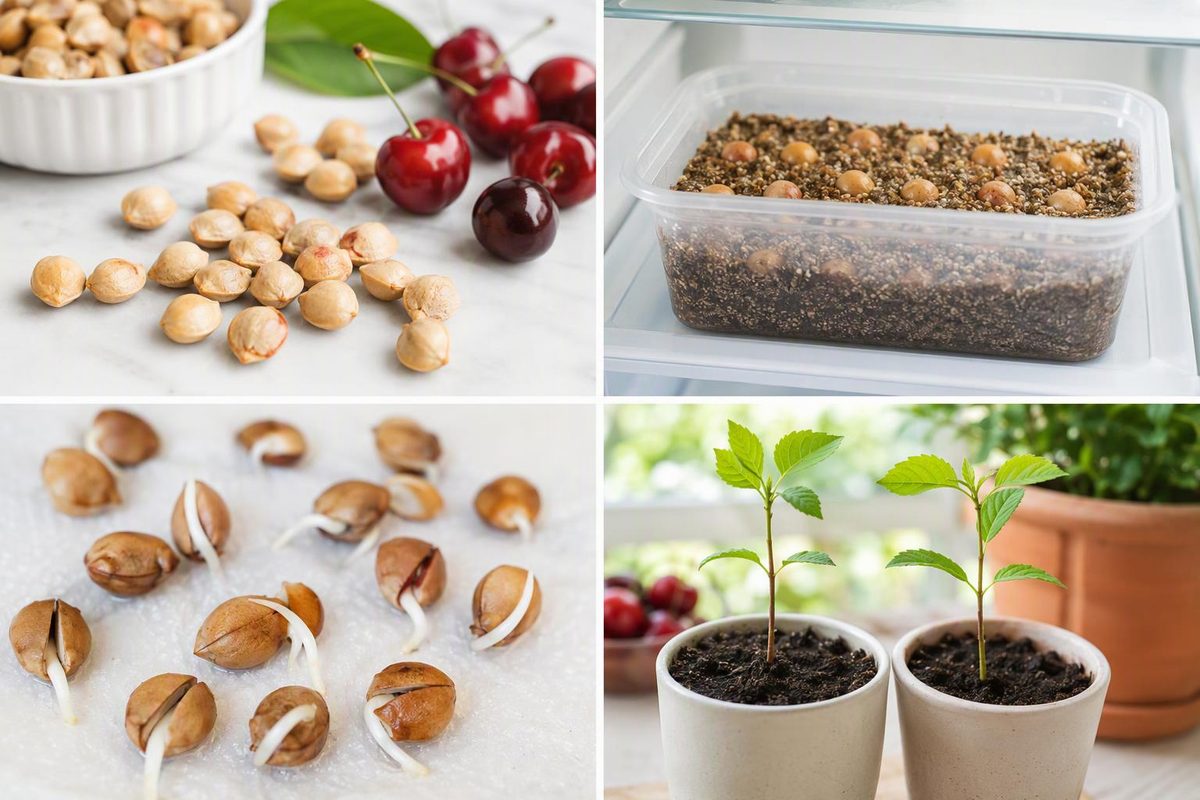
To germinate cherry seeds, clean the pits from fully ripe fruit, place them in a lightly moist medium, and refrigerate them to help break dormancy. Plan for months rather than days, and watch the pits—not just the calendar. Some seeds begin growing while still in the refrigerator.
This method is a starting approach for sweet cherries (Prunus avium) and sour or tart cherries (Prunus cerasus), not every ornamental or wild cherry. Growing a pit is a seedling experiment: cultivated cherries generally do not reproduce true from seed. If you want a particular fruit variety, choose a grafted tree instead. Iowa State Extension explains the chilling requirement and the limits of seed propagation.
1. Clean several ripe cherry pits
Remove the flesh and wash away remaining pulp and juice. Start several pits rather than relying on one: apparently normal cherry pits can contain poorly developed or nonviable seeds, and maturity affects viability. The hard pit surrounds the actual seed inside. The USDA Forest Service’s Prunus reference describes seed maturity, cleaning and pit structure.
For a beginner batch, leave the pits intact. Removing the shell can hasten germination, but it is not a substitute for treating embryo dormancy. The USDA reference reports successful germination through stratification without additional shell treatments.
2. Refrigerate in moist—not wet—medium
You will need a labeled plastic bag or small container, clean vermiculite, and a refrigerator thermometer.
- Moisten the vermiculite evenly. It should feel damp, with no standing water.
- Mix in the pits loosely; do not pack the medium tightly. If using a rigid container, put small air holes in its lid.
- Label it with the cherry type and starting date.
- Place it in the refrigerator, not the freezer. Aim for 35–40°F (2–4°C).
Cold stratification requires moisture and oxygen as well as low temperature. A dry pit sitting in the refrigerator is not receiving the same treatment. Oklahoma State Extension recommends moist vermiculite and loosely packed containers; Iowa State describes vented lids, and the USDA reference supports chilling around 2–5°C.
How long should cherry seeds chill?
| Cherry type | Planning guide |
|---|---|
| Sour or tart cherry (P. cerasus) | Iowa State recommends 90–150 days at 33–41°F. |
| Sweet cherry (P. avium) | UC Davis lists 120 days for its Mazzard ‘Saylor’ seedling rootstock—not a deadline for every sweet-cherry pit. |
Sources: Iowa State’s species-specific guidance and UC Davis Foundation Plant Services’ Mazzard protocol. The full UC Davis protocol includes a 24–36-hour water soak and cracking before sowing, so its timing does not establish an exact schedule for intact grocery-store pits.
Allow roughly three to five months initially, with room to pot early sprouters indoors. Some sweet-cherry seed lots respond better to alternating warm and cold treatments than to cold alone, as the USDA reference reports. Purchased seed should follow its supplier’s species-specific schedule; intact pits may need longer than these reference periods.
3. Check for a split pit or emerging root
Make a weekly check part of your routine, especially later in the chilling period:
- Medium drying out: add a little water and redistribute it.
- Visible mold: separate affected pits and replace contaminated medium; discard soft or rotting material.
- Pit splitting naturally or a root protruding: pot that seed promptly. Avoid letting the root grow long enough to tangle in the medium.
Split shells and emerging roots are recognized germination checkpoints. Keep checking firm, unsplit pits rather than assuming they are ready—or dead—when the reference period ends. Moving still-dormant pits into warmth prematurely can induce renewed dormancy, and long roots are easily broken during sowing. The USDA reference describes these handling risks.
4. Pot sprouted seeds and provide light
Use an individual pot with drainage holes and fresh seed-starting mix. Make a hole that accommodates any emerging root without bending it, and place the root downward.
For sour cherry, sow 1/2 inch deep, following Iowa State. For sweet cherry, follow supplied sowing directions; about 1/2 inch is a practical potted starting depth, close to the 1-centimeter depth used in a Mazzard experiment summarized by the USDA Forest Service. Cover the pit gently rather than compressing the mix around the root.
Keep the mix moist without leaving the pot in water. Once the shoot emerges, provide strong light. Before moving an indoor-grown seedling outdoors, gradually introduce it to sun and wind and protect it from freezing temperatures, following Extension’s hardening-off guidance. Our indoor seed-starting guide covers lighting, watering and hardening off.
An outdoor alternative
Where winter provides sustained cold, sow cleaned pits in fall in a labeled, well-drained spot and protect them from rodents. Natural winter moisture and cold can supply stratification. Where winters are too warm—or you want to inspect individual pits—the refrigerator offers more control. Oklahoma State Extension identifies sufficient winter cold, moisture and rodent protection as conditions for successful fall sowing.